Yesterday in Parliament the Education Amendment Bill (No 2) went through it's 3rd reading and was passed into law. This officially means there will be no CoOLs (Communities of Online Learning) in New Zealand.
Hon. Nikki Kaye argued to keep in place some provisions for online learning, and made an amendment to include a Review of Online Learning (which was not passed). Her argument was that you can't take this away without putting something in it's place. We supported this argument as we were working towards being a CoOL and relying on it to support the development of online learning moving forward. Yet the government counters that there never were CoOLs anyway, so why would you need to replace them, and that online learning has been happening successfully in schools for many years so therefore the status quo remains.
The VLN has been operating in schools for 25 years this year (10 for the VLN Primary). But for the last decade the VLN communities have been seeking a way to be sustainably and fairly resourced in schools, to grow innovative ways of learning online and to develop this really successful collaborative model further to be accessible for all NZ children. We looked to CoOLs to be the vehicle for this.
To assume the status quo will continue is not helpful to the work the VLN communities have been doing and undermines the potential of what they can contribute to NZ education if they were fully supported. The reality is, Secondary VLN communities are completely self funded through their participating schools. This is additional funding schools have to find to access this learning. This has been a challenge in enabling equitable access for secondary schools, in the disparity and inequity of funding given to Te Kura who provide similar services, and to the viability of regional clusters. Over the last decade several clusters have disappeared (CantaNet, AorakiNet, WestNet, TaraNet, CoroNet, BayLink).
The VLN Primary would not exist without partnership with the Ministry of Education. Our small schools can't afford to completely self fund this collaborative initiative. Over the last decade we have proved that there are important benefits for our children in collaborating to extend their learning opportunities. Yet, every year we have to go back to the Minister with cap in hand, to make a case for continued funding. Surely after a decade we need to get this right, get the funding right, get the framework right.
Some consolation, and its encouraging to hear Minister Hipkins say, that there is some work that needs to be done in this area, and with our recent consultation with the Tomorrow's Schools Review Taskforce, I am cautiously optimistic we will be able to move forward with online learning in a future focused schooling system. We will wait, and advocate, and be persistent about following through on any opportunities for our schools. I hope we can get there sometime in the next decade.
Finally to note, a huge thanks to Hon. Nikki Kaye who has been a champion of future focused learning and the VLN Primary over the years. Without her support the VLN Primary would not be where it is today.
You can read the whole of Hansard and video here. There is lots of discussion about VLN, Virtual Learning and Communities of Online Learning throughout.
VLN Primary Submission to Repeal of Communities of Online Learning
Future Schooling, Communities of Online Learning and Rural Education.
VLN Primary submission to Tomorrow's Schools

Professional reflections on education in NZ - Dancing on the shifting carpet
Showing posts with label future focused. Show all posts
Showing posts with label future focused. Show all posts
Friday, 10 May 2019


Tuesday, 4 April 2017
Fast internet drives 'Rural Renaissance'.
In 2003 TUANZ led a National Broadband Applications Project where cross sector forums were set up regionally to discuss the potential of broadband and come up with some scenarios about what life would be like beyond dial-up. This was during the days of the roll out of Project Probe. We are now well onto the second wave of superfast internet with the roll out of fibre, 4 G networks and improved satellite service.
Those scenarios discussed in 2003 forums were published in "Survival of the Fastest"
I love the education scenario of "A Third Way at Blacksmith's Elbow" (Chapter 4) which describes a small rural community connected to broadband:
And "A Renaissance in our Heartland" (Chapter 4)
Adams, G., & Telecommunications Users Association of New Zealand. (2003). Survival of the fastest: a guide to how New Zealand can use broadband to lead the world, from the TUANZ National Broadband Applications Project. Auckland, N.Z.: Telecommunications Users Association of New Zealand.
Those scenarios discussed in 2003 forums were published in "Survival of the Fastest"
I love the education scenario of "A Third Way at Blacksmith's Elbow" (Chapter 4) which describes a small rural community connected to broadband:
- Broadband brings everybody access to whatever resources they need;
- The community grows, instead of shrinks;
- People find it easier to be life-long learners;
- People are collaborate;
- The school is the hub of the community.
 |
| “Rural New Zealand” by Sarah Stewart is licensed under CC BY 2.0 |
And "A Renaissance in our Heartland" (Chapter 4)
"But perhaps among the most important were social applications. Broadband is ultimately about empowerment and decision-making. It's about access to information. It's about a change in the rural environment. No longer is it just farmers and craftspeople plying their trade in relative isolation. Give them a broadband link and any entrepreneur worth their salt can live and work anywhere. We're already seeing software design becoming a rural industry. With a video-conferencing link, people can have a virtual presence from almost anywhere.These future focused scenarios were envisioned 14 years ago. So where are we now? How far down the track are we heading towards scenarios described here? Or are the paths we are walking different than we had earlier imagined and will they lead us to different destinations?
Broadband access means the whole distribution of the population will be different as the city moves to the country. Why? Because they want to, because they can, and all because of broadband.
And if one person moves, it's likely that the family will, too. They will go to the schools, buy from the shops, use the services, and generally contribute to the community. In turn, they will create jobs, opportunities and lead to a rural renaissance."
Adams, G., & Telecommunications Users Association of New Zealand. (2003). Survival of the fastest: a guide to how New Zealand can use broadband to lead the world, from the TUANZ National Broadband Applications Project. Auckland, N.Z.: Telecommunications Users Association of New Zealand.
Monday, 20 July 2015
A Call to Action - Equity, access, quality and teachers in the digital age
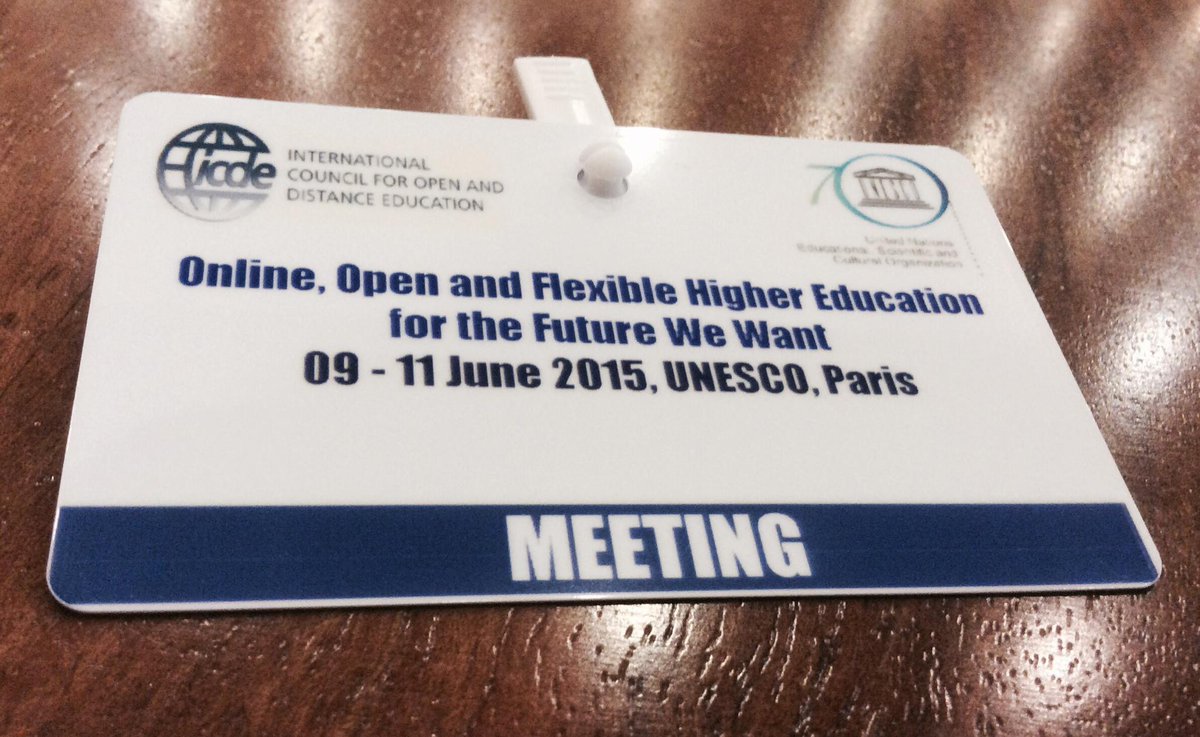 The ICDE (International Council for Distance Education) met in Paris recently for a Global Policy Forum. The aim of the forum was to build on previous work such as recently in Bali and to ensure equity, access and quality learning outcomes. This was framed with some urgency around the area of higher education with the prediction that in the next 15 years there will be a huge increase in the number of students seeking access to a quality education.
They are asking all governments, educational institutions, teachers and students, to jointly address the needs as outlined in the Paris Message (recommend you read this 3 page document) Key messages are around recognizing the importance of online, open and flexible learning to contribute to the quality & provision of education; the development of effective policy & regulation based on principles of equity; and that funding is critical to the initiation and sustainability of elearning initiatives.
These are all messages that resonate strongly with my work with the VLN Primary School. Through open, flexible, online & collaborative learning (I added the last qualifier) we have the potential to unlock the gates to so many learning opportunities for our students. This is not just for higher education, but across the sector and community. Government and the educational sector are just starting to 'get it' in terms of understanding the contribution online networked learning can make and are still way behind in resourcing and supporting initiatives such as ours. A good part of my time is spent advocating, and applying for different funding streams because we as yet don't fit into any government 'policy parameters' of which there are a host beginning to be aimed at schools collaborating. This is quite a frustration as what we really should be doing is spending our very little time that we do have working with schools, teacher and students.
Image attribution: https://twitter.com/JGlapaGrossklag/status/608193506444722176
Wednesday, 15 October 2014
Promoting Asian Languages

I was recently invited to join discussions with Asia NZ on the future directions of Learning Languages (particularly Asian Languages) in New Zealand. It was very well organised for conversation as we moved Cafe style around changing groups of participants from across the sector and language and cultural organisations. This engaged us in discussions that teased out key themes and issues that emerged throughout the day. Thanks Jeff for superb facilitation of the day & outgoing AsiaNZ director John McKinnon for an inspiring welcoming speech (you can read the accompanying opinion piece here). The Key Question was: "By 2025, all school students in New Zealand will have the opportunity to learn an Asian language. How do we make this happen?"

Some of the general discussion raised around the room was echoed by many - access to NZ based teachers, the recognition of languages as important, the drop off in students past year 10, competition for resourcing within schools & lack of policy direction. This is not just the case for Asian Languages but these are the same messages coming through on the Languages listservs i belong to as well.
For me the main themes I formed from discussions I had, was the need for a clear strategic direction that should be developed and enacted through the collaboration of all key stakeholders; alongside this is the need to engage with the wider community and to make learning relevant to our students in order to incentivise greater participation. You can read the full overview of the day's discussion collated and shared by Asia New Zealand here.
It is encouraging to know that the government is investing in this area and schools can access funding to support learning Asian languages but at the same time it also a concern that this funding isn't aligned to clear educational strategies. Schools will find it useful to refer to this supporting document from Asian New Zealand that gives guidelines for planning, piloting and sustaining Asian Language learning programmes.
So moving forward from here we look forward to taking these conversations further, building on our collaborative partnerships and developing new ones to support Asian language learning opportunities for our students. Watch this space!
So moving forward from here we look forward to taking these conversations further, building on our collaborative partnerships and developing new ones to support Asian language learning opportunities for our students. Watch this space!
Tuesday, 30 September 2014
Eyes on the Horizon, Feet on the Ground
As all of my work is exclusively in the virtual and online education world, it has been a welcome change in the last couple of weeks to have the opportunity to meet with teachers and get my feet on the ground in schools. It's exciting to be working on the edges of educational change but it's so important to keep it real too! Here's my first update:
 Thanks to Edgecumbe Primary for hosting, @jeanettem1 for organising and leading this initiative and @mrs_hyde for supporting this first event. This builds on from other Connected teachers groups in Rotorua, Taupo & more recently Napier. DIY PLD, the knowledge is in the room! Good to be around classroom teachers, hearing what is important and happening in their schools and getting to know people in the Eastern Bay. Looking forward to another hui at the end of the month in my town Matata.
I have been following @Neil_NPS 'Principal of Ngatea Primary School where we challenge and re-define our learning environment.' and had been keen to stop in and see what was happening at this school, so just to be nosy i invited myself for a school visit on my way up to Auckland. Thanks @hull_karla for showing me around and sharing your school's learning journey with me. Lots of great things happening with student centred personalised learning, flexible timetables, collaborative teaching, open learning spaces, 1:1 chromebooks. Most of my questions were around logistical things like how to support learning in flexible time & space; now I'm keen to go back and find our more about about the learning than the organisation. Has any research been done yet in our MLE schools? Would be interested to see.
Check out this short virtual tour:
EBOP Connected Teachers
Ngatea Primary School
 |
| Image attribution:http://karlas-learning.blogspot.co.nz/ |
Check out this short virtual tour:
Tuesday, 24 June 2014
Primary Science
You don't need to be a Scientist to DO Science!
Don't think you need to leave it to the experts for your students to learn about Science, there are lots of great PD opportunities & resources to support you in providing Science learning opportunities for our kids.
Check out this online PD from the Open Polytech - no fees! Register now for July's intake.
"The Graduate Certificate in Primary Science Teaching (Curriculum) takes the perspective that science can be fun. It encourages the learning of science by doing science and discusses the effectiveness with which science concepts and principles are embedded into learning experiences. Through the programme practising teachers will become more confident in their science knowledge, and their ability to design and deliver learning experiences that support and inspire students to investigate and understand science knowledge and concepts."
Scien ce Alive provides outreach programmes in the Christchurch area, they also have some great open source resources.
Follow them on twitter @sciencealive
 Science in a Van also run outreach programmes, anywhere in NZ.
 'The Science Learning Hub is developed by educators and teachers in collaboration with New Zealand scientists to provide resources for teachers of students up to year 10.'
Hear what teachers have to say about how they use the Science Learning Hub to support them in the classroom. Twitter @NZScienceLearn
There are a number of Science groups in the VLN Groups area. The following three seem to be the most subscribed, open and active:

 Not forgetting Science Online @TKI. Linked from TKI are a series of papers developed from the questions raised here:
"The Chief Science Adviser raised some challenging questions in his 2011 report. The Ministry of Education responded by funding three new science education projects. His questions were:
- How can we “engage and enthuse” more young New Zealanders in science?
- Is the science we teach getting students ready to address serious questions we will all face in the future?
- How might science education help New Zealand's development as a smart, innovative, knowledge-oriented country? "
Some interesting professional reading.
Lastly not forgetting the VLN Primary School as a way to collaborate and extend Science learning opportunities across our schools. Currently we are running a Day Time Astronomy class - we welcome schools and teachers who have expertise to share across our network.
"The Graduate Certificate in Primary Science Teaching (Curriculum) takes the perspective that science can be fun. It encourages the learning of science by doing science and discusses the effectiveness with which science concepts and principles are embedded into learning experiences. Through the programme practising teachers will become more confident in their science knowledge, and their ability to design and deliver learning experiences that support and inspire students to investigate and understand science knowledge and concepts."
"The Chief Science Adviser raised some challenging questions in his 2011 report. The Ministry of Education responded by funding three new science education projects. His questions were:
- How can we “engage and enthuse” more young New Zealanders in science?
- Is the science we teach getting students ready to address serious questions we will all face in the future?
- How might science education help New Zealand's development as a smart, innovative, knowledge-oriented country? "
Lastly not forgetting the VLN Primary School as a way to collaborate and extend Science learning opportunities across our schools. Currently we are running a Day Time Astronomy class - we welcome schools and teachers who have expertise to share across our network.
Tuesday, 20 May 2014
Sole Charge & Rural Teaching Principals Conference
I have spent the last day at Sole Charge & Rural Teaching Principals Conference in Palmerston North, connecting with many of our VLN Primary principals and sharing our story.
It is great to have this time with Principals away from the busy distractions of daily school life and to talk about what matters for our students and how we can work together to make a difference to their learning.
Our conversations now are no longer so much about how does this online learning stuff work, and what can we learn together (although there is still some of this in introducing new schools). We know it works and we are aware of the potential there is to push the boundaries in learning opportunities for our students. Conversations are now beginning to move into how can we build this capability across our schools, and how can we improve what we are doing? What are our children achieving through their participation in their online classes and how is it making a tangible difference to their learning. What evidence have we got to support our understandings beyond anecdotal feedback & observations. Time to step things up another gear!
It is great to have this time with Principals away from the busy distractions of daily school life and to talk about what matters for our students and how we can work together to make a difference to their learning.
 |
| Principals from the Rural/Remote Schools Project |
Subscribe to:
Posts (Atom)