Showing posts with label curriculum. Show all posts

Tuesday, 20 May 2014

Sole Charge & Rural Teaching Principals Conference

I have spent the last day at Sole Charge & Rural Teaching Principals Conference in Palmerston North, connecting with many of our VLN Primary principals and sharing our story.

It is great to have this time with Principals away from the busy distractions of daily school life and to talk about what matters for our students and how we can work together to make a difference to their learning.
Principals from the Rural/Remote Schools Project
Our conversations now are no longer so much about how does this online learning stuff work, and what can we learn together (although there is still some of this in introducing new schools). We know it works and we are aware of the potential there is to push the boundaries in learning opportunities for our students. Conversations are now beginning to move into how can we build this capability across our schools, and how can we improve what we are doing? What are our children achieving through their participation in their online classes and how is it making a tangible difference to their learning. What evidence have we got to support our understandings beyond anecdotal feedback & observations. Time to step things up another gear!


Wednesday, 23 September 2009

The Connected Curriculum

Thanks to Phil for sharing this with us:

“We had Lester Flockton as a Keynote at the KN & NZC Conference – and MANY really appreciated his commitment to the revised NZ Curriculum, and his informed, sane and humourous approach to implementing curriculum change. 

Here is the link to the NZEI website where they have stored a dozen different video clips and PPT sections under appropriate headings related to the NZC (values, KCs, etc)

http://www.nzei.org.nz/connectedcurriculum/The+Connected+Curriculum.html

These video clips are downloadable (eg via Firefox and Videodownload Helper), and I noticed many of the slides are similar to what we saw, (including the humourous ones).  :-)  (The videos run better, of course, once downloaded.  They are Flash files, but FLV Player – free download – runs them as well.)

Hope that this is of some use for you/your school/your cluster.”

Below is the introduction to this video series

Thursday, 19 June 2008

What Learning Do You Value? Julia Atkins

julia I joined an excellent PD session with Julia Atkins and others around the country about focusing on Key Competencies in the Learning Areas. It was disappointing that noone from any of our cluster schools could find the time to attend this session - they missed a great learning opportunity. This session was recorded so i will download it & extract some of the key points for sharing with my colleagues. The following are some notes from the session:

We began with a discussion on how the curriculum has evolved over the last 120 years. How it has continually expanded & expanded with new subjects as different things have become important over the years. We haven't changed the curriculum in all this time except to add more things. Now to make this more manageable we have created  Key Learning Areas so we can group all these subjects. While we try to make sense of all of this the important thing to think about is "What is the educative purpose of school?" What is Essential Learning - Development of self & self for society.
The Integration of Key Learning Areas, Values & Key Competencies - this will help us achieve our educative process.
Questions:
How do we do this?
How do we develop 21st Century teachers from Industrialised Ages teachers?
How do we maintain the love of learning that our students come to school with at age 5?
How do we counter the challenges of assessment driven learning with the high stakes assessments of NCEA?

Bringing our Teachers Onboard - Professional Learning

Keep the focus on the learning needs of the students themselves, teachers work collaboratively (PLGs) in improving their practice.

Reframing teachers notions about their own learning before you can they can do that for their students.
Phases of development:
Tacit knowledge (don't engage, succeed with kids by chance)
Explicit knowledge - (they gain some understanding, are more open to learning)
Then can get stuck in the 'guru loop' - looking out to others to tell them what to do
Need to internalise their thinking and look to themselves than thinking an outside factor will change things.

Inspirational videos to get people to open up their minds (have used a few of these before ;-):
When I Become a Teacher....


Pay Attention

Shift Happens


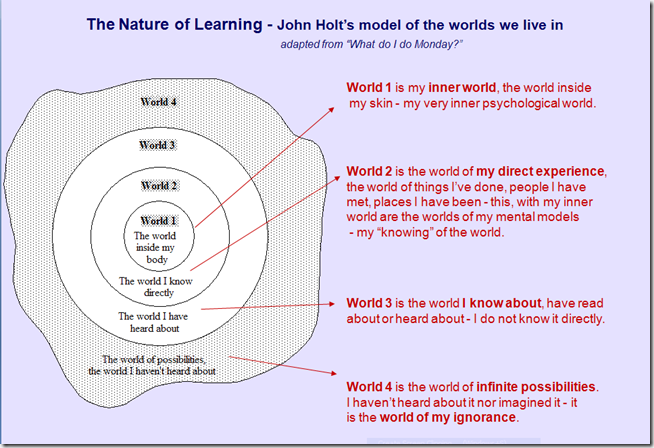
John Holts Model of the worlds we live in - the Nature of Learning:

4 Worlds from our most inner, to the world around us that we have experienced first hand, to the world which we know about but haven't experienced, and then the possible world which is a big unknown.
We develop our own mental models and they don't change until they are confronted.
clip_image001

Julia Atkins "Teaching for Effective Learning" presentation.

Current mental models in education  - 'Teaching as telling & learning as listening' (Yoram Harpez) emphasis on World 3 stuff - knowing about. "Chewing & spewing"
Important to do the experiential learning - need to engage them in developing and knowing.
learning_models 
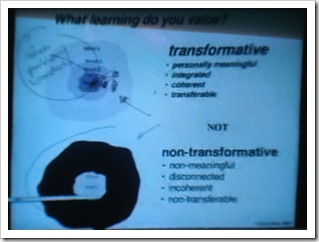
What Learning Do You Value?
In the top model learning starts at the centre and across the worlds, the model below is World 3 learning.

A process to change: Help develop shared mental models of the skills & attributes we want for our students - develop ownership from all - staff, community - use the curriculum document as reference point.
What learning experiences will they need? What are we doing well? What do we need to change? Develop a learning model for your school?

Sunday, 29 October 2006

Curriculum Consultation

Many of our schools took Tuesday as a Teacher Only Day to discuss the draft curriculum & feedback to the MOE in the consultation process.
I spent the morning @ Stratford where Bruce was leading discussion. We examined the teaching practises of the industrial age classroom as we experienced it growing up in NZ and discussed what we wanted a Yr8 graduate to look like at SPS - what skills, attitudes & capabilities we felt they needed. These were all generic to the rhetoric that supports the idea of a 'life long learner in the knowledge age' & has been articulated by all our BardWired teachers in 'visioning' workshops before. Pretty much all summed up in the draft curriculum vision - our young people will be...
Confident
  • Positive in their own identity
  • Motivated and reliable
  • Entrepreneurial
  • Enterprising
  • Resiliant
Connected
  • Able to relate well to others
  • Effective users of communication tools
Lifelong Learners
  • Literate and numerate
  • Critical and creative thinkers
  • Active seekers, users, and creators of knowledge
  • Informed decision makers
Actively Involved
  • Participants in a range of life contexts
  • Contributors to the well-being of NZ - social, economical & environmental
All very worthy attributes ok, but I can't help thinking that what we have criticised industrial age teaching for - moulding our kids to suit society (Another Brick in the Wall) we are still doing but for a different society 'The Knowledge Society'. No country wants to be left behind in our new "Flat World"! I really felt this also as I listened to Jane Gilbert speak at ULearn as well. Somewhere in the equation needs to be some student voice and choice...

Sunday, 15 October 2006

Welcome Robert Swartz


Today I was proud to welcome Robert Swartz to Taranaki for his workshop tomorrow "Infusing Critical & Creative Thinking into Content Instruction" He very kindly put up with an entourage of hungry children as we picked him up from New Plymouth, checked out the workshop venue & had a brief tour of the New Plymouth waterfront. Though my children have never been so polite & well behaved as i saw them today! I did say to Robert that i would photoshop this picture but i photoshopped myself right out of it... Maybe take a better picture tomorrow.
Particulary relevant to this workshop is the work that is going on in schools around the consultation and implementation of the draft NZ curriculum in particular the key competency Thinking. So this to ponder from the draft document:

“Thinking is about using creative, critical, metacognitive, and reflective processes to make sense of and question information, experiences, and ideas. These processes can be applied to research, organisation, and evaluation for all kinds of purposes – developing understanding, making decisions, shaping actions, or constructing knowledge. Intellectual curiosity is at the heart of this competency. Students who have well-developed thinking and problem-solving skills are active seekers, users, and creators of knowledge. They reflect on their own learning, draw on personal knowledge and intuitions, ask questions, and challenge the basis of assumptions and perceptions.”

Wednesday, 2 August 2006

The Vision Vacuum

A must read article by Gwen Gawith in the latest Good Teacher Magazine.
Gwen discusses educational vision in the light of the 'new curriculum' and in reference to Bruce Hammonds comments on the Ministry's vision (or lack of it) for education in NZ.

Gwen defines vision as "being able to see clearly:
  • why we want learners to learn in our schools,
  • how we want learners to learn in our schools,
  • what we want them to learn to equip them for life now and later,
  • how we want them to be taught.
Simplifying it to seeing the critical WHAT, WHY, HOW of learning is NOT simplistic"

She argues passionately that the WHAT of children's learning is very important and has been neglected by those who think that simply learning to learn is the most important thing regardless of topic or context. Gwen encourages us not to wait for the MOE to drop their vision on us but to "Simply articulate and share your OWN school vision of learning, focus your own school curriculum, and work to achieve it."
Yes i agree with her it's not rocket science, just do it, but i wonder in how many of our schools that are developing their own vision for learning (talking the talk) how much of this translates into practise in the classroom (walking the walk). And how many of our schools have not even begun to talk the talk let alone walk the walk.

Monday, 12 December 2005

Plagiarising Richard - Bruce Hammonds

I hope you don't mind Richard but I borrowed your notes from your site
(they were so much more refined than the original ones you sent me)
I have been a bit under the weather of late, working at a snail's pace and finding it really hard to keep up with stuff. And this was important stuff so felt it needed to be on BardWired.
So: "Don't ask for permission, Ask for forgiveness!"
Thanks Richard @ Toko School

In the morning the Management team and anyone else that was able to get there listened to and talked with Bruce Hammonds. An excellent mornings discussion. Big messages for me were:
We are not curriculum delivery boys and girls... we make the icecream! IN other words we design the curriculum for the kids we have. We are best placed to do this and distant unmanagable curriculums from Wellington are not part the answer.
We are the curriculum experts! The untapped wisdom is ours!!!
We need depth not coverage! Fewer things well...
Realistic meaningful units are memorable for children.
IEP's for everyone...... personalised learning is the future for learning. Just a bit scared of this one....
Portfolios are shot, (always were) Children's exercise books, valued an cared for are the best samples of children work.
SO we have to look after them and not let them disappear!!!! Even staple two together to get a feel over time. Kids will value their books.
Children need to be taught shown modeled layout and design. They don't learn it through osmosis. Design is an essential skill.
Handwriting and book layout and care and attention and measuring, and planning , are vital skills and we need to be more tenacious with our children's exercise books. They are the standard we expect. They reflect our teaching.
Developing relationships is key to success. Collegiality not necessarily congeniality. A school with new ideas and direction and belief wont always be a smooth path.
Literacy numeracy and learnacy... do they still want to learn! LEARNACY what a good word. Do our children still want to learn... If they don't they will certainly fail.
The very word teacher implies a series of promises to children. What do we promise?

Questions to think about.
What is working well at our school?
What is not working well?
What do we need to do?

Just to add to this some recommended reading:
Blink - Malcolm Gladwell
The Tipping Point - ditto
Re-imagine - Tom Peters
In the Early World - Elwyn S. Richardson
Simplicity - Edward de Bono
Developing Teacher Leaders: how teacher leadership enhances school success - Frank Crowther