Showing posts with label school visits. Show all posts

Wednesday, 1 October 2014

VLN Primary Schools Roadtrip

A quick round up of my road trip to Auckland last week. It was great to pop in to some of our schools who have students learning with us in our online classes and projects. So good to have some face to face time with our students, getting to meet teachers & kids we have been working with throughout the year; also good to catch up with old friends in real space & time :-)

Moanataiari School                                     

Students at Moanataiari school participate in our extension Mandarin class, extension Maths & te Reo Māori. In addition to these students are another dozen joining in with My Story, Our Story, Your Story - Photography project. (Lots of kids running around with camera's & a very keen classroom teacher). Feedback from their Principal ise that in Mandarin they are 'going great guns', te reo just starting to come out of their shell and participating more, were a little whakama to start with & maths students are being challenged with the step up in learning.

You can listen to some of the students comments here:

Mahurangi Christian School

A shame that I spent a good part of my visit on Helen's floor looking for the screw for my glasses and then more time with her sticky taping my glasses together - we did have a short 'meet &greet' to touch base. Language classes are the interest for this school at the moment & perhaps we won't see them again next year with the prospects of having a Japanese teacher at school. Which is a good thing, some of our schools are participating or NOT depending on the needs of their students and what support they need at the time. The VLN Primary should not be an end in itself but a bridge to connect our students, our schools and learning opportunities. Other projects are of interest but only if they fit what's happening for these kids - so message here - just keep in the loop, keep connected, hook in & engage where there is a clear & relevant purpose to participate.
Great to see independent student learning & inquiry based learning in this school and have the children tell me all about how it works in their school. Thanks for taking the time to chat with me Louise. Here's a short video via VPLD on how Staff at Mahurangi Christian School connects the classroom to the community through digital technologies.


Ahuroa School


A great little country school less than an hour north of Auckland. Ahuroa School was my destination to meet Theressa who is running a collaborative Photography project - again another great opportunity to make a face to face connection. Although completely virtual, if there is an opportunity to touch base in person, it is really worthwhile making the time. Theressa is a great asset to her school, not only running the photography club, but also their Robotics team, and a keen hands on interest in elearning. Thanks Theressa for taking the best of what you do in your school and collaborating with other schools - i know there are a lot of teachers & kids already buzzing with this project, Some nuts & bolts still to work out around managing so many photos, maintaining a feedback & improvement process and keeping engagement going to ensure student are improving their photography skills, choosing relevant photo's to the theme and having some great thoughtful images to exhibit in 2015. Looking forward to watching this unfold.

Monday, 22 June 2009

Humberstone Junior School

DSC00495

DSC00496Humberstone Junior is a Year 3 – 6 school with a roll of around 400 students. We spent the morning visiting classrooms and talking to Sophie (Year 3 Head) about how they did things in their school. In many ways it seemed very similar to a small NZ school with it’s organisation into teaching teams, it’s colourful classroom displays, streaming of Maths classes, dance practise for school production and even the classroom management style of the Kiwi teacher we observed. It’s students were from a diverse range of cultural backgrounds. It was different in that class work was very much prescribed by school wide schemes of work that were separated into quite discrete subject areas. There was little ICT in the classroom (except for teacher Interactive Whiteboards). ICT was taught more as a subject in the school’s ICT room. Next year Sophie hopes to lead an initiative in the school to integrate curriculum.

Wednesday, 10 June 2009

Bowbridge Primary School

We visited Bowbridge School to see a school with a focus on sustainability. Their showcase is a new environmentally designed building. I was surprised to see this school has been surviving for the last 50 years in Army Huts and only just got a new building. The huts after being left by the army were then used by displaced people after the war until a council estate was built. The people moved out into their council homes & the children moved into their school. All Bowbridge’s families come from the council estate with 95% unemployment. Bowbridge has very strong links with the community through it’s  adult education programmes. This is one key aspect of all schools we visited – they all offered what was called Extended Services. It could be after school clubs or sport for students or classes for the wider community. Another difference to our system is that schools come under the Department of Children, Schools & Families (which would be like a combination of our MOE & CYFS) and also Local Education Authorities (a branch of local government)

While we were there they were having a ‘Great Outdoors’ Week with students engaged in lots of hands on activities outside. There is plenty around the school that is ‘eco- friendly’ such as it’s wood pellet heating system, playground map made out of recycled jandle plastic, rain water usage monitor, plants growing, amongst other things.

http://bowbridge.primarypodcast.com/

NCSL case study school around the theme of Sustainability. 

Wednesday, 17 October 2007

E-Learning Options

I had a busy day attending Options meetings with senior students and their families at Waitara this afternoon and then again at Opunake.
Two quite different formats. Waitara was set up like a 'trade fair' with subject areas set up around the hall for people to visit and discuss what was on offer. There was a good turn out and I had lots of interesting conversations with students and their parents who wanted to know more about elearning opportunities.
Opunake was more of a presentation from the front style with time for families to discuss further afterwards. Though you did manage to say things only once instead over and over again to different people, I think I didn't have the depth of conversation and inquiry as earlier.
I had some interesting requests for options that I had to go back and find out about: Drama, Business Studies, Computer Programming and even Religious Education.

I think we are getting to a point in the VC network that schools are beginning to look at the VLN as a supermarket of option choices. They are looking for just the right 'off the shelf' course to enrol in. In some ways it is good that there are so many choices out there (though enrolment restrictions can mean you can't always get in or have to wait to hear if you can enrol). But I also think that schools and clusters need to collaborate in more constructive ways to provide tailored learning for our students. The difficulty in this I guess is coordinating student need, teacher availability & schools resourcing to fulfill this beyond what they are already contributing.

It was good to hear directly from students about what they were interested in and helping them look for pathways to lead them there. It was a good opportunity to promote VC elearning as something quite different from what many parents & some students saw as 'Correspondence'. As a result I am looking at setting up some opportunities for students & parents to observe a VC lesson first hand by hooking into a VC lesson in progress.
(Ceri - eTeacher - Art History)

Thursday, 24 August 2006

Regional Meeting Road Trip


A big trek up to Paengaroa today for the last of our ICTPD regional meetings and so i took the opportunity to detour along the way to catch up with Clare bear at Otewa School. A great little 3 classroom school in a quiet rural valley 10 minutes out or Otorohonga. As with new beginnings it has been tough especially as when she arrived the school office/admin was in her house! But she is really easing into her new role, getting involved in the community and seems to be loving it :-) She has big plans for new computers in the school - if only she could find some money... A lovely new SmartNet server and top class cabling throughout but no computers to hook up to this great new network. Uuuummm think the MOE is missing something out of the equation here.

Sunday, 20 August 2006

Junior Jaunt - St Georges

St George's was like walking onto the set of Harry Potter - a beatiful school and very unique :-) At Castlecliff we were really looking specifically at the work of Mary Dean and practical ICT examples; at St George's we were looking at their Inquiry Process and thinking skills. Here we saw a range of "innovations" in place consistent across the school and implemented from Day 1 when a student arrives at school. It was really interesting to see their whole school approach that incorporated the Dunn & Dunn model of Learning Styles, David Hyerle's Thinking Maps & Habits of Mind. Their inquiry model is from the PYP Primary Years Programme as they are an International Baccalaureate School. Many schools are now developing their own school models of learning with these types of elements especially so now with the freeing up on the NZ Curriculum. St George's have as well, but within the PYP programme this being for them 'a point of difference'. A bit like (trying not to be too cynical here...) but a learning driven model meets market driven model. It seems to be working really well for them in their school. Thanks Pauline & Ken for being such kind and informative hosts.
More pics on Flickr.

Junior Jaunt - Castlecliff

Last week 20 Bard Wired Junior classroom teachers visited two schools in Wanganui to observe specifically in the Junior school (Y1 -3) examples of: "Effective use of ICT, Inquiry Learning, Thinking Skills and Innovative classroom ideas"
Lots of positive feedback from all teachers involved that now other teachers in our schools are asking "When is the Middle Schools visit?" What we saw in the schools we visited was not rocket science or revolutionary in any way but for some teachers an affirmation of the things they are already doing and for others a wealth of ideas and inspiration. A great opportunity for our busy teachers to take time out to look into other classrooms, reflect on their own practise and to discuss this with colleagues. I think that the schools we visited could return the visit to our cluster schools and gain just as much as we did from the experience.

Our first visit was to Castlecliff School and Mary Dean who was a fantastic host - our group found her to be a dynamic speaker and very knowledgeable about using ICTs in the classroom.
The school is well resourced with a well managed network, at least 4 computers in every classroom and a full suite of computers - so access is no issue here. Mary admits that school-wide itegration of ICTs has slumped since coming out of an ICTPD contract 2 years ago. She is trying to boost this along by using CRT time to work with children from throughout the school & hopefully teachers will take this onboard back in their own classrooms (uuummmm - tried this approach before...) Some food for thought about 'Cluster sustainability' after the contract is ended which we will be discussing @ the Regional Meeting on Friday - i am beginning to get some opinions about this topic but will blog another time on this.

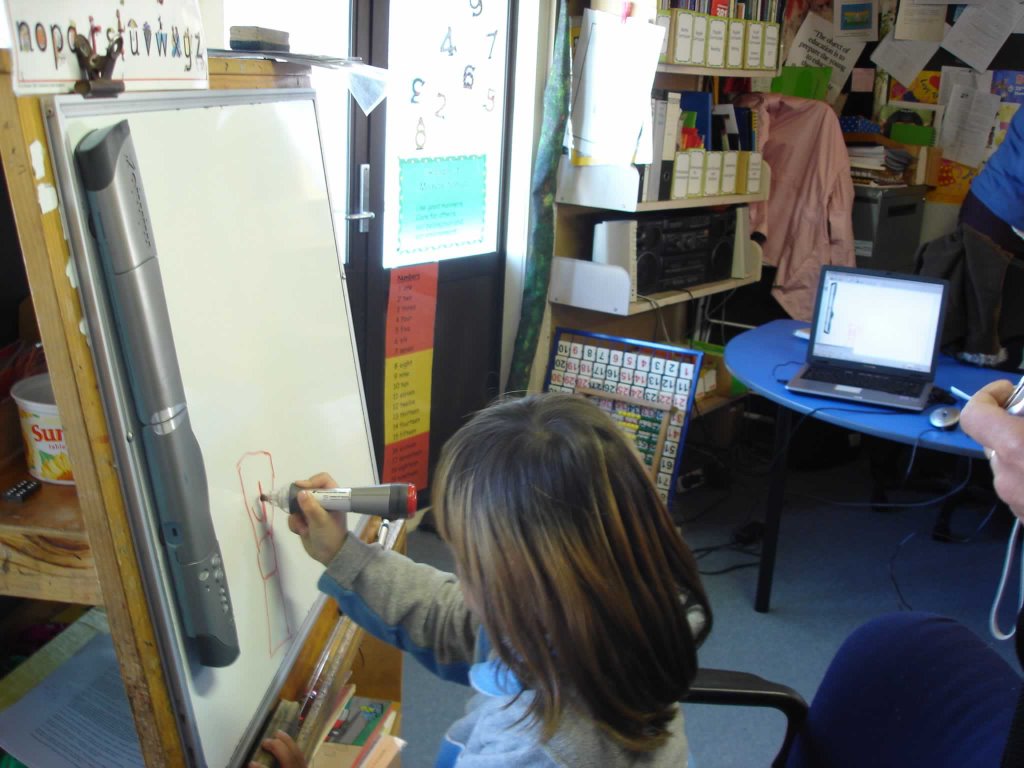
In the Junior Classrooms (lots of pics on Flickr) we saw a lot of use of Digital Photography to support literacy - wordbank pictures, shared writing, writing from experience, visual cues etc. Children's illustrations created in Revelation Natural Art. Letterland software, PM reader software and Clicker were all used in tandem with the literacy programme. Mary uses a Mimeo to record Newsboard each morning (we weren't early enough to see this in action). In this picture you can see the child writing by the Mimeo & it is recorded on the laptop attached - this can be made into a full interactive whiteboard by setting up the data-projector onto the board (not sure how it works - bit like smoke & mirrors to me) We then spent some time in the ICT suite as Mary worked with a group who were creating digital stories in PhotoStory. We had a good look at Clicker which many teachers know only through it's use with our Special Needs children. Mary showed us how she used Clicker to create activities that were relevant to her programme (she has created a huge bank of Clicker resources). She also showed us how to batch file photo's in Irfanview - maybe a bit hard for most of our teachers - who may be best to stick to iPhoto or MS Picture Manager to start with... Photofiltre was another free tool that we looked at.
Stratford Primary have most of this software (not Clicker) installed on the laptop pods & St Joseph's on the library & ICT room computers - check it out! Toko & Eltham you don't need any of this stuff - you've got MACS!! :-)
Just up on BardWired Interact are Mary Dean's PhotoStory resources (learning intentions & instructions) Thanks Mary.

Sunday, 6 August 2006

Bard Wired Big Day Out

A group of principals & lead teachers had a day out to visit other Taranaki Schools. We went to Manaia Primary School to observe the use of Smart Boards in the classroom and then to Opunake Primary School to look at Curriculum Integration.

At Manaia, Principal Allan Forsyth had used a terms sabbatical study grant to write an EDI proposal to develop a school wide Information Literacy programme. His proposal can be found on Leadspace. The EDI proposal was successful and very generous allowing for (amongst other things) the purchase of 8 SmartBoard in the school - one in each classroom & one in the library.

Prior to introducing IWB to classrooms, Manaia had been very well resourced with a new server, networking & computer lab funded by WITT for a Community Education computer course. A number of other schools have hosted WITT community ed. Computer courses but none were as well resourced to do this – maybe because those schools already had good existing services… What a bonus for a school to have all of this provided. The school itself is looking really mint with alterations to buildings – corridors, computer lab, admin, staff room & hall looking great – though classrooms themselves seemed to have no major changes and were your traditional school work spaces. Staff at Manaia have all participated in InfoLink this year and follow the action learning model school-wide, they have had training in the use of the Smart Boards & provide their own just-in-time PD and sharing . SmartBoards are handy tools, to organize your lessons, pull in a range of resources, record & store your learning notes as you go (through lesson annotations), display visual images and I sure would like one when I get back into a classroom but in themselves they don’t really change what happens in a classroom – they just deliver the same stuff but differently. To be honest, I found what I expected to in all of the classrooms – nothing out of the ordinary, no innovations apart from some very nice gear around the place :-) Manaia, like all our schools are on a learning journey, with a lot of the same ingredients: whole school focus on a learning model (in this case Action Learning), Literacy contract, NUMPA, ATOL – what is their vision for learning and how will the great resources in the school support this? They are first steps on this journey and there is a lot of potential to be realized here. It will be interesting to visit again in another year and see how they are progressing. Thank you Alan for sharing your school’s experience with us :-)

So
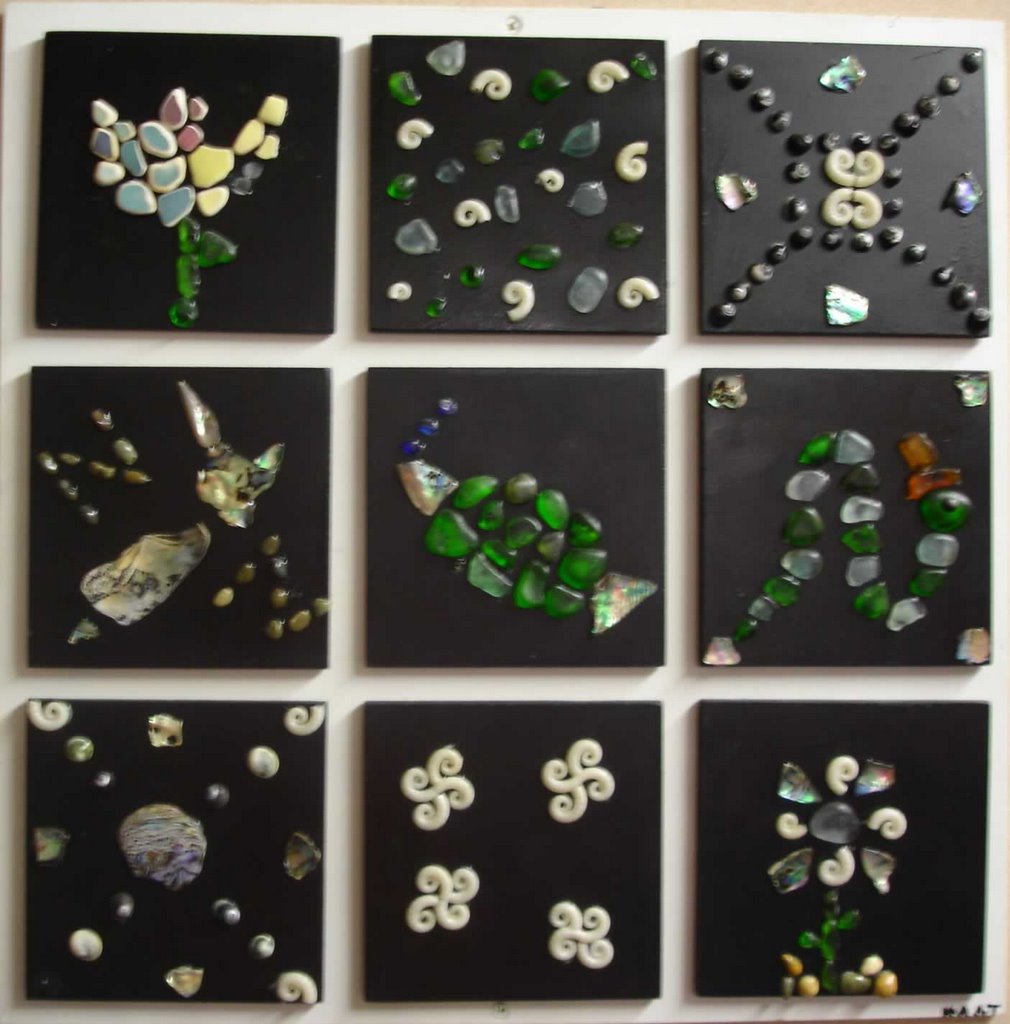
me great artwork @ Manaia Primary (more pics on Flickr)


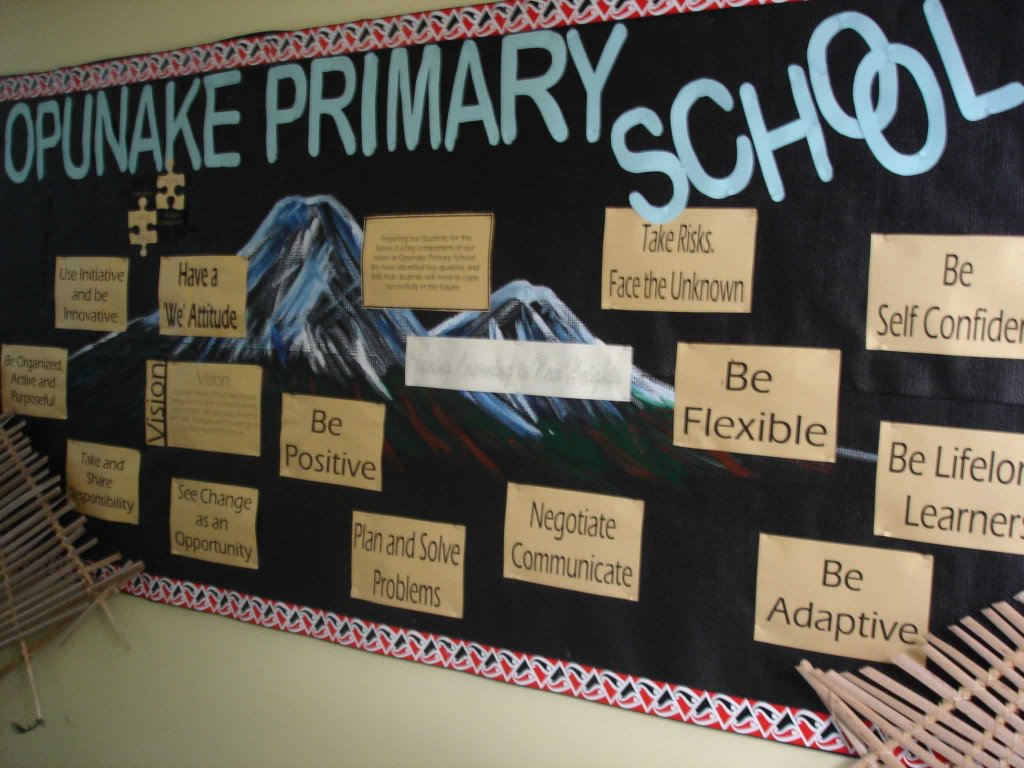
Opunake Primary School was everything I expected it to be - some great things happening here with Integrated Curriculum. Numeracy & Literacy is taught separately but all other curriculum areas are fully integrated. Lorraine began implementing an integrated curriculum at Opunake a few years ago in response to the needs of the kids many of them who were not engaged in their learning & as she said 'sick of doing worksheets'. They were involved in a CI research project along with Eltham Primary School last year and this year are the lead school in an EHSAS contract. Wow, does Lorraine walk the talk, driving learning in her school with passion and commitment. Before we had an opportunity to visit classrooms, Lorraine walked us through the nuts & bolts of how Curriculum Integration works at Opunake Primary School - an overview: CI @ Opunake is - based on student questions/interest; related to real life as often as possible; hands on learning; co-operative learning; Thinking Skills; Habits of Mind; Whole school/ including the community & Evolving. Towards the end of every term the school has an open day to share their learning with the wider community - i visited one a few years ago - awesome - well worth going out of your way to see. Thanks Lorraine for hosting us :-)

Tuesday, 20 June 2006

West End - The Thinking School

What a great opportunity today to visit West End School in Palmerston North with Jacqui & Megan from Eltham Primary School. Eltham had begun their journey down the pathway towards Curriculum Integration "The Eltham Way" to the point where they were starting to pull the threads together of what it would look like in their school - the nuts & bolts of it - how to make it work for them. This journey has stalled of late with recent staff turnovers and now they are looking to restart the process. Today, if anything, was an affirmation of current thinking & an opportunity to take away practical strategies & a framework to help scaffold the process.
Thank you to Gary Punler, Principal West End, for spending lots of time with us sharing the West End story and then setting us free around the school! Thank you also to all the teachers who so kindly put up with us traipsing in and out of their rooms with our cameras, taking the time to answer questions and being so welcoming. Kids too were excited about sharing their learning with us :-)
Gary's most potent words of wisdom were that be sure about the 'Why' and the 'How' will follow - whatever 'model' you put into place. Your staff really needs to buy into the bigger picture vision to make changes together. Everybody got on the bus at West End because they all believed that they needed to chuck out the 'over-crowded' curriculum and focus on skills for learning within an integrated curriculum. So how does it work here - well a picture tells a thousand words. Gary believes that they have not achieved full curriculum integration as literacy & numeracy are taught outside the framework then all other areas come within a term long 'rich topic', explicit learning intentions, rubrics, student portfolios within 'Thinking & Learning Strategies' (key competencies): Information Skills, Investigating, Working Together, Using classroom opportunities and managing learning time, Knowing We're Learning, Thinking strategies (the whole range here with a big emphasis on 6 hats but introduced across the school levels based on Pohl's framework). I am a bit biased here but i was surprised to see that ICTs didn't figure as an explicit part of their overall framework. There was a document that highlights ICT skills that should be used within the Integrated Curriculum. Apart from a couple of students publishing we didn't see much activity in this area. Digital photography was used a lot by teachers especially in the junior classrooms to model learning intentions and one class had been videoing their KapaHaka - a great way to self & peer assess. A curriculum review team looks out for learning areas that may be missed along the way that need to be picked up on with future learning. School teams plan together, with the first two weeks of a unit providing a wide knowledge base for students to ask their own questions and direct their own learning (i think the term 'front-loading' fits in here). There is a lot of self & peer assessment where students (with teacher guidance) provide feedback & feedforward for next steps. They have developed a very comprehensive CDP - curriculum development plan that provides the structure that they all work within. Overall it's not rocket science (don't we know all this stuff) but it's no silver bullet either. The point of difference though is this school has successfully pulled it together, they have worked together over the last four years to develop a model that works for them based on the needs of their children and not upon a document dreamed up by experts in Wellington. Gary sees this as a continual work in progress as he says there are no final documents everything is always a draft. He and a number of key staff have led the changes but he expresses pride in the fact that his teachers have picked up and run with this further than he ever expected.