Another great camp with these cool schools and their awesome kids and teachers:

Professional reflections on education in NZ - Dancing on the shifting carpet
Showing posts with label collaboration. Show all posts
Showing posts with label collaboration. Show all posts
Tuesday, 21 May 2019


Tuesday, 2 May 2017
Effective networks = Collaboration
Collaboration is a key theme in my research question and in my reading I have found it is closely linked and underpins effective school networks. Santiago & Fullan (2016) equate effective networks with collaboration that deepens learning, grows professional capital and is a positive driver for system improvement.
They say that on its own mandated collaboration (top-down) nor grass roots (bottom-up) collaborations will work. Effective school networks need both approaches.
In the NZ setting you can see CoLs (Communities of Learning) as being driven from the top down; although necessary as they provide the resources, structure and support necessary to sustain long term collaboration. Offset this with grass roots collaborations that have been happening for many years - ICT PD clusters, VLN communities, LCN networks & many more. These have been where the heart of collaborative practice and communities of learning have grown in NZ but have been unsustainable because they have lacked the ongoing systems resources and support.
Patel-Taylor (2014) supports this view distinguishing between systems collaboration and a culture of collaboration.
Systems collaborations are more technical in nature - structures, roles, resourcing - they are necessary but not enough on their own. A culture of collaboration takes place in the the learning spaces within and across classrooms and schools, and involves a focus on sharing practice, co-constructing new learning and evolving cycles of inquiry. Patel-Taylor (2014) defines collaboration as “the process of sharing learning and engaging in dialogue, to create joint new learning that informs future actions focused on the learning of leaders, teachers, students and/or the wider community, over time” (p 8).
School leaders need to be just as concerned for students in all schools as they are in their own schools - this is indicative of a higher moral purpose and 'Systemness' where people deliberately contribute to and benefit from the larger system (Santiago & Fullan 2016). It can be illustrated as well in this adaptation of Spackman's Model:
What features do you recognise in your schools cluster, CoL or network? Where are the missing pieces that would make your network more effective and sustainable? Read Santiago & Fullan's work linked below for a really good overview of this.
They say that on its own mandated collaboration (top-down) nor grass roots (bottom-up) collaborations will work. Effective school networks need both approaches.
In the NZ setting you can see CoLs (Communities of Learning) as being driven from the top down; although necessary as they provide the resources, structure and support necessary to sustain long term collaboration. Offset this with grass roots collaborations that have been happening for many years - ICT PD clusters, VLN communities, LCN networks & many more. These have been where the heart of collaborative practice and communities of learning have grown in NZ but have been unsustainable because they have lacked the ongoing systems resources and support.
 |
| Dr. Cherie Patel-Taylor |
Systems collaborations are more technical in nature - structures, roles, resourcing - they are necessary but not enough on their own. A culture of collaboration takes place in the the learning spaces within and across classrooms and schools, and involves a focus on sharing practice, co-constructing new learning and evolving cycles of inquiry. Patel-Taylor (2014) defines collaboration as “the process of sharing learning and engaging in dialogue, to create joint new learning that informs future actions focused on the learning of leaders, teachers, students and/or the wider community, over time” (p 8).
School leaders need to be just as concerned for students in all schools as they are in their own schools - this is indicative of a higher moral purpose and 'Systemness' where people deliberately contribute to and benefit from the larger system (Santiago & Fullan 2016). It can be illustrated as well in this adaptation of Spackman's Model:
 |
| Derek Wenmoth - adaption of Spackman’s Moral Scale of decision making |
8 features of effective networks
- "focussing on ambitious student learning outcomes linked to effective pedagogy;
- developing strong relationships of trust and internal accountability;
- continuously improving practice and systems through cycles of collaborative inquiry;
- using deliberate leadership and skilled facilitation within flat power structures;
- frequently interacting and learning inwards;
- connecting outwards to learn from others;
- forming new partnership among students, teachers, families, and communities;
- and securing adequate resources to sustain the work."(Santiago & Fullan, 2016, p 10)
 |
| Essential features of effective networks in education - Santiago & Fullan 2016 |
Santiago Rincón-Gallardo, & Michael Fullan. (2016). Essential features of effective networks in education. Journal of Professional Capital and Community, 1(1), 5–22. https://doi.org/10.1108/JPCC-09-2015-0007
Taylor-Patel, C. (2014). Networking – Weaving the net; gathering the pearls. Auckland, N.Z. Retrieved from http://appa.org.nz/wp-content/uploads/2014/11/Cherie-Taylor-Patel.pdf
Wenmoth, D. (2013, February 16). Change or Die: vision, trust and support. Retrieved 30 April 2017, from http://blog.core-ed.org/derek/2013/02/change-or-die-vision-trust-and-support.html
Wenmoth, D. (2013, February 16). Change or Die: vision, trust and support. Retrieved 30 April 2017, from http://blog.core-ed.org/derek/2013/02/change-or-die-vision-trust-and-support.html
Sunday, 30 April 2017
Collaboration - different viewpoints
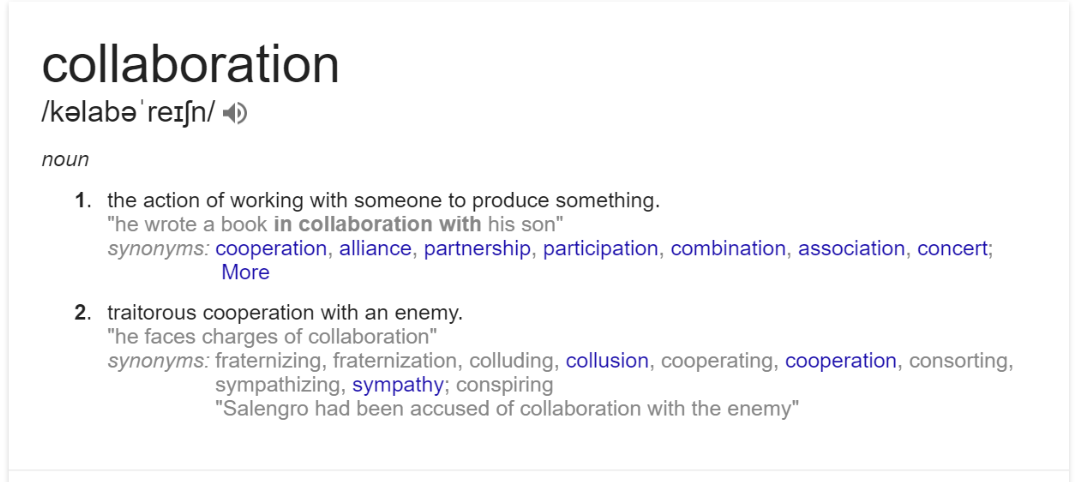
The simple definition of collaboration can be a double-edged sword - working for the collective good or conspiring to change the status quo. This is a reflection of the current education climate where schools are being strongly encouraged and incentivised to form collaborative Communities of Learning. In the educational sector, some look at this from the view of No.1 (image below), and some see No. 2 and are skeptical that collaboration risks undermining their own schools and is a tool of the neo-liberal agenda and school reform. I think they are both right but from the point of view of No. 2, I think we are long overdue for a system change (without the ideological jargon & baggage of a neoliberal agenda).
 The benefits of collaborative groups particularly for rural principals is recognised:
"Collaboration is a practice that professional educators have always incorporated in their practice. It provides the opportunity to share both challenges and solutions and to create solutions where they don’t exist.
Collaborative groups are also great sources of PLD for schools and many share resources which they then agree to channel into a common area for development, whether that is for teachers within schools or for leadership. It has always been a challenge for isolated or rural principals to participate in collaborative groups for PLD, because of the extra travel component.
However, it is perhaps even more important that rural principals are able to connect with each other because they are already isolated with little or no contact with other principals. [my emphasis] The Virtual Learning Network (VLN) has become very popular with isolated schools as they can collaborate at least virtually, even if not in person."
To read more about the lead up to Communities of Learning in NZ:
- Investing in Educational Success - Systems change in the making;
- Connected communities: What are the implications for school leadership?;
- and The Joint Initiative - A Better Plan.
 |
| Iain Taylor - NZPF President 2016 |
Collaborative groups are also great sources of PLD for schools and many share resources which they then agree to channel into a common area for development, whether that is for teachers within schools or for leadership. It has always been a challenge for isolated or rural principals to participate in collaborative groups for PLD, because of the extra travel component.
However, it is perhaps even more important that rural principals are able to connect with each other because they are already isolated with little or no contact with other principals. [my emphasis] The Virtual Learning Network (VLN) has become very popular with isolated schools as they can collaborate at least virtually, even if not in person."
Saturday, 18 February 2017
Collaboration Across New Zealand Rural Primary Schools: A Virtual Learning Perspective.
So here is my successful Research Proposal. I'm going through the process of preparing my Ethics Approval now and hope to be inviting participation in this research in about a month's time.
Abstract/Summary
Virtual learning has been taking place in New Zealand for two decades and pioneered in our rural
schools (Barbour, 2011; Roberts, 2010; Wenmoth, 1996).
Virtual learning has been taking place in New Zealand for two decades and pioneered in our rural
schools (Barbour, 2011; Roberts, 2010; Wenmoth, 1996).
“Small rural schools in New Zealand are in the forefront of changes in the application of information and communication technologies to teaching and learning. The emergence of rural school electronic networks is an important step towards the development of virtual classes in New Zealand, requiring new ways of organising teaching and learning. It is particularly appropriate to reconsider the pedagogy of the one- and two- teacher school in relation to the emerging virtual class. These small schools could have a new role in the information age and should, accordingly, be repositioned within the national educational system” (Stevens, 1996, p. 93).
This quote from Ken Stevens, made 20 years ago, has challenged me to consider how virtual learning has evolved over the last twenty years. How have rural schools been leading the way and benefiting from virtual learning? To what extent are we seeing new ways of teaching and learning online?
Virtual learning can be defined as learning that is facilitated by a range of technologies to enable communication and collaboration, where students and teachers are in distributed locations (Bolstad &Lin, 2009).
My research aims to examine how collaborative practice between schools working in virtual learning environments can alleviate the challenges small rural schools face for both students and teachers. These challenges could be in relation to access to professional support and a wider curriculum because of a school's small size and relative isolation. I will explore how collaborative online learning could enable innovative practice and new ways of thinking about the nature of schooling; while also exploring the challenges and potential pitfalls this may bring to schools. This research will be undertaken within the context of the Virtual Learning Network (VLN) Primary School network within which I work, and with the Principals who participate in VLN Primary programmes and projects.
The VLN Primary extends learning opportunities for students by enabling online learning between schools. Children have the choice to engage with a wide range of subjects that may not be available in their school. The VLN Primary provides professional development for teachers, student learning support, technical support and logistical coordination of online classes and programmes to schools around New Zealand (Virtual Learning Network Primary School, 2013). Learning is tailored to meet the needs of students, and make the most of the strengths of the schools. For example, through a reciprocal arrangement, the schools provide teachers in a subject in which they have a high level of expertise. Where it isn't possible for schools to provide that teacher, another teacher is contracted into the VLN Primary. Students and teachers use a range of synchronous and asynchronous tools that enable them to communicate and learn online together. The VLN Primary School is a registered Charitable Trust governed by its participating schools and supported, in part, by the Ministry of Education (Virtual Learning Network Primary School, 2016).
Research question or hypothesis
My main research question is:
What are the challenges small rural schools face and how can collaborating online provide benefits to learners, teachers and principals?
Supporting questions:
- What is the experience of teachers/principals with online collaboration across schools?
- What are their beliefs about learning online?
- What are some of the enablers and barriers to collaboration across schools?
- What are some of the enablers and barriers for teaching and learning online?
- How do teachers/principals think that teaching and learning online may change the nature of schooling in the future?
Methodology
The conceptual context of this research will be situated within an interpretivist or constructivist framework. Within this framework reality is socially constructed, is context dependent (socially, culturally and historically) and can have multiple meanings depending on individuals’ perspectives. The stance of the researcher is not subjective as they are part of the research process, and involved in co-constructing meaning (Cohen et al., 2007; Mutch, 2013).
In addition to this there will be some elements of Critical Theory emerging as underlying the aims of the VLN Primary School are notions of social justice through providing greater equity and access to learning. Tait & O’Rourke, (2014, p.51) articulate the vision of the VLN Primary really well when they say: “our concept of social justice for each individual encompasses both the notion of equality rights as a ‘level playing field,’” and the “right to opportunities and support that enable each person to fully participate in all aspects of society—to get to the playing field in the first place.”
Semi-structured interviews will be held with a focus group of school Principals. Key themes will be drawn from the focus group discussion and followed up in more detail with individual interviews with no more than six of these Principals. I will use an iterative data analysis process whereby patterns and trends emerging at each stage of data collection are used to inform the next stages of data collection (Srivastava & Hopwood, 2009). Existing VLN Primary documents will be analysed to contribute to the body of knowledge developing. eResearch will be woven through the process not only because it makes sense due to the context but because it enables and amplifies research in ways that were not previously possible. eResearch will include online focus group discussions, the collection of data such as recorded lessons, conversations, screenshots, chat transcripts and Google analytic tracking of website usage and interactions. With this type of eResearch, ethical concerns of privacy are raised. Pardo & Siemens, (2014) identify four principles that should be addressed in regards to privacy of online data in educational institutions; they are transparency of processes, student control over data, security and access to data, and accountability and assessment of systems
Who would be interested in the outcome of your study?
Whanau and communities who have children learning in collaborative online communities would be interested in this study to gain a better understanding of their children’s online learning experiences. For those whanau and communities whose children are not learning in the virtual setting, this research may make them more aware of the potential benefits and challenges involved and cause them to consider supporting virtual learning in their own schools.
Schools (teachers, principals and Boards of Trustees), who are involved in collaborative online learning might be interested in the findings of this research for self-review and school improvement purposes; and schools that are not yet involved may be interested to see the possibilities and to learn from experiences of those who have pioneered the space.
Research findings will inform policy makers on current practice in collaborative online learning across schools and how we can realise the potential benefits of virtual learning for students, teachers and school communities with the New Zealand educational setting. This study aligns with Ministry of Education priorities in relation to collaborative practice and system changes within IES - Communities of Learning and the current Education Review - Taskforce on Regulations Affecting School Performance (2014). Particularly relevant is the proposed regulatory framework for online learning and potential formation of CoOLs (Communities of Online Learning). It also aligns to the Ministry of Education (2016), priorities as outlined in 'The Four Year Plan 2016 - 2020' for improving student centred pathways and championing 21st century practice in teaching and learning.
References
Barbour, M. K. (2011). Primary and secondary e-learning: Examining the process of achieving maturity. Christchurch, New Zealand: Distance Education Association of New Zealand. Retrieved February, 2015, from http://www.vln.school.nz/mod/file/download.php?file_guid=114023
Bolstad, R., & Lin, M. (2009). Students’ experiences of learning in virtual classrooms. Wellington: NZCER. Retrieved November, 2016, from http://www.nzcer.org.nz/system/files/students-experiences-learning-virtual-classrooms.pdf
Cohen, L., Manion, L., & Morrison, K. (2007). Research methods in education (6th ed.). London ; New York: Routledge.
Ministry of Education. (2016) Ambitious for New Zealand: The Ministry of Education Four Year Plan 2016 - 2020. Retrieved November, 2016, from http://www.education.govt.nz/assets/Uploads/4-Year-Plan-2016-WEB.pdf
Ministry of Education. (2016) Establishing a regulatory framework for online learning. Retrieved November, 2016, from http://www.education.govt.nz/ministry-of-education/legislation/the-education-update-amendment-bill/establishing-a-regulatory-framework-for-online-learning/
Mutch, C. (2013). Doing educational research: a practitioner’s guide to getting started. Wellington: NZCER.
Pardo, A., & Siemens, G. (2014). Ethical and privacy principles for learning analytics. British Journal of Educational Technology, 45(3), 438–450. doi:10.1111/bjet.12152
Roberts, R. (2010). Increasing access for learners – The Virtual Learning Network. In V. Ham & D. Wenmoth (Eds.), e-Learnings: Implementing a national strategy for ICT in education, 1998-2010 (pp. 144-152). Christchurch, New Zealand: CORE Education Ltd.
Srivastava, P., & Hopwood, N. (2009). A practical iterative framework for qualitative data analysis. International journal of qualitative methods, 8(1), 76-84.
Stevens, K. (1996), The Technological Challenge to the Notion of Rurality in New Zealand Education - Repositioning the Small School. New Zealand Annual Review of Education, 5, 93 - 102.
Tait, A., & O’Rourke, J. (2014). Internationalization and Concepts of Social Justice: What Is to Be Done? In Online distance education: towards a research agenda. Retrieved from http://www.aupress.ca/books/120233/ebook/99Z_Zawacki-Richter_Anderson_2014-Online_Distance_Education.pdf
Taskforce on Regulations Affecting School Performance. (2014). Considering education regulation in New Zealand. Retrieved November, 2016, from http://www.minedu.govt.nz/theMinistry/EducationInitiatives/~/media/MinEdu/Files/TheMinistry/EducationInitiatives/Taskforce/TaskforceReport.pdf
Virtual Learning Network Primary School (2013). Charter & Strategic Plan 2013 - 2015 - Connecting New Zealand Schools for Enhanced Learning Outcomes. Retrieved November, 2016, from https://docs.google.com/document/d/1vLMmV1-1zJvMH3kL7z9VzyTvZYdtnRKIbQpUXVB5WEA/edit?usp=sharing
Virtual Learning Network Primary School (2016). Submission on the Education (Update) Amendment Bill. Retrieved November, 2016, from https://goo.gl/LHXttO
Wenmoth, D. (1996). Learning in the distributed classroom. SET Research Information for Teachers, 2(4). 1–4
Sunday, 11 October 2015
VLN Primary School in Print - STA News
Here is an article i wrote for the NZ School Trustees Association about the VLN Primary School. It gives a pretty good snapshot on who we are and what we do:
"At a time when schools are increasingly stretched to find the resources to provide a broad and relevant curriculum for students, they are also being challenged to become more collaborative and future focused. We are on the cusp of major changes both politically driven through IES Communities of Schools and technologically driven through the N4L managed network for schools. There is a drive to harness the power of technology to change the way we learn, make learning more student centred and personalised and for collaboration across schools. How are schools meeting these challenges? With a deluge of ipads, the ‘appification’ of learning (there’s an app for that), should we have 1-1, BYOD, Chromebooks, Google, Microsoft, Wireless, have we been snupped, when do we get on to N4L? We are getting close to the point where technology is ubiquitous, a utility like power or water. Schools need to look beyond the digital network and environment to the people network that connects and learns in that space.
The Virtual Learning Network (VLN) Primary School has as its’ tagline “Connecting Schools for Enhanced Learning Outcomes”. It is a people network collaborating online and dedicated to providing equity and access to learning opportunities for New Zealand students. It aims to connect schools through a collaborative online network (the virtual school) in order to open up access to specialist teachers, share the best of our teaching strengths, and to build professional capability that enables schools to become more flexible and open places of learning for our children. It began as a school cluster hosted within Matapu School, South Taranaki, and has evolved into a Charitable Trust led by school leaders and virtual learning advocates. It is partly funded in partnership with the MoE and contributions from participating schools.
The VLN Primary School builds on work that has been developed in the schooling sector, over the last nearly 20 years where programmes have been provided ‘virtually’ through online classes & projects taught by NZ based teachers. Approximately 80 primary schools and 1000 students have participated in the VLN Primary School to date since 2009. Learning opportunities are developed through the needs and strengths of the schools themselves and eteachers and tutors are provided by schools themselves or contracted into the network.There are regular weekly scheduled classes for extension maths, literacy, science, Astronomy and a wide range of languages - Te Reo Māori, Mandarin, Spanish, French, Cook Islands Māori, German, Japanese, Afrikaans, Korean, Bahasa Indonesian and Tagalog.
In addition to this the ‘Over the Back Fence’ run by Rosmini College, has regular connections with schools in NZ, Pacific, India & globally focussing on Health & Environmental topics. Our Rural & Remote Schools Project brings together schools from Stewart Island, Great Barrier, Eastern Taranaki & Wairarapa with the goal of reducing the social isolation of these distributed students, giving them opportunities to learn alongside peers their own age and preparing them for leaving their districts to go to High School. There is a great opportunity to build on this project to extend the benefits to many other small and isolated schools, but sustainability of resources has prevented us from scaling up this very successful project.
Participation in the VLN Primary School gives students a voice and choice in what they learn, how, when and where they learn, and who they learn with; regardless of their geographical location and economic means. It aims to provide teachers and school leaders across networked schools with professional learning and support to enable them to develop as future focused learning organisations. When you next think of your school network, think beyond the technology to the people network and how your school can become connected to an online community of learners."
Sunday, 4 October 2015
What's up for the VLN Primary School
We're coming up to the downhill side of the 2015 school year and we are still not sure if we have got funding to continue our VLN Primary operations into 2016 and beyond. This is a real challenge!

So to keep ourselves afloat for 2016 until we can take our (rightful) place within the publicly funded schooling system, I have spent the last month in chasing up and writing funding applications through our charitable trust, breaking down various parts of our projects & operations to aim at different funding opportunities. I have all my fingers and toes crossed waiting to hear.
(one glimmer of good news is that we do have an Asian Languages contract with the Ministry of Education and will be continuing with Chinese, Japanese, Korean & Bahasa Indonesian)
Just been remixing our Virtual Learning Network Primary School Story, created by Kath after our last rural camp. What an...Posted by Virtual Learning Network Primary School on Saturday, October 3, 2015
Tuesday, 21 July 2015
The Joint Initiative - A Better Plan

Today the NZEI released details of the Joint Initiative - a plan forward with the MoE instead of the IES that was rejected by the NZEI collective.
Communities of Learning instead of Communities of Schools
The aim of this initiative is to give more emphasis on collaboratively improving students achievement outcomes and less on the roles and admin of a system change that was being proposed through IES.
Is it just the same thing but dressed up differently using different eduspeak? I am sure members will be discussing that as they meet to vote on this over the coming few weeks.
Louise Green, NZEI President, tells members, "We believe the new model is an exciting educational development, genuinely shaped by educators. Inevitably, as with any negotiations, we have had to make compromises, but we are confident that the progress we have made will genuinely improve teaching and learning."
Key Learnings from the Working Group were summarised as:
- Communities of Learning should self-identify with clear pathways across the sector;
- Their clear purpose is to improve educational achievement aligned with NZC, though they can define their areas of focus;
- Data, evidence & research is used to target efforts;
- Each Community should determine its own leadership, teaching, collaboration and support functions:
- Some roles will be required for all and these will be appointed in conjunction with an external professional advisor;
- Be flexible and prepared for change over time;
- Each Community will assess it's own resource needs;
- 'Whole of Community of Learning collaboration" is critical to success;
- Commit to second stage - further work on priority areas - Māori, Pasifika, ECE, Support Staff, Special Ed, PLD;
- Community roles will align with career pathways.
So what will this look like when we come to implement such a plan?
How flexible will this plan be?
How will this work for the rural and isolated school, will they be able to develop CoL that are geographically distributed?
How flexible will this plan be?
How will this work for the rural and isolated school, will they be able to develop CoL that are geographically distributed?
How do schools select their Community that has clear pathways when the pathways for many of our students are so diverse?
Where will be the tension between roles determined by the Community and roles required by the MoE - and how will resources be distributed between them?
One positive that were raised for me was that there was recognition of the roles across schools as well as within schools - this may provide some support for the role I have occupied across schools for years with no formal recognition, support or career pathway.
Another point to flag in this plan was the inclusion of Professional Learning and Support as an explicit feature to be worked towards in the second stage of the Joint Initiative. We have been waiting for some time as to the outcome of the Professional Learning & Development Review, so this may be the basket it is ending up in.
So still a work in progress, and a space i am watching closely with the hope that the 'Policy Parameters' of this plan are flexible enough to include the work of the VLN Primary School.
Wednesday, 15 April 2015
Our Stories - Exhibition Coming Up

''My Story. Our Story. Your Story'
The result of a year long project initiated and co-ordinated by the Ahuroa School Photography Club, and facilitated online via the VLN Primary School.
The Project
An exploration of photography as a means of telling and sharing a story, for primary school aged children. “My Story” - individual journey’s of self discovery; “Our Story” - the combining of individual photographic stories to become a representation of a school community; “Your Story”- school communities stories are compared and combined to tell one story - our exhibition.
Our Story
We are a small, rural country school. We have a story to tell. But are our stories different to those of kids who live in the city, or kids whose cultures are different from ours, or from kids who have had experienced natural disasters? What about kids who live in isolated places? What about kids who live in different countries to us? Will their stories be different? How? Or, will their stories be similar? Will their be a common connection?
Participating Schools:
New Zealand
Kaikohe West School (Kaikohe); Mulberry Grove (Great Barrier Island); Kaitoke School (Great Barrier Island); Ahuroa School (Warkworth); Hobsonville Point School (Hobsonville); Devonport Primary School (Auckland); Te Poi School (Matamata); Toko School (Taranaki); Moanataiari School (Coromandel); Pahiatua School (Palmerston North); Rewa Rewa School, (Wellington); Dipton School (Otago); Burnside Primary (Christchurch); Glenorchy Primary School (Glenorchy); Half Moon Bay School (Stewart Island)
International
Flowery Branch Elementary (Hall County, USA); Lakeview Elementary (Robbinsdale, Minnesota, USA); Nexus International School (Singapore);
AMMAC, Chihuahua (Mexico); Beaconhouse School (Islamic Republic of Pakistan)"
from http://www.estuaryarts.org/currently-showing.html
Monday, 23 March 2015
I Love Zotero - the webs best referencing tool!

I have been meaning to write about Zotero for some time but as more of my friends are resuming their studies i thought it would be timely to share this post.
When i returned to study last year i tried Zotero for the first time, wow so much better than EndNote that i had used many years ago. EndNote may be good but here are the reasons i LOVE Zotero.
- So easy to use and organise your work
- Stand alone & mobile versions sync really well, enabling easy access to readings from your tablet or ipad
- Browser add on enables you to pull bibliographic info straight in at a click of a bookmarklet
- If you know the isbn or doi number and put that in it automagically populates all info
- And the best reason i love Zotero is you can create groups in Zotero online and SHARE
What a great way to crowd source around a topic, create groups with your class mates, ask your lecturer to share the readings straight into Zotero (now that would be handy) - Completely free to use

Here is a group i set up called VLN Scholars specifically for NZ teachers - you are welcome to join and contribute.
Here are Zotero getting started guides - happy studying!
Wednesday, 11 March 2015
More than just Sharing a few Pics - My Story, Your Story, Our Story.
It has been great to follow and support the project My Story, Your Story, Our Story Big kudos to Theressa for initiating and driving this schools collaboration. As the project progresses we can see it is more than just developing some expertise in photography skills & techniques, or sharing their best pictures. It is about making meaningful connections that provide different perspectives on our lives and this has been particularly evident, so far, with the global participation.
Here Stephanie shares her story of participating in this project - Bringing the classroom out into our World. And here they are again practicing a waiata for their school visitors, inspired by their interactions with the My Story Project. Click over there and give the students some positive feedback on their kapa haka efforts! Here is the direct link to their photos.

Here Stephanie shares her story of participating in this project - Bringing the classroom out into our World. And here they are again practicing a waiata for their school visitors, inspired by their interactions with the My Story Project. Click over there and give the students some positive feedback on their kapa haka efforts! Here is the direct link to their photos.
Monday, 26 January 2015
Online Learning Opportunities 2015 #Participate!
From our latest newsletter:
Tēnā koutou katoa
Welcome back to the 2015 school year! Here is a heads up on the year ahead for the VLN Primary School and an invitation for all interested students & teachers to participate.
VLN Primary School activities - online classes and projects are open for all NZ schools to participate. Please read our Protocols of Participation for specific details on how to participate and what costs are involved.
This year we have a wide range of languages available - te Reo Māori, Mandarin, Japanese, Korean, French, Spanish, German; also Extension Maths, Science (Chemistry - Mixing things). Over the Back Fence & Rural & Remote Schools, are long running projects that are welcoming interest from new participants.
There are several programmes under development, that are yet to be confirmed for 2015 - Tokelauan, Ngā Pūrākau, Asian Studies, Science (Plant Biology) and we welcome expressions of interest for participation in these. We would also love to be able to offer Cook Islands Māori, Astronomy, Extension Literacy, Coding & Minecraft challenge and are looking for teachers who are keen to run these programmes. (We have run some of these programmes before and have supporting resources available.)
We are keen to support new projects or classes getting started so please make your suggestions!
All schools wishing to register for online programmes for Semester 1 (classes begin mid March) should do so on this online form as soon as possible. For expressions of interest in anything mentioned above or queries please Contact Rachel.
Check out our 2014 year's highlights
Wednesday, 21 January 2015
A Vision Without Action is just a Dream - Learning Languages - A Global Future
Yesterday i had the privilege of collaborating with a room full of passionate language learning advocates from community groups, schools and supporting organisations. Our main focus was to discuss the challenges and opportunities for schools in developing and sustaining language programmes in schools and how we can provide support and guidance for schools in the ALLiS initiative.
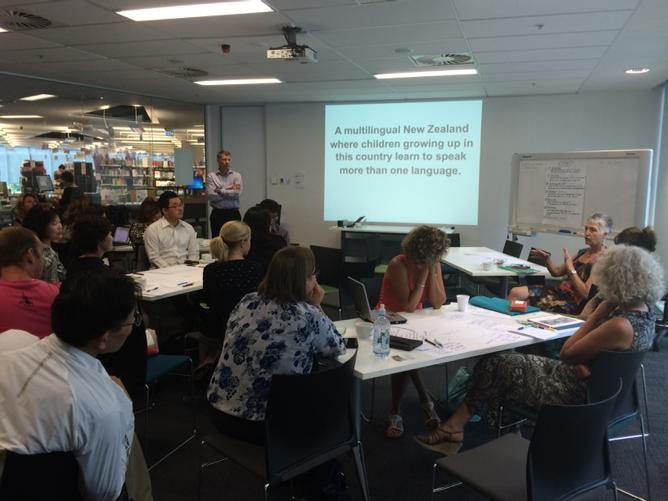
There were many details discussed of how we can collaborate to support successful and sustainable programmes but what has been clear in this meeting and previous ones is that a national language policy & strategic plan for learning languages is critical to co-ordinate, drive and sustain this work.
It was really interesting to meet Susan Warren and hear about the work of COMET educational trust and in particular the development of a Languages Strategy for Auckland. It makes a strong case for developing Auckland (and that should read - New Zealand) as a multi-lingual community and also a strong case for a National Languages policy. Here are some of the points that resonated with me - you can read the whole document here and there is still an opportunity to submit a response here within the week.
"Multilingualism is central to a diverse city: it allows us to value ourselves, build community, build tolerance, and live peacefully and prosperously.Currently, many Aucklanders miss out on the cognitive advantages of multilingualism. As a community we miss out on the potential of younger language learners because we fail to take advantage of the best windows for language learning and the most effective years for language maintenance. Auckland’s migrants, especially our older migrants, could receive much better support for their aspirations to learn communicative English. As a community we fail to grasp the cultural and aesthetic benefits of multilingualism, and many Aucklanders cannot garner the educational attainment that crosses language boundaries and unifies knowledge in varied domains. One of the more obvious impacts of the absence of a languages policy in New Zealand is seen in education. Evidence shows that quality bilingual or immersion instruction in children’s first or heritage language brings measurable gains in literacy achievement in the target language and also in English[1]. However requests to the Ministry of Education for tailored materials or professional development for bilingual classes are met with an explanation that there is no policy to enable provision for learning through languages other than English, te reo Māori and NZ Sign Language.Most New Zealanders (93 per cent) agree it is valuable to learn another language[2]. Language skills and cultural sensitivity are now required for successful participation and engagement locally, nationally and globally in all spheres of activity. Auckland is well placed to harness its language potential.In the past, it has been possible to “get by” in English only. For our young people to thrive in the future, they will need more options and more experience as language learners. Because most of the world is multilingual this need will be felt even more acutely as today’s young Aucklanders spread their wings globally. Most English-dominant countries today require their young people to have another language; all of New Zealand’s associates in ASEAN require kids to learn another language from a young age. New Zealand identifies strongly with the ethics of team membership: being a team player in the 21st century will mean being multilingual."
[2] Ministry of Education (2008). Teaching and learning for bilingual Pasifika students in New Zealand.
Monday, 8 December 2014
Wednesday, 19 November 2014
Connect your Learners - Over the Back Fence 2015
Successful projects keep on running & keep getting better. Well done Geoff into your third (4th?) year of Over the Back Fence Project.

Geoff is welcoming schools wanting to participate in 2015
What is OtBF?
• We broadcast a simple health/safety lesson to your class each week.
• The lesson is between 5 and 10 minutes. We use Skype or Connect.
• The classroom teacher can choose the topics or chose from our list.
• Lessons are taught at the same time each week to avoid confusion.
• The lesson is between 5 and 10 minutes. We use Skype or Connect.
• The classroom teacher can choose the topics or chose from our list.
• Lessons are taught at the same time each week to avoid confusion.
Here is the schedule of available times for 2015 - contact Geoff gmwood@xtra.co.nz for more information or to secure a time for your school to participate.
MONDAY
|
10:10-10:40
|
11:25-11:55
| |
TUESDAY
|
10:10-10:40
|
12:10-12:40
| |
2:20-3:00
| |
WEDNESDAY
|
10:10-10-40
|
1:40-2:10
| |
2:20-3:00
| |
THURSDAY
|
10:10-10:40
|
FRIDAY
|
10:10-10:40
|
2:20-3:00
|
Subscribe to:
Posts (Atom)