Showing posts with label teaching. Show all posts

Monday, 31 August 2009

Student Centred Learning

In this news article “Jump to High School too big for some” differences in pedagogies are seen as contributing to students’ difficulties in adjusting to the transition to high school and advocates for a focus on maintaining a ‘middle school’ Yrs 7 – 10. So why is it that when you get to high school the teacher becomes the centre of learning and not the student? Why should we change to a focus on ‘middle school’ to ease this transition? Why not work on changing teaching styles to put students at the centre – where they belong.

“Kay Matheson, from Victoria University in Wellington, studied the differences in teaching between Year 8 (form two) and Year 9 (form three).

Matheson's study found Year 9 teachers were more teacher-centred than Year 8 teachers.

"The focus shifts from student-centred learning to teacher-centred learning," the study said. "This may be a contributing factor in the decline in mathematics achievement that has been shown to occur at this phase of education in New Zealand."

The study observed teaching at a secondary school and one of its feeder intermediate schools. Three teachers of mathematics at Year 9 from the secondary school and three Year 8 teachers from the intermediate school were videotaped, each for three lessons.

"In the type of statements used there were significant differences," the study said. "The Year 9 teachers used instructional and control statements more than the Year 8 teachers ... Year 8 teachers had a higher percentage of explanatory statements. The study found greater use of "confidence-building statements" by Year 8 teachers." read more

Tuesday, 17 March 2009

Engaging Teachers in Reflective Discussion

As I prepare to have conversations with eTeachers around Performance Appraisal & Goal Setting I have been reading through some Leadership PD material from www.interlead.co.nz about 'Conversations for the Professional Teaching Career'

It discusses how to align conversations with the different stages of a teacher's professional career leading from more Direct Conversations with Novice teachers to more Reflective Conversations with Expert teachers, with reference to John Hattie "Distinguishing Expert Teachers from Experienced & Novice Teachers." This is particularly important for eteachers as though they may have many years of experience & possibly be an expert classroom teacher, with the change to being an eteacher they may find themselves feeling that they are right back at the Novice stage. 

One of the challenges for me is how to engage teachers in reflective practice without being judgemental while at the same time reinforcing the requirements of their unique teaching position and motivating them to change their teaching practice to better meet the needs of our elearning students.

Interim results from an NZCER research project highlight that from our student's perspective eteachers generally have not adapted their teaching strategies from the face to face environment. (unpublished)

There is a lot of work to continue with eTeacher PD & the development of their online classes. ePrincipals are currently beginning collaborative work on creating a shared framework for eLearning Design.


image

Picture courtesy http://www.conversationthatmatters.com/conversation-meter.htm 
(more explanation there)

Thursday, 19 June 2008

What Learning Do You Value? Julia Atkins

julia I joined an excellent PD session with Julia Atkins and others around the country about focusing on Key Competencies in the Learning Areas. It was disappointing that noone from any of our cluster schools could find the time to attend this session - they missed a great learning opportunity. This session was recorded so i will download it & extract some of the key points for sharing with my colleagues. The following are some notes from the session:

We began with a discussion on how the curriculum has evolved over the last 120 years. How it has continually expanded & expanded with new subjects as different things have become important over the years. We haven't changed the curriculum in all this time except to add more things. Now to make this more manageable we have created  Key Learning Areas so we can group all these subjects. While we try to make sense of all of this the important thing to think about is "What is the educative purpose of school?" What is Essential Learning - Development of self & self for society.
The Integration of Key Learning Areas, Values & Key Competencies - this will help us achieve our educative process.
Questions:
How do we do this?
How do we develop 21st Century teachers from Industrialised Ages teachers?
How do we maintain the love of learning that our students come to school with at age 5?
How do we counter the challenges of assessment driven learning with the high stakes assessments of NCEA?

Bringing our Teachers Onboard - Professional Learning

Keep the focus on the learning needs of the students themselves, teachers work collaboratively (PLGs) in improving their practice.

Reframing teachers notions about their own learning before you can they can do that for their students.
Phases of development:
Tacit knowledge (don't engage, succeed with kids by chance)
Explicit knowledge - (they gain some understanding, are more open to learning)
Then can get stuck in the 'guru loop' - looking out to others to tell them what to do
Need to internalise their thinking and look to themselves than thinking an outside factor will change things.

Inspirational videos to get people to open up their minds (have used a few of these before ;-):
When I Become a Teacher....


Pay Attention

Shift Happens


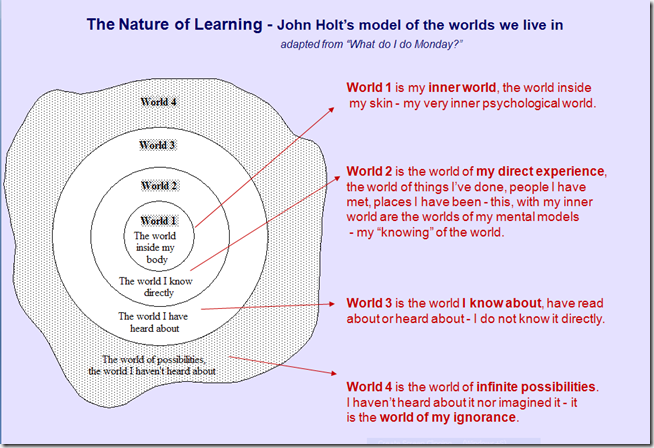
John Holts Model of the worlds we live in - the Nature of Learning:

4 Worlds from our most inner, to the world around us that we have experienced first hand, to the world which we know about but haven't experienced, and then the possible world which is a big unknown.
We develop our own mental models and they don't change until they are confronted.
clip_image001

Julia Atkins "Teaching for Effective Learning" presentation.

Current mental models in education  - 'Teaching as telling & learning as listening' (Yoram Harpez) emphasis on World 3 stuff - knowing about. "Chewing & spewing"
Important to do the experiential learning - need to engage them in developing and knowing.
learning_models 
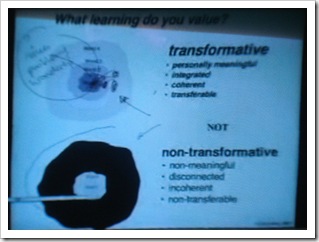
What Learning Do You Value?
In the top model learning starts at the centre and across the worlds, the model below is World 3 learning.

A process to change: Help develop shared mental models of the skills & attributes we want for our students - develop ownership from all - staff, community - use the curriculum document as reference point.
What learning experiences will they need? What are we doing well? What do we need to change? Develop a learning model for your school?

Tuesday, 13 May 2008

Mahi Tahi Talks eTeacher Appraisal

ePrincipals had a great discussion in our VC meeting to discuss developing an appraisal process and standards for eteachers. Chris, an experienced Principal helped guide our thinking and had some great insights. This one is a classic: "A great appraisal system is like great sex. It should be consensual, continuous, mutually satisfactory, and lead to enhanced performance in the future." ;-)
Our discussions centred around appraisal being a process for professional growth and not a compliance exercise. Though we didn't like the idea of using checklists and measurement we did think there is a need to develop aspirational (professional) standards for eteachers. These standards would provide guidelines for setting professional goals, and be supported by self & peer assessment, student feedback & observation.
DSC01471 (Large) DSC01463
Mahi Tahi is the name we have given our group of ePrincipals & mentors. This literally means 'working as one' These pics are of us working together at the MOE offices last term; Connecting with Adobe Connect & chatting to Jodi from Colorado Online School. More Mahi Tahi pics.

Thursday, 20 March 2008

Te Reo Online

Back at Opunake today to spend a PD day with Rangiroa. Our main focus today was the development of his course for putting onto his class website on Interact. We discussed the challenges of teaching his L1 Te Reo class of mixed abilities & ages - year 9 through to 12. There are students who are thinking this is too hard and others way too easy. We talked about how best to meet the needs of Maori students learning at a distance. There is an initiative running in all our cluster schools on raising Maori achievement so what about our maori students who are distance learners? We have talked about organising a VC hui for Maori teachers to discuss these questions. There is some interest from other teachers in the VLN schools but have not found someone with the depth of experience to lead and mentor this group of teachers.
A little googling shows me that there has been some research in this area but in the area of higher education. Maybe some of the answers can be found from the KAWM schools.
If you are or have been a distance learning Maori educator and would like to share your expertise with our teachers please contact me.

Tuesday, 6 February 2007

We Need More of These.....

Holidays?? Yep maybe ;-) No we need more male teachers!!
Is it just NZ? or are we short of men in the classroom everywhere?