Looking for the right person to join our team PLZ RT #eLearning Support position .4FTTE http://t.co/OqpJEBVCRN #virtuallearning #pld #eteach
— VLN Primary School (@VLNPrimary) December 15, 2014

Professional reflections on education in NZ - Dancing on the shifting carpet
Showing posts with label elearning. Show all posts
Showing posts with label elearning. Show all posts
Tuesday, 16 December 2014
VLN Primary School appointing - plz share with your networks


Tuesday, 10 June 2014
Happy Birthday Bardwired - 10 Years Old Today!
Wow what a milestone, I am feeling old today as my baby hits double digits!

To start with it was text only, you had to have some working knowledge of html to make anything else happen. Pictures weren't easy and it was four months before any images appeared on my pages.
Flickr arrived early in 2005 and that was the beginning of my love for Flickr. That was also the time i began to use hyperlinks but it was still awhile until hyperlinks became part of my deliberate writing style. My writing here waned when blogging became a professional requirement for my two other roles with the VLN Primary & VPLD; Twitter & Facebook also took over my attention. As with any pride & joy there are special milestones & highlights - here are a few of mine.
Here are some of my babies milestones:
First podcasts May 2006 - Prensky@School Marc Prensky's keynote from Learning@SchoolFirst video May 2006 on Vimeo - Kidz & Kitez @ Makahu,
First flash animation - Christmas 2006
First friends - Tom & Graham - when i learnt that blogging is about conversations and learning together
First blog post from my phone - moblogging February 2007
First Youtube video embeds TUANZ 2007
First embedded slideshow - Around te Maunga May 2007
First avatar - Meez May 2007
First Panorama - Panoramic Pitt August 2007
First slap on the wrist for this post May 2009
Highlights:

Where Are We Going??????? - 2005 thoughts about GoogleConnecting with others - Edubloggers Offices Photostream
Starting nzedublogs with Jedd
Life changing highlight - getting to know my darling Rick
Time 4 Online Conference
Dead Cats & Laptops - most interesting/gross picture
Helping Bruce update his blog
Connecting with others - 8 random facts meme (great to be reminded of those connections :-)
VLN Primary kicks off at Matapu School
The Future of Education (i just like this post)
Being 'published'
eLearning eBooks (i liked this one too)
N4L consultation early conversations
Tuesday, 12 June 2012
"Future-oriented learning and teaching" report now online
I am sure there will be much to process, think about & discuss in this report. Will download onto my reader so i can take my time to have a good look through.

Supporting future-oriented learning and teaching - a New Zealand perspective
"This research project draws together findings from new data and more than 10 years of research on current practice and futures-thinking in education. The report discusses some emerging principles for future learning, how these are currently expressed in New Zealand educational thinking and practice and what they could look like in future practice.
Author(s): Rachel Bolstad and Jane Gilbert, with Sue McDowall, Ally Bull, Sally Boyd and Rosemary Hipkins [New Zealand Council for Educational Research]"
Supporting future-oriented learning and teaching - a New Zealand perspective
"This research project draws together findings from new data and more than 10 years of research on current practice and futures-thinking in education. The report discusses some emerging principles for future learning, how these are currently expressed in New Zealand educational thinking and practice and what they could look like in future practice.
Author(s): Rachel Bolstad and Jane Gilbert, with Sue McDowall, Ally Bull, Sally Boyd and Rosemary Hipkins [New Zealand Council for Educational Research]"
Monday, 12 December 2011
Network for Learning
Last week the VLN Community met with Marg McLeod, Acting Group Manager, Curriculum Teaching and Learning, and Eddie Reisch from the MOE to discuss the proposed Network for Learning.
‘The Network for Learning, available progressively from 2013, will provide schools with affordable, safe, ultra-fast internet access as well as a range of online content and centrally-procured services.’
It was great to see such a good turn out from the VLN Community, including many Principals from various clusters, to listen to Marg and be involved in discussion and consultation prior to the development of this initiative. As Marg discussed with us, here in NZ we have a more devolved approach to elearning developments compared to many other countries that push things through from the top down and the VLNC has an important role to play as early adopters. So now is the time to make sure you are involved in the consultation process, beginning at Learning@School and following up with regional seminars in 2012.
The following are some notes from Marg’s presentation":
UFB in Schools – Strategic Issues:
- Use of ICT in classroom teaching and learning
- Changing patterns of educational provision
- Formal and informal learning
- Supporting learning networks for professional practice
- Public engagement on education issues
- More informed parents, communities, and then general public
- more equitable access to online learning opportunities
- more effective sharing of resources and knowledge
- reduced ICT complexity and cost
- increased operational efficiencies
- improved connection and collaboration between learners, teachers, school leaders and school communities.
- opportunity to move to more modern learning environments that support 21st Century education delivery
- lift in student achievement through greater engagement driven by innovative approaches to teaching and learning
- Online world now integral to students’ lives
- Increasing evidence that learning in online environments can significantly enhance engagement and lift achievement.
- Particularly effective for students who are underserved by traditional teaching methods
- Potential for increasing collaborative learning opportunities can particularly suit preferred learning styles of many Māori and Pasifika learners
- Providing information and support for schools pre, during and post UFB connection
- Supporting schools in upgrading internal network infrastructure to be ‘UFB-ready’ via SNUP
- Providing hardware and software
- Supporting schools in building e-Learning capability
- Establishing a Network for Learning to optimise the Government’s investment in UFB to improve outcomes for learners
- Ministry currently undertaking trial with 102 schools, using REANNZ’s KAREN network as backbone
- Trial investigating issues and opportunities for schools in accessing online content and services over a dedicated network
- Findings are informing planning for development and implementation of the Network for Learning
- KAREN’s role in the Network for Learning will be determined as part of procurement process
- Progressively available to schools from 2013
- Intention is all schools will be able to join
- Not mandatory – therefore benefits need to be clear and compelling
- Network will be the channel for education content and service delivery
- Major implications for the way the Ministry and other agencies deliver content and services to schools
Tuesday, 4 October 2011
Enabling e-Learning web presence - NOW LIVE
Thanks to Hazel from VPLD to alerting us that the new Enabling eLearning website is now live.

This web presence is the Ministry’s online ‘hub’ for ICT related education resources and programmes in New Zealand. It brings together everything that school leaders and teachers need to develop their the skills, knowledge and confidence in using e-learning.
This web presence consists information, research and resources in the Enabling e-Learning website supported by an online community in the Virtual Learning Network.
This web presence consists information, research and resources in the Enabling e-Learning website supported by an online community in the Virtual Learning Network.
From the Enabling ELearning Team:
"Enabling e-Learning, the Ministry of Education’s new online ‘hub’ for ICT-related education resources and programmes in New Zealand, is now live on TKI.
About Enabling e-learning
Enabling e-Learning, is the Ministry of Education’s online ‘hub’ for ICT-related education resources and programmes in New Zealand, bringing together everything that school leaders and teachers need to improve their e-learning practice. Enabling e-Learning will continually evolve and change in response to feedback from New Zealand schools and communities. We want to hear from you about what you’re doing in the e-learning space, so please visit us regularly and share what works and what doesn’t, and all your news and views.
You can connect with Enabling e-Learning in the following ways:
● Explore our dedicated area on TKI
● Participate in communities of interest on the Virtual Learning Network
● Follow us on Twitter
● Post your comments on our Facebook page
Enabling e-Learning, is the Ministry of Education’s online ‘hub’ for ICT-related education resources and programmes in New Zealand, bringing together everything that school leaders and teachers need to improve their e-learning practice. Enabling e-Learning will continually evolve and change in response to feedback from New Zealand schools and communities. We want to hear from you about what you’re doing in the e-learning space, so please visit us regularly and share what works and what doesn’t, and all your news and views.
You can connect with Enabling e-Learning in the following ways:
● Explore our dedicated area on TKI
● Participate in communities of interest on the Virtual Learning Network
● Follow us on Twitter
● Post your comments on our Facebook page
Friday, 5 August 2011
Talkwheel – just another collaborative tool?

I came across this new tool this morning www.talkwheel.com as i was browsing through my rss feeds. I had just been talking to a colleague about strategies and online tools that would enable our students to interact more with each other in class, instead of just the teacher led discussions and interactions. I know there is no such thing as a silver bullet solution but could this be a tool that our students would be keen to engage in?
To me it looks like an old fashioned threaded forum but attractively packaged to be more visual than simple text flowing down the page. Though with any tool, it depends on the skill of the teacher/facilitator to engage students in learning - we can't and shouldn't rely on the 'gee whiz' factor of online tools alone to hook our kids into learning.
Thursday, 26 May 2011
Hurry in for Adobe Connect Workshops
Adobe Connect is the tool we are using for our VLN Primary real time online classes. If you are interested in learning to use Adobe for online teaching, or professional learning you are welcome to register for these workshops.
Wednesday, 20 April 2011
Changes to PLD for Schools
At the end of 2010, the MoE went through a process of retendering all it’s professional learning development (PLD)contracts for NZ schools. More information can be found about how to access PLD here on the Educational Leaders website.
One of the big changes in the elearning area was a move away from the ICTPD clustering model to a regional model “Blended e-Learning Professional Learning and Development Programme” in addition to this there are other supporting initiatives such as VPLD (Virtual Professional Learning & Development) – which i now have a facilitative role in. You can see an overview of the VPLD programme here. The PLD projects in the elearning area, as well as other areas, are provided by Te Toi Tupu. Check out their website to find more information about Te Toi Tupu and what programmes they are providing.

“Te Toi Tupu - Leading Learning Network consortium (CORE Education, The University of Waikato, Cognition Education, The New Zealand Council for Educational Research and Waikato Tainui) are providers of professional development and professional learning programmes.”
Tuesday, 8 March 2011
VLN Primary Kicking Off for 2011
Taster class
View more presentations from first last
Things are ready to roll with the VLN Primary online classes for 2011. We are starting with confirmed classes this school term of Te Reo, Japanese, French, German & Astronomy. In the wings, to be confirmed and starting from next term will be Spanish, more Japanese & Te Reo classes, Gaelic & Electronics.
It is great to be continuing with a small but solid base of schools who collaborated last year and to welcome a growing number of schools to the VLN Primary community. I have been running Taster Classes the last couple of days (and on request for anyone interested in learning more). We have had quite a number of students from schools as diverse as Thorndon in the heart of Wellington city, to Kaingaroa a school in a lovely and remote Chatham Islands fishing settlement and smalls schools in the hill country of Eastern Taranaki.
Taster classes are designed to familiarise students with the online learning environment and iron out any technical problems schools may encounter when they connect, before they come into our scheduled classes. Students learn about the technology and they also learn how to communicate & interact with others in a way that is quite different from face to face classrooms. These classes allow schools to get an inside look into how online classrooms work before they decide to make a commitment to participate.
One of the students said ‘This is so cool, I can’t wait to start my class!’ Though i responded with a reality hit back to say, ‘Yes i hope you feel like this every week till you complete your class.’ I don’t want students and schools to be instantly hit by the WOW – novelty factor but understand this is an ongoing commitment to learning. Even so, i was also thinking ‘Me too!’ Looking forward to teaching my class on Friday!
Friday, 4 March 2011
Christchurch Schools – Where is the vision?
“Re-locatable classrooms may be put onto sports grounds to house more than 10,000 pupils whose schools are closed”
I continue to be disappointed by the lack of vision our Ministry of Education has in responding to the needs of Christchurch school children – both immediate and long term.
What is this huge preoccupation with bricks & mortar as the necessary foundation of schooling for our children? Why should we be relocating buildings to create overcrowded schools when learning centres can be (and are being) set up within the community? Why should you be encouraging teachers from around the country to offer relief assistance when eteachers around the country are willing and able to take on more students into their classes and provide new classes?
As the Christchurch Council bravely starts to espouse a vision of a very different city rising from the rubble how is a vision being developed for education? Where is the creativity in changing ideas and approaches to meet the learning needs of our students?

Quakeboarding: Photo by Alicia Krueger
The VLN Community is well positioned with the networks, people and expertise to help make a difference now and into the future for so many of these affected students but this requires some higher level thinking on behalf of the MoE and strategic planning and support.
Here is the VLN Community response:
“The VLN Community is working now to increase capacity in all our existing online classes as well as exploring how new classes and online learning support can be put in place to take more of our displaced students. There are a number of teachers who have indicated their willingness to support these students with keeping up with their learning, some who are even willing to do this in their own time. With some increased staffing from the MoE there is quite a pool of experienced eteachers that can come online and offer learning opportunities for these kids. The VLN Community can give professional support for teachers who want to connect with their students online by assisting them with accessing and using online tools available to them through the MoE.”
Friday, 18 February 2011
The Rainforest Connection

Check out Rainforest Connection. An opportunity for your students to connect to experts in the rainforest of Belize. This is only available until the 25th February. Get onto it now if you are interested!
Tuesday, 19 October 2010
Video Conferencing Technology Options
Many of the Secondary elearning clusters online classes are based on Video Conferencing between schools. Much of the VC equipment (in our cluster anyway) is now 8 years old - wow that must be over 100 in human years! It is really important for schools to have in their long term plans and budgets contingencies for the replacement of equipment. The following is an overview and comparison of VC solutions from the simple desktop through to HD VC.
Although VC is not the only way to connect learners online. In some ways i think VC can be a pedagogically unsound way to run classes as it is so easy to replicate the f2f transmission model of learning. Other options for online learning that schools can be looking at are the use of Adobe Connect for real time classes which has more functionality for the interactions of students and the further development and use of Web 2.0 tools and LMS classroom environments with a focus on putting the student at the centre of learning.
Thursday, 14 October 2010
The French Connection

ULearn is a great place for making connections and in a round about way through those connections I have made contact with Pascale.
Merci beaucoup Pascale for profiling learning languages online!
Pascale shares examples of our TaraNet Y9/10 French class and the VLN Primary languages programme.
http://www.french.ac.nz/blog/French+via+Video+Conferencing+/
This is a great website for supporting NZ French teachers.
Monday, 19 July 2010
TaraNet Students Rate their Online Learning

Half or our students think that learning online is just as good as face to face. While the other nearly half think that it is better than Correspondence. A big tick for the VLN :-)
Interesting to note too that one of the biggest challenges our students face with their online learning is the quality of their school internet connection – roll on UFB (ultra fast broadband)!
Thursday, 17 June 2010
eLearning eBooks
I have been looking at a couple of free ebooks about elearning available in the last few days which would be very handy to share with other teachers to guide them in their professional learning. The first couple are recent & Reach is only available as a free download for another couple of days. The others are ones that I have accessed in the past. As i looked up the links for the original downloads I found this presentation from Zaid which showcases more ebooks about elearning.
Amazing FREE eLearning eBooks Collection
View more presentations or Upload your own.

“20 webtools EFL ESL teachers can use to maximize learning.”
Reach available for another couple of days

“Building learning communities and networks online means reaching beyond the walls of your classroom, the walls of your school, and even the walls of your own state, country, or continent to create connections. Once you reach out and make connections with other educators, professional learning like you have never experienced before starts to flow your way. You will soon find yourself in a state of continual learning. Taking advantage of the constant stream of information available today on the web at any given moment and using it for your own professional growth is what it means to learn in today's digital world. It is the ability to connect to the information and people you want to learn from. It is literally having the resource that is the Internet at your fingertips when you need it.”

“This broad reaching collection of essays on e learning examines accomplishments, new directions, and challenges from many perspectives. The essays are arranged in categories, which include e learning and e learners, teaching and instruction, student en-gagement, learning communities, outcomes assessment and institutional leadership, all of which relate to learners and programs from college, K 12, career, to corporate training. Of special interest is a focus on successful outcomes for students and programs, and essays on often overlooked niches of learners, including generational differences (Gamers, Boomers, Gen X, and Gen Y), stay at home mothers, working mother e learners, homeschoolers, bilingual online education and training.”
Facilitating Online a Course Leaders Guide

“Facilitating Online is a course intended for training educators as online facilitators of fully online and mixed mode courses. The Centre for Educational Technology (CET) produced a Course Leader’s Guide as an Open Educational Resource to assist educators and trainers who wish to implement a course on online facilitation within their institution or across several institutions.”
Using Moodle - Teaching with the Popular Open Source Course Management System

The Amazing Web 2.0 Projects Book
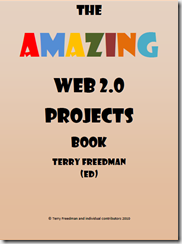
Coming of Age: An introduction to the new world wide web

“A collaborative venture between 14 people from the USA, Canada, Thailand and the UK.
editor Terry Freedman www.ictineducation.org The main objectives of this free publication are first to inspire teachers to want to try some of these "new tools" (web 2.0) for themselves and with their classes, and then to provide practical advice and guidance on how to do so.”
eBooks from The eLearning Guild!
eBooks from The eLearning Guild are guaranteed to put a wealth of information at your fingertips! The Guild has two formats for eBooks. While each eBook is focused on one theme, some are collections of tips we gather from Guild members from around the world, and some are collections of articles from key industry leaders. In either case, you'll find valuable information that you can use in your organization!
Friday, 11 December 2009
TaraNet Top eLearner 2010
 Congratulations to Tama from Waitara High School who was top TaraNet eLearner this year. He is in his second year as an elearning student, this year studying L2 History with Rangiora New Life College in the South Island. Tama loves learning online and is always positive, enthusiastic and hardworking. Congratulations too Tama, Deputy Head Boy next year! :-) He receives a notebook computer from our generous sponsors Gen-i Taranaki.
Friday, 4 December 2009
Central North Island VLNC - Professional Development Days
TaraNet teachers joined with teachers from the Volcanics & CoroNet schools for two days of very focussed professional learning at Stratford High School. There was such a range of experience, from those yet to begin to a few of the first original eteachers. The continuum of confidence & capability in elearning technologies was also very broad from the ‘old school’ not too sure of any of the technology but willing to give it a try, to the very technically savvy. All had something to share and conversations between eteachers was very important to those who spend much of their year in elearning isolation. We had 3 Spanish teachers so there was a lot of conversation happening there, as well as an ebaby, Sonia’s baby Amelia who was very happy for two whole days … thank goodness ;-)
A big thank you to all who contributed to our day – Lynda Walsh-Pasco (OtagoNet), Trevor Storr (AorakiNet), Derek Wenmoth & Jason Reid (SILC). Also to the staff at Stratford High who made the organisation of this day much easier with the allocation of classrooms, technical support and catering.
You can see our programme and resources here.
Wednesday, 16 September 2009
FableForge
Via Stephen Downes:

John adds, in his email, "I see several potential classroom uses:
* Teachers create games to teach concepts, facts, or apply learning from historical readings, practical training, etc.
* Students individually or in groups to demonstrate competence on a concept or a unit by creating a game....rather than a quiz or test.
* Language Arts students could use this to create their own fables, or to show understanding of themes in writing...or even to illustrate plot lines that they create in their writing."
I’m going to try this one out with my C4 kids :-) & knowing them they will go on themselves to make their own games for each other…
Monday, 7 September 2009
eLearning Award 2009

- A big thank you to Gen-i Taranaki for their continued generosity in supporting our TaraNet elearning students. They will be awarding an HP Mini Netbook to this year’s top TaraNet elearner. Being an elearner presents a unique set of challenges that requires special qualities from our students. These qualities are being a great communicator, showing patience, perseverance & flexibility, self management, a positive attitude, a willingness to embrace new technologies and a good work ethic. The criteria for eligibility are: they must be an elearning student from a TaraNet school enrolled in a course through the Virtual Learning Network; show a commitment to their studies (attendance & diligence); be a positive role model for elearning. Schools will be asked to nominate one of their students for this award commenting on how student’s demonstrate that they meet the criteria. Then eteachers are also asked to add their comments & support. Given the level of commitment shown by many of our TaraNet students it’s going to be a really tough choice to make again this year. Last year’s top elearner was Toni from Coastal.


Tuesday, 25 August 2009
Publishing in Print

I guess i have published huge amounts on this blog over the years but there’s something very cool about being published in print. To pick up a magazine or journal, thumb through the pages & see your own work there. Finally after much redrafting & updating, to & fro between the editor, the Journal of Distance Learning is out with a revised version of “Video Conferencing in Distance Learning: A NZ Schools’ Perspective”. Hopefully this will do more to raise the profile of the VLN and the important role it plays now & for the future of our students.
Subscribe to:
Posts (Atom)