Showing posts with label change. Show all posts

Sunday, 30 April 2017

Collaboration - different viewpoints

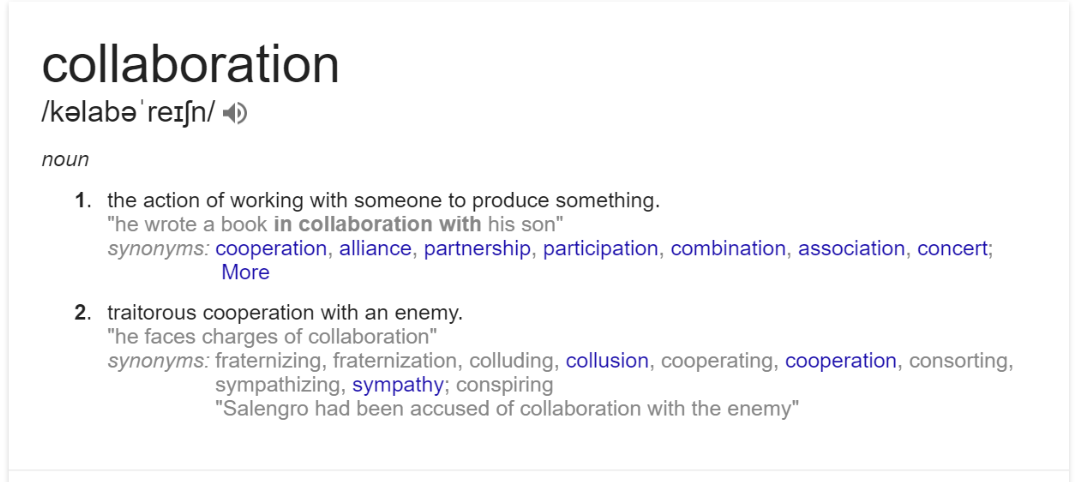
The simple definition of collaboration can be a double-edged sword - working for the collective good or conspiring to change the status quo. This is a reflection of the current education climate where schools are being strongly encouraged and incentivised to form collaborative Communities of Learning. In the educational sector, some look at this from the view of No.1 (image below), and some see No. 2 and are skeptical that collaboration risks undermining their own schools and is a tool of the neo-liberal agenda and school reform. I think they are both right but from the point of view of No. 2, I think we are long overdue for a system change (without the ideological jargon & baggage of  a neoliberal agenda).

To read more about the lead up to Communities of Learning in NZ:
The benefits of collaborative groups particularly for rural principals is recognised:

Iain Taylor - NZPF President 2016
"Collaboration is a practice that professional educators have always incorporated in their practice. It provides the opportunity to share both challenges and solutions and to create solutions where they don’t exist.
Collaborative groups are also great sources of PLD for schools and many share resources which they then agree to channel into a common area for development, whether that is for teachers within schools or for leadership. It has always been a challenge for isolated or rural principals to participate in collaborative groups for PLD, because of the extra travel component.

However, it is perhaps even more important that rural principals are able to connect with each other because they are already isolated with little or no contact with other principals. [my emphasis] The Virtual Learning Network (VLN) has become very popular with isolated schools as they can collaborate at least virtually, even if not in person."

Sunday, 12 March 2017

CoOLs - Communities of Online Learning - A double edged sword?

Tomorrow the report from the Education and Science Select Committee, who are looking at Education (Update) Amendment Bill, is due. There are a raft of changes proposed in this bill, though the part that is most of interest to me is Part 3A - Communities of Online Learning.

With my work at the VLN Primary School, I have been asking for something like CoOLs for a very long time. Here are our VLN Primary Submissions over recent years, they all ask for better resourcing, support and for inclusion of online learning within the mainstream schooling sector:
Why the outrage from parts of the sector that say they have been blind sided by part 3A of the Education Amendment Act bill? That it came out of nowhere, and there has been a clear lack of consultation? Well no, for some that were 'gobsmacked' to hear about it, they just didn't have this on their radar because they aren't taking notice of what is already happening in our schools. It isn't through lack of engagement on my part, I have been trying to get these ideas through to the wider sector for many years, as have some of my colleagues & been frustrated by the sectors lack of interest and support.

I have to support the notion of CoOLs this is what I have been working for most of my professional life towards. So why would I be concerned that CoOLs is going to come back and bite us on the bum!

Because it's not just about the VLN and its not just about CoOLs alone, its about being part of a whole system change, with some contentious neoliberal agendas in the mix.

The VLN Primary School has always been about providing equity and access to our learners where ever they are through online learning; the flip-side some see commercial providers using online learning as a tool to provide cheap online education to the masses.

The VLN Primary School has always been about collaboration across schools and building collective capacity, networks and relationships where all are contributing to the education and well being of our learners; the flip-side the imposition of networks across schools with a focus on standards based learning and accountability of achievement, this may change the unique character or rural education in NZ.

If you want to know more about what has been happening with Virtual Learning in New Zealand, and have some myths about online learning busted, then watch my EdTalks video, screened at ULearn16.

CENZ presents Rachel Whalley from EDtalks on Vimeo.

If you want to read some of the submissions about CoOLs made to the Science & Select Committee you can see them all in their entirety, or you can read notes from some key submissions that I have collated here. This will give you an idea of many of the concerns that are being put forward about CoOLs, some of which I agree with.

Saturday, 16 August 2014

Connected communities: What are the implications for school leadership?

Cross-posted from the NZEALS forum:
"A report by the 21st Century Learning Reference Group entitled Future-focused learning in connected communities (May 2014) refers to evidence suggesting the beneficial impact that collaborating in regional networks and across school communities has on student outcomes.

With this in mind what might principals need to consider in schools’ strategic planning to provide opportunities for school communities to connect and collaborate in ways that are productive and meaningful to staff, students and the wider community?"

I think school leaders need to start developing a collective vision of education that goes beyond their own classroom walls & school gates. Tomorrow's Schools has done a great job of creating a silo system of schools and creating an environment where collaboration is difficult between schools. This post of Derek's is worth a read - we really need school leaders thinking at the top level of Spackman's moral scale and in a schooling system that supports and enables that.

I really like the definition of Learning Communities in the LCO (Learning Communities Online) Handbook :

"-- Learning – this must always be the primary focus of these communities. The emphasis here is on the emerging pedagogical practices that must be explored and adopted in the networked school, and on the outcomes that are sought for learners. This also recognises that teachers are also learners in this system, and that provision must be made for them to access learning opportunities in this way.

* Community – a networked school is more likely to succeed if it acts as part of a collaborative community. The term community here embraces the notions of participation, trust, agreement and purpose. Individual schools may be a part of several communities, and each will be defined differently by its purpose and the roles of those within it. For most it is likely that there will be a primary community, one defined by geography or special character, to which an individual school will belong."

The LCO handbook, although with a focus on online collaborations, is a useful guide to the myriad of considerations communities of schools need to go through from Proposal (Develop a philosopical context; Identify community of interest; Establish purpose; Set goals and principles; Agree on membership; Explore potential funding sources) through to planning, implementation & sustainability. I recommend you take a look, if you haven't already - you can download the whole LCO as a pdf)

The VLN communities of schools (that created this LCO handbook) show that long term sustainable collaboration is possible and it doesn't necessarily have to be geographically based, it can be with other schools with similar learner needs anywhere in NZ. These sorts of successful collaborations need to be seriously considered and supported when looking towards the systems level change that IES will bring the NZ schooling sector.

Tuesday, 10 June 2014

Happy Birthday Bardwired - 10 Years Old Today!

Wow what a milestone, I am feeling old today as my baby hits double digits!

I was introduced to blogging by Richard & his students at Matau School & thought this would be a great way to keep schools in touch with what was going on around the Bardwired ICTPD cluster. Sure beats stuffy reports to Principals' once a month. It has been quite a journey over that time, with many highlights and in the last couple of years quiet patches too. My first post was a very factual account, in fact a list, of what i did at work that day...i think it only got better after that.

To start with it was text only, you had to have some working knowledge of  html to make anything else happen. Pictures weren't easy and it was four months before any images appeared on my pages.

Flickr arrived early in 2005 and that was the beginning of my love for Flickr. That was also the time i began to use hyperlinks but it was still awhile until hyperlinks became part of my deliberate writing style. My writing here waned when blogging became a professional requirement for my two other roles with the VLN Primary & VPLD; Twitter & Facebook also took over my attention. As with any pride & joy there are special milestones & highlights - here are a few of mine.

Here are some of my babies milestones:

First podcasts May 2006 - Prensky@School Marc Prensky's keynote from Learning@School
First video May 2006 on Vimeo - Kidz & Kitez @ Makahu,
First flash animation - Christmas 2006
First friends -  Tom & Graham - when i learnt that blogging is about conversations and learning together
First blog post from my phone - moblogging February 2007
First Youtube video embeds TUANZ 2007
First embedded slideshow - Around te Maunga May 2007
First avatar - Meez May 2007
First Panorama - Panoramic Pitt August 2007
First slap on the wrist for this post May 2009

Highlights:

Where Are We Going??????? - 2005 thoughts about Google
Connecting with others - Edubloggers Offices Photostream
Starting nzedublogs with Jedd
Life changing highlight - getting to know my darling Rick
Time 4 Online Conference
Dead Cats & Laptops - most interesting/gross picture
Helping Bruce update his blog
Connecting with others - 8 random facts meme (great to be reminded of those connections :-)
VLN Primary kicks off at Matapu School
The Future of Education (i just like this post)
Being 'published'
eLearning eBooks (i liked this one too)
N4L consultation  early conversations

Sunday, 8 June 2014

Investing in Educational Success - Systems change in the making.

Investing in Educational Success
Last week this Working Group report was released on the government initiative 'Investing in Educational Success'. All documentation including this report can be found on the Ministry of Education website.

Q & A was held with Graham Stoop on Thursday (advance notice would have been good) Check out the conversation here.

It is certainly encouraging that we are due for some change in our schooling system, the VLN Primary has been asking for system level change that will enable us to work in a sustainable & 'legitimate' way across NZ schools (see our Position paper). The VLN Community have been discussing the need for change going back many years. It is definitely time to move away from the isolating and competitive nature of Tomorrow's Schools and to work more collaboratively across schools. It won't be an easy journey, it will be complex & challenging and one that should be taken with a measured & critical approach.

There is a lot to digest in this report & it's background papers and it is worth looking at in more detail. Some of the points that were raised for me were:
  • Really worthy goals around schools collaborations, and working together to improve student achievement (this is what the VLNP is all about).
  • There seems to be a competing rationale or tension between the development of new professional pathways & rewards for school leaders, raising student achievement and changing the system to structure collaboration. What is the main intended purpose of this strategy? What will be the spin-offs?
  • Specialist positions (& accompanying release time & salaries) seems to be being held out as a carrot and one that the unions are picking up on, with the danger of stepping up the old boys network another level. It is already noted that the PPTA & NZEI have included their separate position statements within the report. 
  • Communities of Schools (CoS) - it is interesting to note this term being used; it is a main descriptor in the VLN Community charter. How will existing collaborations such as the VLN Primary & VLN Community be supported in the new educational landscape? Will they just be swept away with the changes?
  • N4L - has been highlighted as an initiative that would support this change. The N4L has been tasked to create a managed network for schools & also an internet portal Pond. The analogy for me is like asking your school server and website to join your BOT - how does that work? The N4L would need to be developed as a people network such as the VLN groups has become.
    Attribution: http://allthingslearning.wordpress.com/
  • Collaborative action doesn't happen through good intentions alone, it needs to be strategically approached, led and driven in an ongoing way. Working across schools, even the willing and engaged, is still akin to Herding Cats. There will be a lot of facilitation support (PLD) in the early stages of setting up CoSs.
  • 250 CoSs will be created - for some school clusters this will be a no-brainer; for others really challenging. How do you go from competing with the school down the road, to being expected to work really closely with them? One of the successes of the VLN Primary collaboration is that schools have more freedom working outside of their geographic locations, there is less concern about competition between schools. How will this work for schools of different sizes/ demographics/ community needs? How will this work for our rural & remote schools? How can schools participate in more than one community? Where will schools decide where they fit and for some schools will it be like 'choosing sides for basketball'?
I feel very positive about the prospect of meaningful changes to our schooling system that will enable greater collaboration, although I have some reservations about potential design & implementation of a huge undertaking such as this. It is a bold move based on a small local body of knowledge of schools collaborations. I am also wary of the different political levers that surround a restructuring of our system and am concerned schools can have a genuine voice in the process.

Next steps in the process - work streams on Communities of Schools; Professional Standards; Selection, Appointment & Appraisal. (All things that the VLN Community has discussed and developed over the years in our own CoSs).

Join the conversation and make sure your voice is heard #iesnz