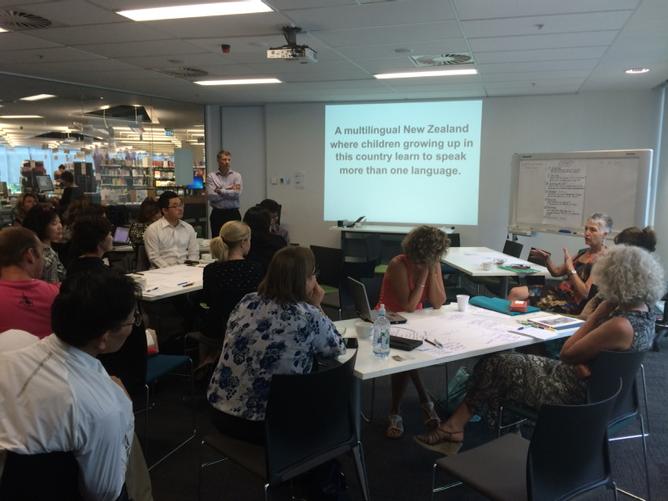
Yesterday i had the privilege of collaborating with a room full of passionate language learning advocates from community groups, schools and supporting organisations. Our main focus was to discuss the challenges and opportunities for schools in developing and sustaining language programmes in schools and how we can provide support and guidance for schools in the ALLiS initiative.
There were many details discussed of how we can collaborate to support successful and sustainable programmes but what has been clear in this meeting and previous ones is
that a national language policy & strategic plan for learning languages is critical to co-ordinate, drive and sustain this work.
It was really interesting to meet Susan Warren and hear about the work
of COMET educational trust and in particular the development of a Languages Strategy for Auckland. It makes a strong case for developing Auckland (
and that should read - New Zealand) as a multi-lingual community and also a strong case for a National Languages policy. Here are some of the points that resonated with me - you can
read the whole document here and there is still an opportunity to
submit a response here within the week.
"Multilingualism
is central to a diverse city: it allows us to value ourselves, build community,
build tolerance, and live peacefully and prosperously.Currently, many Aucklanders miss out on the
cognitive advantages of multilingualism. As a community we miss out on the
potential of younger language learners because we fail to take advantage of the
best windows for language learning and the most effective years for language
maintenance. Auckland’s migrants, especially our older migrants, could receive
much better support for their aspirations to learn communicative English. As a
community we fail to
grasp the cultural and aesthetic benefits of multilingualism, and many
Aucklanders cannot garner the educational attainment that crosses language boundaries
and unifies knowledge in varied domains. One of the
more obvious impacts of the absence of a languages policy in New Zealand is
seen in education. Evidence shows that
quality bilingual or immersion instruction in children’s first or heritage
language brings measurable gains in literacy achievement in the target language
and also in English[1]. However requests to the Ministry of Education
for tailored materials or professional development for bilingual classes are
met with an explanation that there is no policy to enable provision for
learning through languages other than English, te reo Māori and NZ Sign
Language.Most New
Zealanders (93 per cent) agree it is valuable to learn another language.
Language skills and cultural sensitivity are now required for successful
participation and engagement locally, nationally and globally in all spheres of
activity. Auckland is well placed to harness its language potential.In the past,
it has been possible to “get by” in English only. For our young people to
thrive in the future, they will need more options and more experience as
language learners. Because most of the world is multilingual this need will be
felt even more acutely as today’s young Aucklanders spread their wings
globally. Most English-dominant countries today require their young people to have
another language; all of New Zealand’s associates in ASEAN require kids to
learn another language from a young age. New Zealand identifies strongly with
the ethics of team membership: being a team player in the 21st century will
mean being multilingual."
Asia New Zealand,
http://asianz.org.nz/newsroom/media-releases/2014/perceptions-asia-2013