Showing posts with label strategy. Show all posts

Wednesday, 21 January 2015

A Vision Without Action is just a Dream - Learning Languages - A Global Future

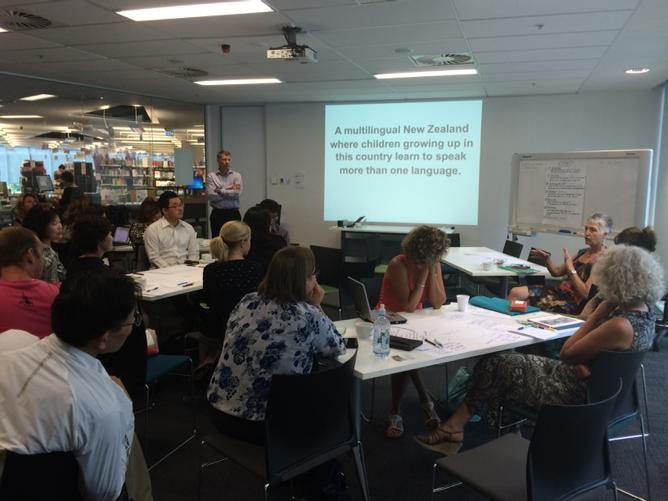
Yesterday i had the privilege of collaborating with a room full of passionate language learning advocates from community groups, schools and supporting organisations. Our main focus was to discuss the challenges and opportunities for schools in developing and sustaining language programmes in schools and how we can provide support and guidance for schools in the ALLiS initiative.

There were many details discussed of how we can collaborate to support successful and sustainable programmes but what has been clear in this meeting and previous ones is that a national language policy & strategic plan for learning languages is critical to co-ordinate, drive and sustain this work. 

It was really interesting to meet Susan Warren and hear about the work of COMET educational trust and in particular the development of a Languages Strategy for Auckland. It makes a strong case for developing Auckland (and that should read - New Zealand) as a multi-lingual community and also a strong case for a National Languages policy. Here are some of the points that resonated with me - you can read the whole document here and there is still an opportunity to submit a response here within the week.

"Multilingualism is central to a diverse city: it allows us to value ourselves, build community, build tolerance, and live peacefully and prosperously.Currently, many Aucklanders miss out on the cognitive advantages of multilingualism. As a community we miss out on the potential of younger language learners because we fail to take advantage of the best windows for language learning and the most effective years for language maintenance. Auckland’s migrants, especially our older migrants, could receive much better support for their aspirations to learn communicative English. As a community we fail to grasp the cultural and aesthetic benefits of multilingualism, and many Aucklanders cannot garner the educational attainment that crosses language boundaries and unifies knowledge in varied domains. One of the more obvious impacts of the absence of a languages policy in New Zealand is seen in education.  Evidence shows that quality bilingual or immersion instruction in children’s first or heritage language brings measurable gains in literacy achievement in the target language and also in English[1].  However requests to the Ministry of Education for tailored materials or professional development for bilingual classes are met with an explanation that there is no policy to enable provision for learning through languages other than English, te reo Māori and NZ Sign Language.Most New Zealanders (93 per cent) agree it is valuable to learn another language[2]. Language skills and cultural sensitivity are now required for successful participation and engagement locally, nationally and globally in all spheres of activity. Auckland is well placed to harness its language potential.In the past, it has been possible to “get by” in English only. For our young people to thrive in the future, they will need more options and more experience as language learners. Because most of the world is multilingual this need will be felt even more acutely as today’s young Aucklanders spread their wings globally. Most English-dominant countries today require their young people to have another language; all of New Zealand’s associates in ASEAN require kids to learn another language from a young age. New Zealand identifies strongly with the ethics of team membership: being a team player in the 21st century will mean being multilingual."


[1] Asia New Zealand, http://asianz.org.nz/newsroom/media-releases/2014/perceptions-asia-2013 

[2] Ministry of Education (2008).  Teaching and learning for bilingual Pasifika students in New Zealand.

Wednesday, 15 October 2014

Promoting Asian Languages


I was recently invited to join discussions with Asia NZ on the future directions of Learning Languages (particularly Asian Languages) in New Zealand. It was very well organised for conversation as we  moved Cafe style around changing groups of participants from across the sector and language and cultural organisations. This engaged us in discussions that teased out key themes and issues that emerged throughout the day. Thanks Jeff for superb facilitation of the day & outgoing AsiaNZ director John McKinnon for an inspiring welcoming speech (you can read the accompanying opinion piece here). The Key Question was: "By 2025, all school students in New Zealand will have the opportunity to learn an Asian language. How do we make this happen?"


Some of the general discussion raised around the room was echoed by many - access to NZ based teachers, the recognition of languages as important, the drop off in students past year 10, competition for resourcing within schools & lack of policy direction. This is not just the case for Asian Languages but these are the same messages coming through on the Languages listservs i belong to as well.

For me the main themes I formed from discussions I had, was the need for a clear strategic direction that should be developed and enacted through the collaboration of all key stakeholders; alongside this is the need to engage with the wider community and to make learning relevant to our students in order to incentivise greater participation. You can read the full overview of the day's discussion collated and shared by Asia New Zealand here.

It is encouraging to know that the government is investing in this area and schools can access funding to support learning Asian languages but at the same time it also a concern that this funding isn't aligned to clear educational strategies. Schools will find it useful to refer to this supporting document from Asian New Zealand that gives guidelines for planning, piloting and sustaining Asian Language learning programmes.

So moving forward from here we look forward to taking these conversations further, building on our collaborative partnerships and developing new ones to support Asian language learning opportunities for our students. Watch this space!

Sunday, 8 June 2014

Investing in Educational Success - Systems change in the making.

Investing in Educational Success
Last week this Working Group report was released on the government initiative 'Investing in Educational Success'. All documentation including this report can be found on the Ministry of Education website.

Q & A was held with Graham Stoop on Thursday (advance notice would have been good) Check out the conversation here.

It is certainly encouraging that we are due for some change in our schooling system, the VLN Primary has been asking for system level change that will enable us to work in a sustainable & 'legitimate' way across NZ schools (see our Position paper). The VLN Community have been discussing the need for change going back many years. It is definitely time to move away from the isolating and competitive nature of Tomorrow's Schools and to work more collaboratively across schools. It won't be an easy journey, it will be complex & challenging and one that should be taken with a measured & critical approach.

There is a lot to digest in this report & it's background papers and it is worth looking at in more detail. Some of the points that were raised for me were:
  • Really worthy goals around schools collaborations, and working together to improve student achievement (this is what the VLNP is all about).
  • There seems to be a competing rationale or tension between the development of new professional pathways & rewards for school leaders, raising student achievement and changing the system to structure collaboration. What is the main intended purpose of this strategy? What will be the spin-offs?
  • Specialist positions (& accompanying release time & salaries) seems to be being held out as a carrot and one that the unions are picking up on, with the danger of stepping up the old boys network another level. It is already noted that the PPTA & NZEI have included their separate position statements within the report. 
  • Communities of Schools (CoS) - it is interesting to note this term being used; it is a main descriptor in the VLN Community charter. How will existing collaborations such as the VLN Primary & VLN Community be supported in the new educational landscape? Will they just be swept away with the changes?
  • N4L - has been highlighted as an initiative that would support this change. The N4L has been tasked to create a managed network for schools & also an internet portal Pond. The analogy for me is like asking your school server and website to join your BOT - how does that work? The N4L would need to be developed as a people network such as the VLN groups has become.
    Attribution: http://allthingslearning.wordpress.com/
  • Collaborative action doesn't happen through good intentions alone, it needs to be strategically approached, led and driven in an ongoing way. Working across schools, even the willing and engaged, is still akin to Herding Cats. There will be a lot of facilitation support (PLD) in the early stages of setting up CoSs.
  • 250 CoSs will be created - for some school clusters this will be a no-brainer; for others really challenging. How do you go from competing with the school down the road, to being expected to work really closely with them? One of the successes of the VLN Primary collaboration is that schools have more freedom working outside of their geographic locations, there is less concern about competition between schools. How will this work for schools of different sizes/ demographics/ community needs? How will this work for our rural & remote schools? How can schools participate in more than one community? Where will schools decide where they fit and for some schools will it be like 'choosing sides for basketball'?
I feel very positive about the prospect of meaningful changes to our schooling system that will enable greater collaboration, although I have some reservations about potential design & implementation of a huge undertaking such as this. It is a bold move based on a small local body of knowledge of schools collaborations. I am also wary of the different political levers that surround a restructuring of our system and am concerned schools can have a genuine voice in the process.

Next steps in the process - work streams on Communities of Schools; Professional Standards; Selection, Appointment & Appraisal. (All things that the VLN Community has discussed and developed over the years in our own CoSs).

Join the conversation and make sure your voice is heard #iesnz