In April I was quoted extensively in this article by Education Review on the VLN Primary & CoOLs. I discussed issues of sustainable resourcing, privatisation, competition & accountability. This article stemmed from a discussion with Jude Barback (Ed Review) ahead of the release of the Education & Science Select Committee report on the Education (Update) Amendment Bill. The report was released quietly with no comment from the media (except for the PPTA) and hugely overshadowed by the simultaneous release of another pivotal education review report the Productivity Commission report on 'New models of tertiary education.' The cynic in me would wonder if these two landmark educational policy reports were deliberately released to dilute the comment and feedback. So much to read, so much to process!
So what was in the Education & Science Select Committee report in relation to CoOLs? Well not much. There was very little of substance that has been amended from the original proposed bill apart from the extended timeline and the amalgamation of the section on provisional accredited cools into the main section on Cools. So really no surprises, this report reflects the majority view.
The concerns noted by the minor parties are also echoed in parts of our submission to the committee and it is good to see they pay particular credence to submissions from Dr Michael Barbour (Michael is on our Governance group). You can read the full report here.
Since the report was released there have been a couple of Q & A reports and a Departmental report. The Departmental report is a summary of key points raised in the submissions - 40 pages on CoOLs. Q & A's I have summarised the parts on CoOLs in this document.

Professional reflections on education in NZ - Dancing on the shifting carpet
Showing posts with label policy. Show all posts
Showing posts with label policy. Show all posts
Sunday, 7 May 2017


Tuesday, 28 March 2017
NZ Research & Articles - Online Teaching & Learning
As part of my literature review I am collating as much of the NZ written/NZ based literature on online/virtual learning as I can find. Much of this I have read, and some I have contributed to, been a participant in, or even written myself. Some of it is before my time, but I believe our whakapapa and learning journey contributes to where we are today, and where we will go tomorrow. I also see that what was relevant in a report for example on Telelearning in the early 90s, is still relevant today and is really a case of 'the more things change the more they stay the same.' Two decades and more down the track virtual/online learning is still on the fringes (and often not even a blip on the radar) of mainstream learning. However this may start to change as policy catches up with practice (see recent post on CoOLs).
Although technology brings us closer together (it is only 2 years ago that we were able to turn cameras on in our VLN Primary classrooms!), we are still challenged by many of the same things online teachers were in the 90s. The need for schools to be open and collaborative, the professional learning needed by teachers (& students) to become more digitally fluent, the need to change teacher pedagogies to be more student directed; there are many more similar themes running through the literature some of which I will unpick more of over the coming months.
I use Zotero and have a group with shared bookmarks - genuine contributors welcome to join here. In this post I will share some key resources and include abstracts. There are many more in this Zotero folder & I am sure many new readings to discover.
Monday, 13 March 2017
Review of education funding systems - Threat or opportunity for NZ Rural Schools?
Following on from an earlier post about Rural NZ - A great place to live and learn, here is some context of what is happening in the educational landscape at the moment.
We are currently going through the process of legislative change and a funding review that will have the biggest impact on NZ schools since 1989 and the introduction of Tomorrow's Schools. For more on Tomorrow's Schools see Langley, 2009; Wylie, 2013.
The Education (Update) Amendment Bill proposes a range of changes, of particular relevance to my study is Communities of Online Learning (or CoOLs), which has been the most contested and provocative part of the bill. I write about this in another post.
The Education Funding System Review, that sits alongside the proposed legislative changes, has been in the consultation phase since last year (I recommend that you read the Cabinet Paper that sits behind what is on the MoE website) There has been one change of tack to the original proposal when teacher unions pushed back on Global Funding mechanism - this was seen as another way of bulk funding schools that was so strenuously opposed in the early 2000s. The reasons given for not proceeding with the global budget was
Defining small and isolated services and schools
I can understand the need to simplify a complicated system, I can understand the benefits of network provision across schools, I can see a need for equity across our schooling system, I believe to move forward we need to make changes, and change is challenging. However lets make sure that we do this while retaining what is special about our small rural schools, and not just focusing solely on 'progress that can be measured at each level of the curriculum'.
Langley, J., & Cognition Institute. (2009). Tomorrow’s schools 20 years on-. Auckland, N.Z.: Cognition Institute. Retrieved from http://www.cognitioneducationtrust.org/wp-content/uploads/2013/09/report_cognition_institute_john_langley_ed.pdf
Wylie, C. (2013). Tomorrow’s schools after 20 years: can a system of self-managing schools live up to its initial aims? The New Zealand Annual Review of Education, 0(19). Retrieved from https://ojs.victoria.ac.nz/nzaroe/article/view/1555
We are currently going through the process of legislative change and a funding review that will have the biggest impact on NZ schools since 1989 and the introduction of Tomorrow's Schools. For more on Tomorrow's Schools see Langley, 2009; Wylie, 2013.
The Education (Update) Amendment Bill proposes a range of changes, of particular relevance to my study is Communities of Online Learning (or CoOLs), which has been the most contested and provocative part of the bill. I write about this in another post.
The Education Funding System Review, that sits alongside the proposed legislative changes, has been in the consultation phase since last year (I recommend that you read the Cabinet Paper that sits behind what is on the MoE website) There has been one change of tack to the original proposal when teacher unions pushed back on Global Funding mechanism - this was seen as another way of bulk funding schools that was so strenuously opposed in the early 2000s. The reasons given for not proceeding with the global budget was
"schools indicated that the current system of funding delivery generally works well and can provide the flexibility required"..."Moreover, it is clear that neither principals nor teachers yet have confidence in governance and management to make good choices about the mix of inputs necessary to meet the educational challenge for their students."That last phrase is dynamite and should be of concern if the Minister thinks that after more that 20 years of self governance school leaders lack the skills to make good choices. Without going further into the politics of the discussion in this paper - here are the key points in relation to small and rural schools:
The Proposed Model of Funding
26.1 a core funding model in both early learning and state and state integrated schools made up of two components:
26.1.1 a curriculum-based per-child funding amount - linked to the learning expectations of children and young people at each stage of the curricula. In early learning, this involves moving to per-child funding. In schooling, this involves a review of funding levels at each stage of the curriculum;
26.1.2 additional funding for individual challenges:
26.1.2.1 targeted additional achievement allocation - for children and young people from disadvantaged backgrounds and to replace the current decile system and better align funding to the actual curriculum-based achievement challenge;
26.1.2.2 learning support (special education) allocation - for those learning support needs that services and schools are expected to meet from within their funding;
26.2 for small and isolated early learning services and state and state integrated schools, supplementary funding to enable the maintenance of a network of provision;Of importance to rural and small schools is section 70 - 73:
Defining small and isolated services and schools
70 To support education provision being located as close as reasonably possible to families, I propose supplementary funding for small and isolated services and schools. This takes into account population densities in rural and provincial areas and our objectives for choice and diversity in education provision, including for Maori medium education.
71 Small schools face fixed costs in administration and curriculum delivery, including in providing subject choice at the senior secondary level. Isolated services and schools can face extra costs related to both teaching and learning and accessing trades and services. These services and schools would not be educationally viable if they received only the curriculum based per-child funding amount and the additional funding amount for individual challenges.
72 I am seeking to develop an approach to these services and schools that provides the minimal additional funding necessary, supports our objective of increased collaboration across and system, and takes into account the potential over time for Communities of
Learning I Kahui Ako and for Communities of Online Learning to mitigate some of the costs in the operation of small schools, including those associated with providing curriculum breadth.
73 The first stage of this work involves establishing a coherent basis for defining small and isolated services and schools. The second stage of this work involves determining the extra costs that these services and schools face in maintaining a viable provision and, hence, the funding that they require over and above that provided by the core funding model. There is a close relationship between this work and that related to the per-student funding amount.
I can understand the need to simplify a complicated system, I can understand the benefits of network provision across schools, I can see a need for equity across our schooling system, I believe to move forward we need to make changes, and change is challenging. However lets make sure that we do this while retaining what is special about our small rural schools, and not just focusing solely on 'progress that can be measured at each level of the curriculum'.
If you are a supporter of our small rural schools, I would be watching this review process carefully, talking with Principals in your local schools and advocating on their behalf.
Langley, J., & Cognition Institute. (2009). Tomorrow’s schools 20 years on-. Auckland, N.Z.: Cognition Institute. Retrieved from http://www.cognitioneducationtrust.org/wp-content/uploads/2013/09/report_cognition_institute_john_langley_ed.pdf
Wylie, C. (2013). Tomorrow’s schools after 20 years: can a system of self-managing schools live up to its initial aims? The New Zealand Annual Review of Education, 0(19). Retrieved from https://ojs.victoria.ac.nz/nzaroe/article/view/1555
Tuesday, 21 July 2015
The Joint Initiative - A Better Plan

Today the NZEI released details of the Joint Initiative - a plan forward with the MoE instead of the IES that was rejected by the NZEI collective.
Communities of Learning instead of Communities of Schools
The aim of this initiative is to give more emphasis on collaboratively improving students achievement outcomes and less on the roles and admin of a system change that was being proposed through IES.
Is it just the same thing but dressed up differently using different eduspeak? I am sure members will be discussing that as they meet to vote on this over the coming few weeks.
Louise Green, NZEI President, tells members, "We believe the new model is an exciting educational development, genuinely shaped by educators. Inevitably, as with any negotiations, we have had to make compromises, but we are confident that the progress we have made will genuinely improve teaching and learning."
Key Learnings from the Working Group were summarised as:
- Communities of Learning should self-identify with clear pathways across the sector;
- Their clear purpose is to improve educational achievement aligned with NZC, though they can define their areas of focus;
- Data, evidence & research is used to target efforts;
- Each Community should determine its own leadership, teaching, collaboration and support functions:
- Some roles will be required for all and these will be appointed in conjunction with an external professional advisor;
- Be flexible and prepared for change over time;
- Each Community will assess it's own resource needs;
- 'Whole of Community of Learning collaboration" is critical to success;
- Commit to second stage - further work on priority areas - Māori, Pasifika, ECE, Support Staff, Special Ed, PLD;
- Community roles will align with career pathways.
So what will this look like when we come to implement such a plan?
How flexible will this plan be?
How will this work for the rural and isolated school, will they be able to develop CoL that are geographically distributed?
How flexible will this plan be?
How will this work for the rural and isolated school, will they be able to develop CoL that are geographically distributed?
How do schools select their Community that has clear pathways when the pathways for many of our students are so diverse?
Where will be the tension between roles determined by the Community and roles required by the MoE - and how will resources be distributed between them?
One positive that were raised for me was that there was recognition of the roles across schools as well as within schools - this may provide some support for the role I have occupied across schools for years with no formal recognition, support or career pathway.
Another point to flag in this plan was the inclusion of Professional Learning and Support as an explicit feature to be worked towards in the second stage of the Joint Initiative. We have been waiting for some time as to the outcome of the Professional Learning & Development Review, so this may be the basket it is ending up in.
So still a work in progress, and a space i am watching closely with the hope that the 'Policy Parameters' of this plan are flexible enough to include the work of the VLN Primary School.
Monday, 20 July 2015
A Call to Action - Equity, access, quality and teachers in the digital age
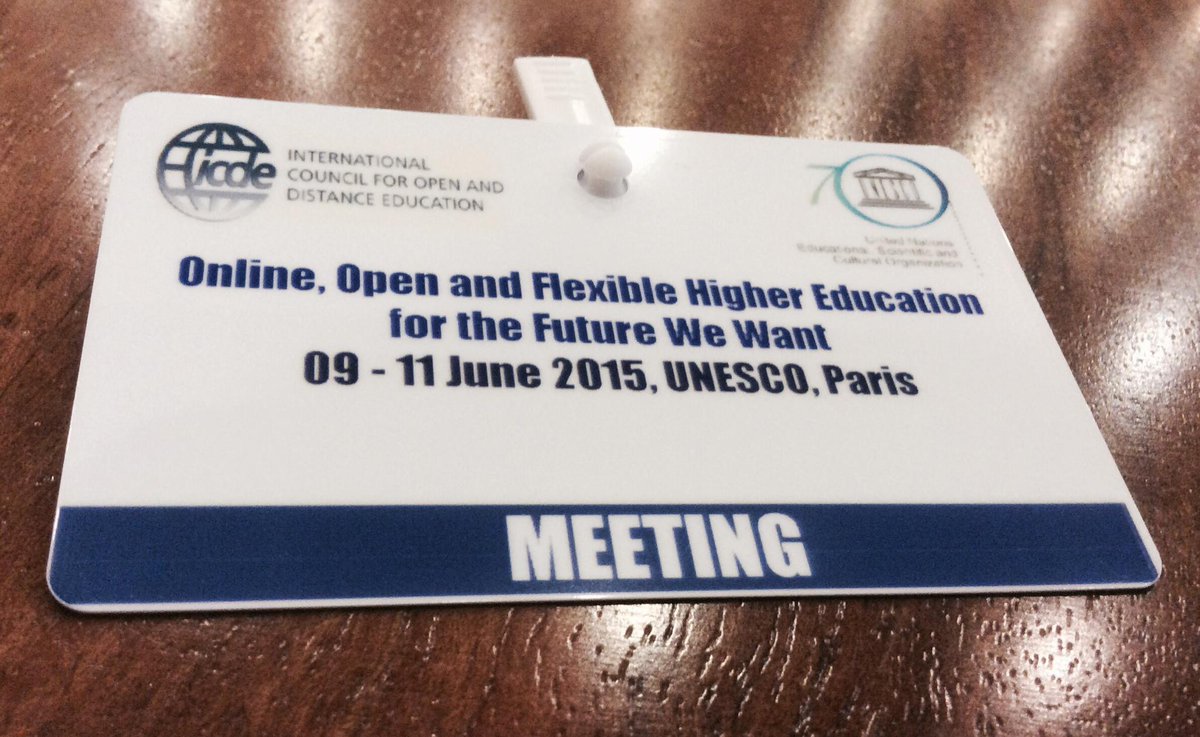 The ICDE (International Council for Distance Education) met in Paris recently for a Global Policy Forum. The aim of the forum was to build on previous work such as recently in Bali and to ensure equity, access and quality learning outcomes. This was framed with some urgency around the area of higher education with the prediction that in the next 15 years there will be a huge increase in the number of students seeking access to a quality education.
They are asking all governments, educational institutions, teachers and students, to jointly address the needs as outlined in the Paris Message (recommend you read this 3 page document) Key messages are around recognizing the importance of online, open and flexible learning to contribute to the quality & provision of education; the development of effective policy & regulation based on principles of equity; and that funding is critical to the initiation and sustainability of elearning initiatives.
These are all messages that resonate strongly with my work with the VLN Primary School. Through open, flexible, online & collaborative learning (I added the last qualifier) we have the potential to unlock the gates to so many learning opportunities for our students. This is not just for higher education, but across the sector and community. Government and the educational sector are just starting to 'get it' in terms of understanding the contribution online networked learning can make and are still way behind in resourcing and supporting initiatives such as ours. A good part of my time is spent advocating, and applying for different funding streams because we as yet don't fit into any government 'policy parameters' of which there are a host beginning to be aimed at schools collaborating. This is quite a frustration as what we really should be doing is spending our very little time that we do have working with schools, teacher and students.
Image attribution: https://twitter.com/JGlapaGrossklag/status/608193506444722176
Wednesday, 21 January 2015
A Vision Without Action is just a Dream - Learning Languages - A Global Future
Yesterday i had the privilege of collaborating with a room full of passionate language learning advocates from community groups, schools and supporting organisations. Our main focus was to discuss the challenges and opportunities for schools in developing and sustaining language programmes in schools and how we can provide support and guidance for schools in the ALLiS initiative.
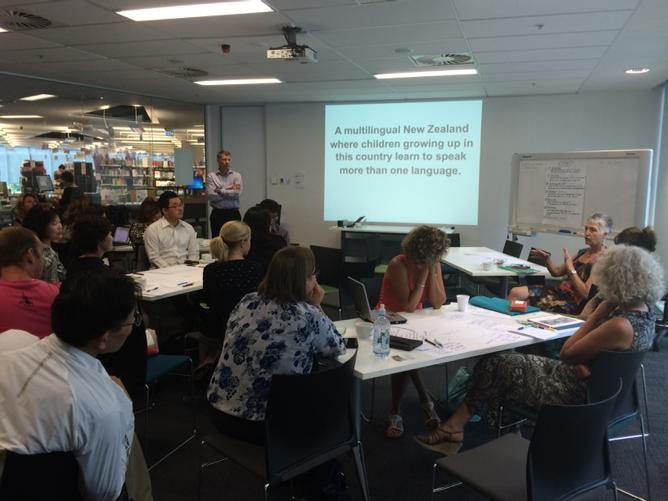
There were many details discussed of how we can collaborate to support successful and sustainable programmes but what has been clear in this meeting and previous ones is that a national language policy & strategic plan for learning languages is critical to co-ordinate, drive and sustain this work.
It was really interesting to meet Susan Warren and hear about the work of COMET educational trust and in particular the development of a Languages Strategy for Auckland. It makes a strong case for developing Auckland (and that should read - New Zealand) as a multi-lingual community and also a strong case for a National Languages policy. Here are some of the points that resonated with me - you can read the whole document here and there is still an opportunity to submit a response here within the week.
"Multilingualism is central to a diverse city: it allows us to value ourselves, build community, build tolerance, and live peacefully and prosperously.Currently, many Aucklanders miss out on the cognitive advantages of multilingualism. As a community we miss out on the potential of younger language learners because we fail to take advantage of the best windows for language learning and the most effective years for language maintenance. Auckland’s migrants, especially our older migrants, could receive much better support for their aspirations to learn communicative English. As a community we fail to grasp the cultural and aesthetic benefits of multilingualism, and many Aucklanders cannot garner the educational attainment that crosses language boundaries and unifies knowledge in varied domains. One of the more obvious impacts of the absence of a languages policy in New Zealand is seen in education. Evidence shows that quality bilingual or immersion instruction in children’s first or heritage language brings measurable gains in literacy achievement in the target language and also in English[1]. However requests to the Ministry of Education for tailored materials or professional development for bilingual classes are met with an explanation that there is no policy to enable provision for learning through languages other than English, te reo Māori and NZ Sign Language.Most New Zealanders (93 per cent) agree it is valuable to learn another language[2]. Language skills and cultural sensitivity are now required for successful participation and engagement locally, nationally and globally in all spheres of activity. Auckland is well placed to harness its language potential.In the past, it has been possible to “get by” in English only. For our young people to thrive in the future, they will need more options and more experience as language learners. Because most of the world is multilingual this need will be felt even more acutely as today’s young Aucklanders spread their wings globally. Most English-dominant countries today require their young people to have another language; all of New Zealand’s associates in ASEAN require kids to learn another language from a young age. New Zealand identifies strongly with the ethics of team membership: being a team player in the 21st century will mean being multilingual."
[2] Ministry of Education (2008). Teaching and learning for bilingual Pasifika students in New Zealand.
Thursday, 8 January 2015
Call to action for Governments & Policymakers - support Open, Online & Flexible Learning.
"Access to, and success in, open, online and flexible learning are key solutions to the pressing development challenges and needs of 21st century societies, emphasizes the November 2014 Bali message by ICDE’s higher education leaders.
Recommendations from a recent summit in Bali called on ICDE and UNESCO to continue their efforts to support and encourage governments to:
- Create favorable frameworks for opening up education – making education at all levels available to all through open, online, flexible, blended and distance education.
- Stimulate the use of Open Educational Resources (OER) – publicly funded educational resources licensed to make materials needed for learners freely available to all.
- Enable learner mobility through the development of transnational qualification frameworks, which make the recognition and transfer of qualifications, course credits and learning within and between jurisdictions part of the fabric of an open, global education system.
- Encourage the adoption of quality standards, guidelines and benchmarks for open, online and distance learning to be mainstreamed into quality frameworks and protocols.
- Foster innovation in the form of new approaches to the assessment of learning outcomes, prior learning and work-based learning; new approaches to instruction, which both increase learner engagement and learning outcomes; and new ways of collaborating and connecting to learners and higher rates of student success.
- Invest in research focused on best practices in the design, development, deployment and delivery of open, online, distance and flexible education; the use of open educational resources; the mobility of learners; new business models for the operation of educational institutions; and new models of public assurance and accountability."

More detail from the Bali UNESCO Policy Forum here.
Sunday, 8 June 2014
Investing in Educational Success - Systems change in the making.

Last week this Working Group report was released on the government initiative 'Investing in Educational Success'. All documentation including this report can be found on the Ministry of Education website.
Q & A was held with Graham Stoop on Thursday (advance notice would have been good) Check out the conversation here.
It is certainly encouraging that we are due for some change in our schooling system, the VLN Primary has been asking for system level change that will enable us to work in a sustainable & 'legitimate' way across NZ schools (see our Position paper). The VLN Community have been discussing the need for change going back many years. It is definitely time to move away from the isolating and competitive nature of Tomorrow's Schools and to work more collaboratively across schools. It won't be an easy journey, it will be complex & challenging and one that should be taken with a measured & critical approach.
There is a lot to digest in this report & it's background papers and it is worth looking at in more detail. Some of the points that were raised for me were:
- Really worthy goals around schools collaborations, and working together to improve student achievement (this is what the VLNP is all about).
- There seems to be a competing rationale or tension between the development of new professional pathways & rewards for school leaders, raising student achievement and changing the system to structure collaboration. What is the main intended purpose of this strategy? What will be the spin-offs?
- Specialist positions (& accompanying release time & salaries) seems to be being held out as a carrot and one that the unions are picking up on, with the danger of stepping up the old boys network another level. It is already noted that the PPTA & NZEI have included their separate position statements within the report.
- Communities of Schools (CoS) - it is interesting to note this term being used; it is a main descriptor in the VLN Community charter. How will existing collaborations such as the VLN Primary & VLN Community be supported in the new educational landscape? Will they just be swept away with the changes?
- N4L - has been highlighted as an initiative that would support this change. The N4L has been tasked to create a managed network for schools & also an internet portal Pond. The analogy for me is like asking your school server and website to join your BOT - how does that work? The N4L would need to be developed as a people network such as the VLN groups has become.
- Collaborative action doesn't happen through good intentions alone, it needs to be strategically approached, led and driven in an ongoing way. Working across schools, even the willing and engaged, is still akin to Herding Cats. There will be a lot of facilitation support (PLD) in the early stages of setting up CoSs.
- 250 CoSs will be created - for some school clusters this will be a no-brainer; for others really challenging. How do you go from competing with the school down the road, to being expected to work really closely with them? One of the successes of the VLN Primary collaboration is that schools have more freedom working outside of their geographic locations, there is less concern about competition between schools. How will this work for schools of different sizes/ demographics/ community needs? How will this work for our rural & remote schools? How can schools participate in more than one community? Where will schools decide where they fit and for some schools will it be like 'choosing sides for basketball'?
 |
| Attribution: http://allthingslearning.wordpress.com/ |
I feel very positive about the prospect of meaningful changes to our schooling system that will enable greater collaboration, although I have some reservations about potential design & implementation of a huge undertaking such as this. It is a bold move based on a small local body of knowledge of schools collaborations. I am also wary of the different political levers that surround a restructuring of our system and am concerned schools can have a genuine voice in the process.
Next steps in the process - work streams on Communities of Schools; Professional Standards; Selection, Appointment & Appraisal. (All things that the VLN Community has discussed and developed over the years in our own CoSs).
Join the conversation and make sure your voice is heard #iesnz
Subscribe to:
Posts (Atom)