Showing posts with label ies. Show all posts

Sunday, 30 April 2017

Collaboration - different viewpoints

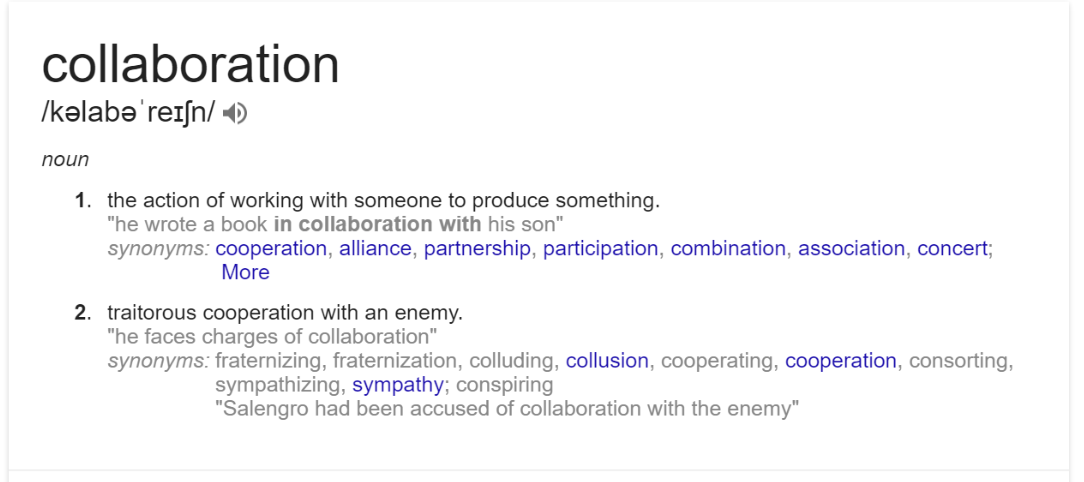
The simple definition of collaboration can be a double-edged sword - working for the collective good or conspiring to change the status quo. This is a reflection of the current education climate where schools are being strongly encouraged and incentivised to form collaborative Communities of Learning. In the educational sector, some look at this from the view of No.1 (image below), and some see No. 2 and are skeptical that collaboration risks undermining their own schools and is a tool of the neo-liberal agenda and school reform. I think they are both right but from the point of view of No. 2, I think we are long overdue for a system change (without the ideological jargon & baggage of  a neoliberal agenda).

To read more about the lead up to Communities of Learning in NZ:
The benefits of collaborative groups particularly for rural principals is recognised:

Iain Taylor - NZPF President 2016
"Collaboration is a practice that professional educators have always incorporated in their practice. It provides the opportunity to share both challenges and solutions and to create solutions where they don’t exist.
Collaborative groups are also great sources of PLD for schools and many share resources which they then agree to channel into a common area for development, whether that is for teachers within schools or for leadership. It has always been a challenge for isolated or rural principals to participate in collaborative groups for PLD, because of the extra travel component.

However, it is perhaps even more important that rural principals are able to connect with each other because they are already isolated with little or no contact with other principals. [my emphasis] The Virtual Learning Network (VLN) has become very popular with isolated schools as they can collaborate at least virtually, even if not in person."

Saturday, 16 August 2014

Connected communities: What are the implications for school leadership?

Cross-posted from the NZEALS forum:
"A report by the 21st Century Learning Reference Group entitled Future-focused learning in connected communities (May 2014) refers to evidence suggesting the beneficial impact that collaborating in regional networks and across school communities has on student outcomes.

With this in mind what might principals need to consider in schools’ strategic planning to provide opportunities for school communities to connect and collaborate in ways that are productive and meaningful to staff, students and the wider community?"

I think school leaders need to start developing a collective vision of education that goes beyond their own classroom walls & school gates. Tomorrow's Schools has done a great job of creating a silo system of schools and creating an environment where collaboration is difficult between schools. This post of Derek's is worth a read - we really need school leaders thinking at the top level of Spackman's moral scale and in a schooling system that supports and enables that.

I really like the definition of Learning Communities in the LCO (Learning Communities Online) Handbook :

"-- Learning – this must always be the primary focus of these communities. The emphasis here is on the emerging pedagogical practices that must be explored and adopted in the networked school, and on the outcomes that are sought for learners. This also recognises that teachers are also learners in this system, and that provision must be made for them to access learning opportunities in this way.

* Community – a networked school is more likely to succeed if it acts as part of a collaborative community. The term community here embraces the notions of participation, trust, agreement and purpose. Individual schools may be a part of several communities, and each will be defined differently by its purpose and the roles of those within it. For most it is likely that there will be a primary community, one defined by geography or special character, to which an individual school will belong."

The LCO handbook, although with a focus on online collaborations, is a useful guide to the myriad of considerations communities of schools need to go through from Proposal (Develop a philosopical context; Identify community of interest; Establish purpose; Set goals and principles; Agree on membership; Explore potential funding sources) through to planning, implementation & sustainability. I recommend you take a look, if you haven't already - you can download the whole LCO as a pdf)

The VLN communities of schools (that created this LCO handbook) show that long term sustainable collaboration is possible and it doesn't necessarily have to be geographically based, it can be with other schools with similar learner needs anywhere in NZ. These sorts of successful collaborations need to be seriously considered and supported when looking towards the systems level change that IES will bring the NZ schooling sector.