Showing posts with label schooling. Show all posts

Tuesday, 2 May 2017

Effective networks = Collaboration

Collaboration is a key theme in my research question and in my reading I have found it is closely linked and underpins effective school networks. Santiago & Fullan (2016) equate effective networks with collaboration that deepens learning, grows professional capital and is a positive driver for system improvement.
They say that on its own mandated collaboration (top-down) nor grass roots (bottom-up) collaborations will work. Effective school networks need both approaches. 
In the NZ setting you can see CoLs (Communities of Learning) as being driven from the top down; although necessary as they provide the resources, structure and support necessary to sustain long term collaboration. Offset this with grass roots collaborations that have been happening for many years - ICT PD clusters, VLN communities, LCN networks & many more. These have been where the heart of collaborative practice and communities of learning have grown in NZ but have been unsustainable because they have lacked the ongoing systems resources and support.

Dr. Cherie Patel-Taylor
Patel-Taylor (2014) supports this view distinguishing between systems collaboration and a culture of collaboration. 
Systems collaborations are more technical in nature - structures, roles, resourcing - they are necessary but not enough on their own. A culture of collaboration takes place in the the learning spaces within and across classrooms and schools, and involves a focus on sharing practice, co-constructing new learning and evolving cycles of inquiry.  Patel-Taylor (2014) defines collaboration as “the process of sharing learning and engaging in dialogue, to create joint new learning that informs future actions focused on the learning of leaders, teachers, students and/or the wider community, over time” (p 8).

School leaders need to be just as concerned for students in all schools as they are in their own schools - this is indicative of a higher moral purpose and 'Systemness' where people deliberately contribute to and benefit from the larger system (Santiago & Fullan 2016). It can be illustrated as well in this adaptation of Spackman's Model:
Derek Wenmoth - adaption of Spackman’s Moral Scale of decision making

  8 features of effective networks

  1. "focussing on ambitious student learning outcomes linked to effective pedagogy;
  2. developing strong relationships of trust and internal accountability;
  3. continuously improving practice and systems through cycles of collaborative inquiry;
  4. using deliberate leadership and skilled facilitation within flat power structures;
  5. frequently interacting and learning inwards;
  6. connecting outwards to learn from others;
  7. forming new partnership among students, teachers, families, and communities;
  8. and securing adequate resources to sustain the work."
    (Santiago & Fullan, 2016, p 10)
Essential features of effective networks in education - Santiago & Fullan 2016
What features do you recognise in your schools cluster, CoL or network? Where are the missing pieces that would make your network more effective and sustainable? Read Santiago & Fullan's work linked below for a really good overview of this.

Santiago Rincón-Gallardo, & Michael Fullan. (2016). Essential features of effective networks in education. Journal of Professional Capital and Community, 1(1), 5–22. https://doi.org/10.1108/JPCC-09-2015-0007
Taylor-Patel, C. (2014). Networking – Weaving the net; gathering the pearls. Auckland, N.Z. Retrieved from http://appa.org.nz/wp-content/uploads/2014/11/Cherie-Taylor-Patel.pdf
Wenmoth, D. (2013, February 16). Change or Die: vision, trust and support. Retrieved 30 April 2017, from http://blog.core-ed.org/derek/2013/02/change-or-die-vision-trust-and-support.html

Sunday, 30 April 2017

Collaboration - different viewpoints

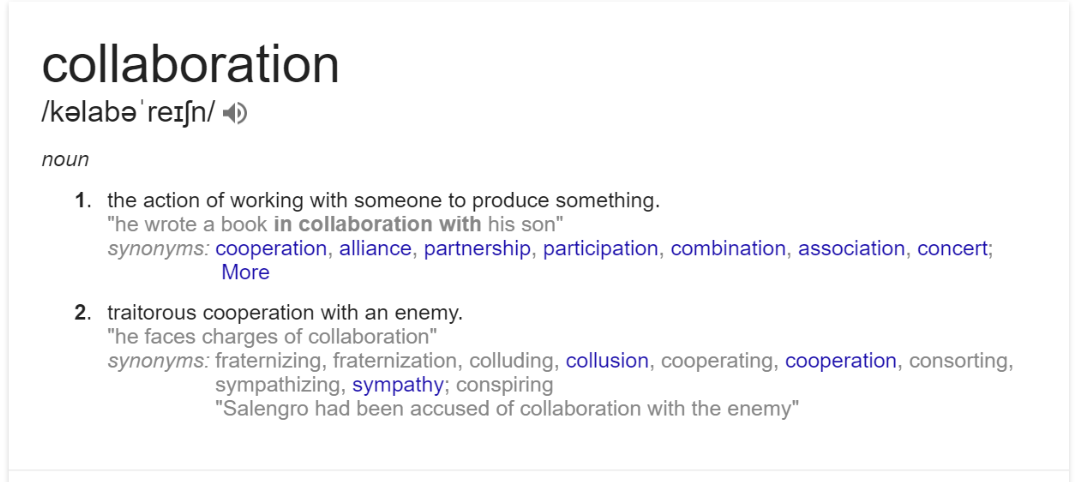
The simple definition of collaboration can be a double-edged sword - working for the collective good or conspiring to change the status quo. This is a reflection of the current education climate where schools are being strongly encouraged and incentivised to form collaborative Communities of Learning. In the educational sector, some look at this from the view of No.1 (image below), and some see No. 2 and are skeptical that collaboration risks undermining their own schools and is a tool of the neo-liberal agenda and school reform. I think they are both right but from the point of view of No. 2, I think we are long overdue for a system change (without the ideological jargon & baggage of  a neoliberal agenda).

To read more about the lead up to Communities of Learning in NZ:
The benefits of collaborative groups particularly for rural principals is recognised:

Iain Taylor - NZPF President 2016
"Collaboration is a practice that professional educators have always incorporated in their practice. It provides the opportunity to share both challenges and solutions and to create solutions where they don’t exist.
Collaborative groups are also great sources of PLD for schools and many share resources which they then agree to channel into a common area for development, whether that is for teachers within schools or for leadership. It has always been a challenge for isolated or rural principals to participate in collaborative groups for PLD, because of the extra travel component.

However, it is perhaps even more important that rural principals are able to connect with each other because they are already isolated with little or no contact with other principals. [my emphasis] The Virtual Learning Network (VLN) has become very popular with isolated schools as they can collaborate at least virtually, even if not in person."

Sunday, 12 March 2017

CoOLs - Communities of Online Learning - A double edged sword?

Tomorrow the report from the Education and Science Select Committee, who are looking at Education (Update) Amendment Bill, is due. There are a raft of changes proposed in this bill, though the part that is most of interest to me is Part 3A - Communities of Online Learning.

With my work at the VLN Primary School, I have been asking for something like CoOLs for a very long time. Here are our VLN Primary Submissions over recent years, they all ask for better resourcing, support and for inclusion of online learning within the mainstream schooling sector:
Why the outrage from parts of the sector that say they have been blind sided by part 3A of the Education Amendment Act bill? That it came out of nowhere, and there has been a clear lack of consultation? Well no, for some that were 'gobsmacked' to hear about it, they just didn't have this on their radar because they aren't taking notice of what is already happening in our schools. It isn't through lack of engagement on my part, I have been trying to get these ideas through to the wider sector for many years, as have some of my colleagues & been frustrated by the sectors lack of interest and support.

I have to support the notion of CoOLs this is what I have been working for most of my professional life towards. So why would I be concerned that CoOLs is going to come back and bite us on the bum!

Because it's not just about the VLN and its not just about CoOLs alone, its about being part of a whole system change, with some contentious neoliberal agendas in the mix.

The VLN Primary School has always been about providing equity and access to our learners where ever they are through online learning; the flip-side some see commercial providers using online learning as a tool to provide cheap online education to the masses.

The VLN Primary School has always been about collaboration across schools and building collective capacity, networks and relationships where all are contributing to the education and well being of our learners; the flip-side the imposition of networks across schools with a focus on standards based learning and accountability of achievement, this may change the unique character or rural education in NZ.

If you want to know more about what has been happening with Virtual Learning in New Zealand, and have some myths about online learning busted, then watch my EdTalks video, screened at ULearn16.

CENZ presents Rachel Whalley from EDtalks on Vimeo.

If you want to read some of the submissions about CoOLs made to the Science & Select Committee you can see them all in their entirety, or you can read notes from some key submissions that I have collated here. This will give you an idea of many of the concerns that are being put forward about CoOLs, some of which I agree with.

Sunday, 8 June 2014

Investing in Educational Success - Systems change in the making.

Investing in Educational Success
Last week this Working Group report was released on the government initiative 'Investing in Educational Success'. All documentation including this report can be found on the Ministry of Education website.

Q & A was held with Graham Stoop on Thursday (advance notice would have been good) Check out the conversation here.

It is certainly encouraging that we are due for some change in our schooling system, the VLN Primary has been asking for system level change that will enable us to work in a sustainable & 'legitimate' way across NZ schools (see our Position paper). The VLN Community have been discussing the need for change going back many years. It is definitely time to move away from the isolating and competitive nature of Tomorrow's Schools and to work more collaboratively across schools. It won't be an easy journey, it will be complex & challenging and one that should be taken with a measured & critical approach.

There is a lot to digest in this report & it's background papers and it is worth looking at in more detail. Some of the points that were raised for me were:
  • Really worthy goals around schools collaborations, and working together to improve student achievement (this is what the VLNP is all about).
  • There seems to be a competing rationale or tension between the development of new professional pathways & rewards for school leaders, raising student achievement and changing the system to structure collaboration. What is the main intended purpose of this strategy? What will be the spin-offs?
  • Specialist positions (& accompanying release time & salaries) seems to be being held out as a carrot and one that the unions are picking up on, with the danger of stepping up the old boys network another level. It is already noted that the PPTA & NZEI have included their separate position statements within the report. 
  • Communities of Schools (CoS) - it is interesting to note this term being used; it is a main descriptor in the VLN Community charter. How will existing collaborations such as the VLN Primary & VLN Community be supported in the new educational landscape? Will they just be swept away with the changes?
  • N4L - has been highlighted as an initiative that would support this change. The N4L has been tasked to create a managed network for schools & also an internet portal Pond. The analogy for me is like asking your school server and website to join your BOT - how does that work? The N4L would need to be developed as a people network such as the VLN groups has become.
    Attribution: http://allthingslearning.wordpress.com/
  • Collaborative action doesn't happen through good intentions alone, it needs to be strategically approached, led and driven in an ongoing way. Working across schools, even the willing and engaged, is still akin to Herding Cats. There will be a lot of facilitation support (PLD) in the early stages of setting up CoSs.
  • 250 CoSs will be created - for some school clusters this will be a no-brainer; for others really challenging. How do you go from competing with the school down the road, to being expected to work really closely with them? One of the successes of the VLN Primary collaboration is that schools have more freedom working outside of their geographic locations, there is less concern about competition between schools. How will this work for schools of different sizes/ demographics/ community needs? How will this work for our rural & remote schools? How can schools participate in more than one community? Where will schools decide where they fit and for some schools will it be like 'choosing sides for basketball'?
I feel very positive about the prospect of meaningful changes to our schooling system that will enable greater collaboration, although I have some reservations about potential design & implementation of a huge undertaking such as this. It is a bold move based on a small local body of knowledge of schools collaborations. I am also wary of the different political levers that surround a restructuring of our system and am concerned schools can have a genuine voice in the process.

Next steps in the process - work streams on Communities of Schools; Professional Standards; Selection, Appointment & Appraisal. (All things that the VLN Community has discussed and developed over the years in our own CoSs).

Join the conversation and make sure your voice is heard #iesnz

Tuesday, 20 May 2014

Sole Charge & Rural Teaching Principals Conference

I have spent the last day at Sole Charge & Rural Teaching Principals Conference in Palmerston North, connecting with many of our VLN Primary principals and sharing our story.

It is great to have this time with Principals away from the busy distractions of daily school life and to talk about what matters for our students and how we can work together to make a difference to their learning.
Principals from the Rural/Remote Schools Project
Our conversations now are no longer so much about how does this online learning stuff work, and what can we learn together (although there is still some of this in introducing new schools). We know it works and we are aware of the potential there is to push the boundaries in learning opportunities for our students. Conversations are now beginning to move into how can we build this capability across our schools, and how can we improve what we are doing? What are our children achieving through their participation in their online classes and how is it making a tangible difference to their learning. What evidence have we got to support our understandings beyond anecdotal feedback & observations. Time to step things up another gear!