Yesterday in Parliament the Education Amendment Bill (No 2) went through it's 3rd reading and was passed into law. This officially means there will be no CoOLs (Communities of Online Learning) in New Zealand.
Hon. Nikki Kaye argued to keep in place some provisions for online learning, and made an amendment to include a Review of Online Learning (which was not passed). Her argument was that you can't take this away without putting something in it's place. We supported this argument as we were working towards being a CoOL and relying on it to support the development of online learning moving forward. Yet the government counters that there never were CoOLs anyway, so why would you need to replace them, and that online learning has been happening successfully in schools for many years so therefore the status quo remains.
The VLN has been operating in schools for 25 years this year (10 for the VLN Primary). But for the last decade the VLN communities have been seeking a way to be sustainably and fairly resourced in schools, to grow innovative ways of learning online and to develop this really successful collaborative model further to be accessible for all NZ children. We looked to CoOLs to be the vehicle for this.
To assume the status quo will continue is not helpful to the work the VLN communities have been doing and undermines the potential of what they can contribute to NZ education if they were fully supported. The reality is, Secondary VLN communities are completely self funded through their participating schools. This is additional funding schools have to find to access this learning. This has been a challenge in enabling equitable access for secondary schools, in the disparity and inequity of funding given to Te Kura who provide similar services, and to the viability of regional clusters. Over the last decade several clusters have disappeared (CantaNet, AorakiNet, WestNet, TaraNet, CoroNet, BayLink).
The VLN Primary would not exist without partnership with the Ministry of Education. Our small schools can't afford to completely self fund this collaborative initiative. Over the last decade we have proved that there are important benefits for our children in collaborating to extend their learning opportunities. Yet, every year we have to go back to the Minister with cap in hand, to make a case for continued funding. Surely after a decade we need to get this right, get the funding right, get the framework right.
Some consolation, and its encouraging to hear Minister Hipkins say, that there is some work that needs to be done in this area, and with our recent consultation with the Tomorrow's Schools Review Taskforce, I am cautiously optimistic we will be able to move forward with online learning in a future focused schooling system. We will wait, and advocate, and be persistent about following through on any opportunities for our schools. I hope we can get there sometime in the next decade.
Finally to note, a huge thanks to Hon. Nikki Kaye who has been a champion of future focused learning and the VLN Primary over the years. Without her support the VLN Primary would not be where it is today.
You can read the whole of Hansard and video here. There is lots of discussion about VLN, Virtual Learning and Communities of Online Learning throughout.
VLN Primary Submission to Repeal of Communities of Online Learning
Future Schooling, Communities of Online Learning and Rural Education.
VLN Primary submission to Tomorrow's Schools

Professional reflections on education in NZ - Dancing on the shifting carpet
Showing posts with label online learning. Show all posts
Showing posts with label online learning. Show all posts
Friday, 10 May 2019


Sunday, 7 May 2017
WILL COOLS GIVE THE VIRTUAL LEARNING NETWORK A PERMANENT HOME?
In April I was quoted extensively in this article by Education Review on the VLN Primary & CoOLs. I discussed issues of sustainable resourcing, privatisation, competition & accountability. This article stemmed from a discussion with Jude Barback (Ed Review) ahead of the release of the Education & Science Select Committee report on the Education (Update) Amendment Bill. The report was released quietly with no comment from the media (except for the PPTA) and hugely overshadowed by the simultaneous release of another pivotal education review report the Productivity Commission report on 'New models of tertiary education.' The cynic in me would wonder if these two landmark educational policy reports were deliberately released to dilute the comment and feedback. So much to read, so much to process!
So what was in the Education & Science Select Committee report in relation to CoOLs? Well not much. There was very little of substance that has been amended from the original proposed bill apart from the extended timeline and the amalgamation of the section on provisional accredited cools into the main section on Cools. So really no surprises, this report reflects the majority view.
The concerns noted by the minor parties are also echoed in parts of our submission to the committee and it is good to see they pay particular credence to submissions from Dr Michael Barbour (Michael is on our Governance group). You can read the full report here.
Since the report was released there have been a couple of Q & A reports and a Departmental report. The Departmental report is a summary of key points raised in the submissions - 40 pages on CoOLs. Q & A's I have summarised the parts on CoOLs in this document.
So what was in the Education & Science Select Committee report in relation to CoOLs? Well not much. There was very little of substance that has been amended from the original proposed bill apart from the extended timeline and the amalgamation of the section on provisional accredited cools into the main section on Cools. So really no surprises, this report reflects the majority view.
The concerns noted by the minor parties are also echoed in parts of our submission to the committee and it is good to see they pay particular credence to submissions from Dr Michael Barbour (Michael is on our Governance group). You can read the full report here.
Since the report was released there have been a couple of Q & A reports and a Departmental report. The Departmental report is a summary of key points raised in the submissions - 40 pages on CoOLs. Q & A's I have summarised the parts on CoOLs in this document.
Wednesday, 5 April 2017
The more things change, the more they stay the same
In my recent post NZ Research & Articles - Online Teaching & Learning, I commented on the similar themes coming up in the research from nearly two decades of learning online. To illustrate this, and just because history really interests me, I want to share this report.
 Te Pouaka Whakaako ki te Kāreti o Ngata
Telelearning and Contexts of Awareness at Ngata Memorial College. Report prepared for Te Puni Kōkiri by Ken Stevens (1998).
This case study of telelearning at Ngata Memorial College in Ruatoria, compares students who are telelearning with those who aren't and what their perceptions were of the wider world.
Telelearning (audiographics) provides students with a connection with the world beyond school and extends educational and vocational opportunities for students and adults in remote communities.
In this report Steven's raises the government's commitment to equality of educational opportunity and how developments in ICT have wide ranging implications for schools, in teaching & learning, and administration policy.
He unpacks in detail the differences between telelearning and distance education in relation to how each was positioned to serve the society of the times. Distance education belongs to an industrial age model; telelearning to the information age. Steven's goes on to describe the changing educational environment where:
Telelearning and Contexts of Awareness at Ngata Memorial College. Report prepared for Te Puni Kōkiri by Ken Stevens (1998).
This case study of telelearning at Ngata Memorial College in Ruatoria, compares students who are telelearning with those who aren't and what their perceptions were of the wider world.
Telelearning (audiographics) provides students with a connection with the world beyond school and extends educational and vocational opportunities for students and adults in remote communities.
In this report Steven's raises the government's commitment to equality of educational opportunity and how developments in ICT have wide ranging implications for schools, in teaching & learning, and administration policy.
He unpacks in detail the differences between telelearning and distance education in relation to how each was positioned to serve the society of the times. Distance education belongs to an industrial age model; telelearning to the information age. Steven's goes on to describe the changing educational environment where:
- schools are inter-connected through ICT networks,
- technologies are used to provide new and better ways of learning,
- ICT skills will provide employment advantage,
- there will be an urgent need to provide the mass provision of appropriate technologies to classrooms.
This report was written just on the advent of Tomorrow's Schools and describes a highly centralised system of education without which small schools would be challenged to provide a quality education in a increasingly competitive environment. This has been a huge change since this time and in itself has been a key driver to the growth in collaborative online networks in the decade to follow. Steven's mentions the growing reality of the virtual classroom with the development of Cantatech & TOSItech and a developing East Coast network (which could be the precursor to the KAWM Network).
There were a number of recommendations from this report to the Ministry of Education. Some are summarised below:
- Recognise their pioneering role in telelearning education and support the expansion to other NZ schools;
- Expanding links to Colleges of Education;
- Recognise the Māori cultural context and consult with the broader Māori community;
- Be recognised as a special technology school, 'a valuable educational laboratory' from which other schools could learn;
- They should no longer be considered a small school but be funded as a virtual school.
It is interesting to see the work that was pioneered by Ngata Memorial College is still very relevant today. Maybe now we are 17 years into the 21st Century we will start to see the change that the Information Age has promised being realised for NZ learners.
Sunday, 12 March 2017
CoOLs - Communities of Online Learning - A double edged sword?
Tomorrow the report from the Education and Science Select Committee, who are looking at Education (Update) Amendment Bill, is due. There are a raft of changes proposed in this bill, though the part that is most of interest to me is Part 3A - Communities of Online Learning.
With my work at the VLN Primary School, I have been asking for something like CoOLs for a very long time. Here are our VLN Primary Submissions over recent years, they all ask for better resourcing, support and for inclusion of online learning within the mainstream schooling sector:- Inquiry into 21st century learning environments and digital literacy - Submission to the 21st Century Committee (2012)
- VLN Primary School - Proposal to Nikki Kaye (2013)
- Consultation on the NZ Education Act (2015)
- Submission to Education and Science Select Committee (2016)
I have to support the notion of CoOLs this is what I have been working for most of my professional life towards. So why would I be concerned that CoOLs is going to come back and bite us on the bum!
Because it's not just about the VLN and its not just about CoOLs alone, its about being part of a whole system change, with some contentious neoliberal agendas in the mix.
The VLN Primary School has always been about providing equity and access to our learners where ever they are through online learning; the flip-side some see commercial providers using online learning as a tool to provide cheap online education to the masses.
The VLN Primary School has always been about collaboration across schools and building collective capacity, networks and relationships where all are contributing to the education and well being of our learners; the flip-side the imposition of networks across schools with a focus on standards based learning and accountability of achievement, this may change the unique character or rural education in NZ.
If you want to know more about what has been happening with Virtual Learning in New Zealand, and have some myths about online learning busted, then watch my EdTalks video, screened at ULearn16.
If you want to read some of the submissions about CoOLs made to the Science & Select Committee you can see them all in their entirety, or you can read notes from some key submissions that I have collated here. This will give you an idea of many of the concerns that are being put forward about CoOLs, some of which I agree with.
Sunday, 4 October 2015
What's up for the VLN Primary School
We're coming up to the downhill side of the 2015 school year and we are still not sure if we have got funding to continue our VLN Primary operations into 2016 and beyond. This is a real challenge!

So to keep ourselves afloat for 2016 until we can take our (rightful) place within the publicly funded schooling system, I have spent the last month in chasing up and writing funding applications through our charitable trust, breaking down various parts of our projects & operations to aim at different funding opportunities. I have all my fingers and toes crossed waiting to hear.
(one glimmer of good news is that we do have an Asian Languages contract with the Ministry of Education and will be continuing with Chinese, Japanese, Korean & Bahasa Indonesian)
Just been remixing our Virtual Learning Network Primary School Story, created by Kath after our last rural camp. What an...Posted by Virtual Learning Network Primary School on Saturday, October 3, 2015
Monday, 20 July 2015
A Call to Action - Equity, access, quality and teachers in the digital age
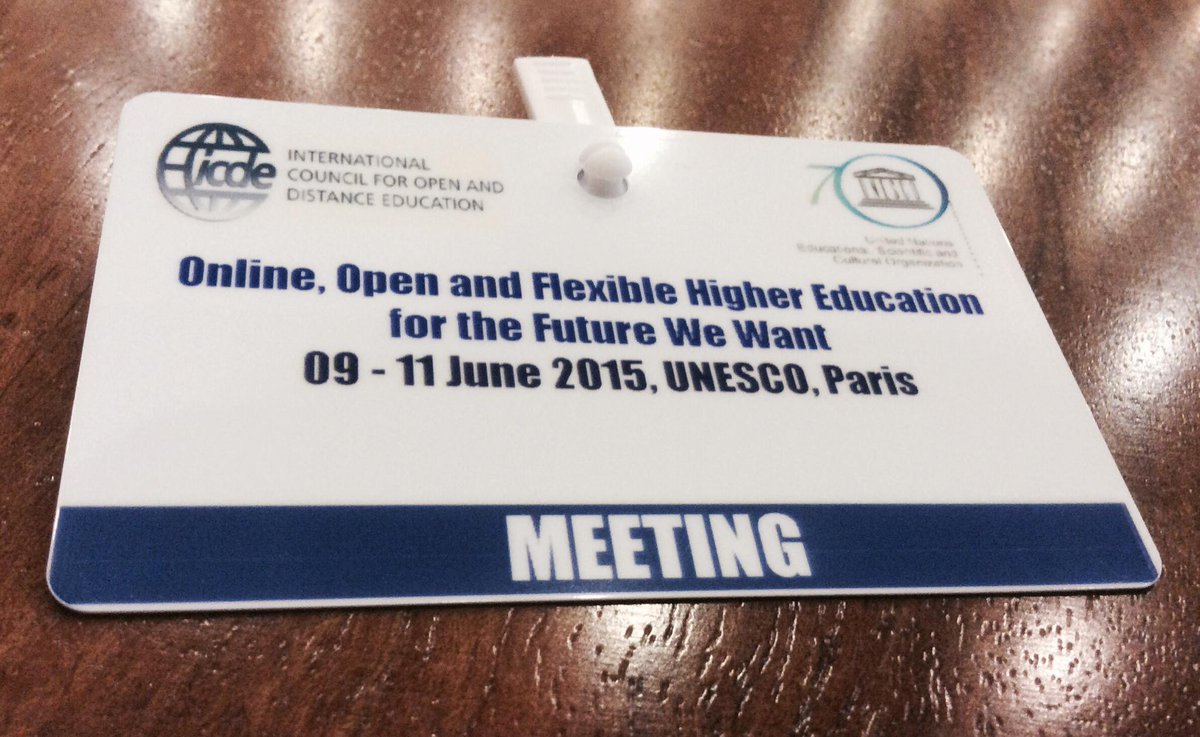 The ICDE (International Council for Distance Education) met in Paris recently for a Global Policy Forum. The aim of the forum was to build on previous work such as recently in Bali and to ensure equity, access and quality learning outcomes. This was framed with some urgency around the area of higher education with the prediction that in the next 15 years there will be a huge increase in the number of students seeking access to a quality education.
They are asking all governments, educational institutions, teachers and students, to jointly address the needs as outlined in the Paris Message (recommend you read this 3 page document) Key messages are around recognizing the importance of online, open and flexible learning to contribute to the quality & provision of education; the development of effective policy & regulation based on principles of equity; and that funding is critical to the initiation and sustainability of elearning initiatives.
These are all messages that resonate strongly with my work with the VLN Primary School. Through open, flexible, online & collaborative learning (I added the last qualifier) we have the potential to unlock the gates to so many learning opportunities for our students. This is not just for higher education, but across the sector and community. Government and the educational sector are just starting to 'get it' in terms of understanding the contribution online networked learning can make and are still way behind in resourcing and supporting initiatives such as ours. A good part of my time is spent advocating, and applying for different funding streams because we as yet don't fit into any government 'policy parameters' of which there are a host beginning to be aimed at schools collaborating. This is quite a frustration as what we really should be doing is spending our very little time that we do have working with schools, teacher and students.
Image attribution: https://twitter.com/JGlapaGrossklag/status/608193506444722176
Wednesday, 25 February 2015
Experts in K-12 online and blended education - Reviewers Wanted
This request forwarded from a colleague:
Siko, J.P. (2014). Testing the waters: An analysis of the student and parent experience in a secondary school’s first blended course offering. International Journal of E-learning and Distance Education, 29(2). Retrieved from http://www.ijede.ca/index.php/jde/article/view/882
Reviewers Needed
My name is Jason Siko, and I’m currently an assistant professor of educational technology at Grand Valley State University in Grand Rapids, MI. My research interests included K-12 online and blended learning. I am looking for teachers, administrators, and researchers to review a series of modules that promote readiness skills in online learning.
These modules were developed to align with the Educational Success Prediction Instrument (ESPRI), a survey that examines student beliefs in four areas: technology use/self-efficacy, academic risk-taking, organization, and achievement. Various studies using the ESPRI have found that it has an 80-90% accuracy rate in determining student success (i.e., pass vs. fail) in online and blended courses (see references below).
There are four modules: one for each of the four areas of concern in the ESPRI. In theory, students could take the ESPRI, and low scores in one or more of the areas would alert an online teacher or facilitator to encourage the student to work through the appropriate modules. However, any student could be encouraged to work through any or all of the modules.
At this point, I am looking for feedback from experts in K-12 online and blended education. If you are interested, please contact me at sikojp@gmail.com. I will set you up with a student account so that you can view the modules as a student would and attempt the tasks associated with each module. Upon completion of each module, a survey will appear allowing you to provide feedback.
Those who successfully provide feedback on all four modules will be entered into a drawing for a small prize.
Thanks in advance.
Sincerely,
Jason Siko
Assistant Professor of Educational Technology
Grand Valley State University
Grand Rapids, MI
jasonsiko.com
References
Roblyer, M.D., Davis, L., Mills, S.C., Marshall, J., & Pape, L. (2008). Toward practical procedures for predicting and promoting success in virtual school students. The American Journal of Distance Education, 22(2), 90-109.
Roblyer, M.D., & Marshall, J.C. (2003). Predicting success of virtual high school students: Preliminary results from an educational success prediction instrument. Journal of Research on Technology in Education, 35(2), 241-255.
Siko, J.P. (2014). Testing the waters: An analysis of the student and parent experience in a secondary school’s first blended course offering. International Journal of E-learning and Distance Education, 29(2). Retrieved from http://www.ijede.ca/index.php/jde/article/view/882
Monday, 23 February 2015
See, Think, Make, Imagine!
I was very excited to hear from Emma Sherie from the West Coast who, while currently on sabbatical and studying for her Masters, has volunteered to teach with us. Yes a word we don't hear so much in this busy day and age VOLUNTEER - 'a person who freely offers to take part in an enterprise or undertake a task.'
I was very impressed with Emma's attitude in stepping up to the challenge to further her knowledge and experience in becoming an online teacher. She is 'walking the talk' with developing her teaching practice to complement the learning she is undertaking with Massey this year.
Our maths teacher Rick has been doing this for the last three years & this year is preparing to write his dissertation based on the VLN Primary School. This is a win/win for our students, not only do they get access to some great teachers, we also get to feed into (& benefit from) research based around our learners.
So if you are a post grad. student focussing on elearning or online learning (or is you work with these students) - i would encourage you to get in touch with us to get some practical experience to base your theoretical knowledge on.
Here is the class that Emma is offering, registrations welcome now!
*Students will be working on the internet and uploading their work. Schools need to check that students are working within the schools internet policy.
I was very impressed with Emma's attitude in stepping up to the challenge to further her knowledge and experience in becoming an online teacher. She is 'walking the talk' with developing her teaching practice to complement the learning she is undertaking with Massey this year.
Our maths teacher Rick has been doing this for the last three years & this year is preparing to write his dissertation based on the VLN Primary School. This is a win/win for our students, not only do they get access to some great teachers, we also get to feed into (& benefit from) research based around our learners.
So if you are a post grad. student focussing on elearning or online learning (or is you work with these students) - i would encourage you to get in touch with us to get some practical experience to base your theoretical knowledge on.
Here is the class that Emma is offering, registrations welcome now!
See, Think, Make, Imagine!
Have you ever wondered how movies are made? Do you want to learn to make your own?
This is a unit designed for extension literacy learners in Year 7-8. Students will have the opportunity to explore areas of filmmaking while making connections with the literacy strand. It is an opportunity for them to explore film making in preparation for junior media at high school.
Students will be scaffolded while they acquire skills. This term the focus will be on; storyboarding, camera angles and editing. They will discover the different roles involved in making a movie and have a chance to hear from a New Zealand film maker. Students will be exposed to a range of apps and online tools to help them create their own short film using an ipad. They will have the opportunity to reflect on and critique their own work and other online participants.
Links to the curriculum:
Key Competencies;
Key competencies are inherent in film making. These include opportunities for group work and the competencies related to working with others, and managing oneself. Students learn to use media language, symbols and texts. They also discover how to be reflective and critical thinkers.
Literacy;
Processes and strategies
Students will:
Integrate sources of information, processes, and strategies with developing confidence to identify, form, and express ideas.
Purposes and audiences
Show a developing understanding of how to shape texts for different purposes and audiences.
Ideas
Select, form, and communicate ideas on a range of topics.
Language features
Use language features appropriately, showing a developing understanding of their effects.
Course Co-ordinator and Facilitator;
Kia Ora,
My name is Emma Sherie I am an experienced New Zealand trained primary school teacher and I have a passion for e-learning, so much so that I am undertaking my Post Graduate in - e-learning this year.
I am also a self confessed “movie buff!” I live in the remote West Coast of New Zealand and you will often find me outside “bush bashing” and practising my photography skills.
I am excited to be part of the VLN Primary School this year, having the opportunity to be able to offer students access to a wider range of learning opportunities, no matter where they live is very cool!
I believe that filmmaking and digital stories are a powerful way for students to demonstrate and share their stories. It is an opportunity for students to use a range of media to express themselves (not just in written form) to entertain, inform and educate us.
I am really excited to be bringing you this unit on filmmaking and look forward to seeing your creative creations as they develop.
Students will need access to;
A laptop
Ipad
Internet
Able to download “Silent Film App” for ipads cost is $1.29
*Students will be working on the internet and uploading their work. Schools need to check that students are working within the schools internet policy.
Check out our Protocols of Participation that outline procedure & costs involved and use our online form to register your students to participate.
(Note if you already have students registered with us this year, please just send an email to primary@vln.school.nz expressing an interest to participate in this class)
Monday, 26 January 2015
Online Learning Opportunities 2015 #Participate!
From our latest newsletter:
Tēnā koutou katoa
Welcome back to the 2015 school year! Here is a heads up on the year ahead for the VLN Primary School and an invitation for all interested students & teachers to participate.
VLN Primary School activities - online classes and projects are open for all NZ schools to participate. Please read our Protocols of Participation for specific details on how to participate and what costs are involved.
This year we have a wide range of languages available - te Reo Māori, Mandarin, Japanese, Korean, French, Spanish, German; also Extension Maths, Science (Chemistry - Mixing things). Over the Back Fence & Rural & Remote Schools, are long running projects that are welcoming interest from new participants.
VLN Primary School activities - online classes and projects are open for all NZ schools to participate. Please read our Protocols of Participation for specific details on how to participate and what costs are involved.
This year we have a wide range of languages available - te Reo Māori, Mandarin, Japanese, Korean, French, Spanish, German; also Extension Maths, Science (Chemistry - Mixing things). Over the Back Fence & Rural & Remote Schools, are long running projects that are welcoming interest from new participants.
There are several programmes under development, that are yet to be confirmed for 2015 - Tokelauan, Ngā Pūrākau, Asian Studies, Science (Plant Biology) and we welcome expressions of interest for participation in these. We would also love to be able to offer Cook Islands Māori, Astronomy, Extension Literacy, Coding & Minecraft challenge and are looking for teachers who are keen to run these programmes. (We have run some of these programmes before and have supporting resources available.)
We are keen to support new projects or classes getting started so please make your suggestions!
All schools wishing to register for online programmes for Semester 1 (classes begin mid March) should do so on this online form as soon as possible. For expressions of interest in anything mentioned above or queries please Contact Rachel.
We are keen to support new projects or classes getting started so please make your suggestions!
All schools wishing to register for online programmes for Semester 1 (classes begin mid March) should do so on this online form as soon as possible. For expressions of interest in anything mentioned above or queries please Contact Rachel.
Check out our 2014 year's highlights
Thursday, 8 January 2015
Call to action for Governments & Policymakers - support Open, Online & Flexible Learning.
"Access to, and success in, open, online and flexible learning are key solutions to the pressing development challenges and needs of 21st century societies, emphasizes the November 2014 Bali message by ICDE’s higher education leaders.
Recommendations from a recent summit in Bali called on ICDE and UNESCO to continue their efforts to support and encourage governments to:
- Create favorable frameworks for opening up education – making education at all levels available to all through open, online, flexible, blended and distance education.
- Stimulate the use of Open Educational Resources (OER) – publicly funded educational resources licensed to make materials needed for learners freely available to all.
- Enable learner mobility through the development of transnational qualification frameworks, which make the recognition and transfer of qualifications, course credits and learning within and between jurisdictions part of the fabric of an open, global education system.
- Encourage the adoption of quality standards, guidelines and benchmarks for open, online and distance learning to be mainstreamed into quality frameworks and protocols.
- Foster innovation in the form of new approaches to the assessment of learning outcomes, prior learning and work-based learning; new approaches to instruction, which both increase learner engagement and learning outcomes; and new ways of collaborating and connecting to learners and higher rates of student success.
- Invest in research focused on best practices in the design, development, deployment and delivery of open, online, distance and flexible education; the use of open educational resources; the mobility of learners; new business models for the operation of educational institutions; and new models of public assurance and accountability."

More detail from the Bali UNESCO Policy Forum here.
Wednesday, 19 November 2014
Connect your Learners - Over the Back Fence 2015
Successful projects keep on running & keep getting better. Well done Geoff into your third (4th?) year of Over the Back Fence Project.

Geoff is welcoming schools wanting to participate in 2015
What is OtBF?
• We broadcast a simple health/safety lesson to your class each week.
• The lesson is between 5 and 10 minutes. We use Skype or Connect.
• The classroom teacher can choose the topics or chose from our list.
• Lessons are taught at the same time each week to avoid confusion.
• The lesson is between 5 and 10 minutes. We use Skype or Connect.
• The classroom teacher can choose the topics or chose from our list.
• Lessons are taught at the same time each week to avoid confusion.
Here is the schedule of available times for 2015 - contact Geoff gmwood@xtra.co.nz for more information or to secure a time for your school to participate.
MONDAY
|
10:10-10:40
|
11:25-11:55
| |
TUESDAY
|
10:10-10:40
|
12:10-12:40
| |
2:20-3:00
| |
WEDNESDAY
|
10:10-10-40
|
1:40-2:10
| |
2:20-3:00
| |
THURSDAY
|
10:10-10:40
|
FRIDAY
|
10:10-10:40
|
2:20-3:00
|
Tuesday, 24 June 2014
Primary Science
You don't need to be a Scientist to DO Science!
Don't think you need to leave it to the experts for your students to learn about Science, there are lots of great PD opportunities & resources to support you in providing Science learning opportunities for our kids.
Check out this online PD from the Open Polytech - no fees! Register now for July's intake.
"The Graduate Certificate in Primary Science Teaching (Curriculum) takes the perspective that science can be fun. It encourages the learning of science by doing science and discusses the effectiveness with which science concepts and principles are embedded into learning experiences. Through the programme practising teachers will become more confident in their science knowledge, and their ability to design and deliver learning experiences that support and inspire students to investigate and understand science knowledge and concepts."
Scien ce Alive provides outreach programmes in the Christchurch area, they also have some great open source resources.
Follow them on twitter @sciencealive
ce Alive provides outreach programmes in the Christchurch area, they also have some great open source resources.
Follow them on twitter @sciencealive
 Science in a Van also run outreach programmes, anywhere in NZ.
 'The Science Learning Hub is developed by educators and teachers in collaboration with New Zealand scientists to provide resources for teachers of students up to year 10.'
Hear what teachers have to say about how they use the Science Learning Hub to support them in the classroom. Twitter @NZScienceLearn
'The Science Learning Hub is developed by educators and teachers in collaboration with New Zealand scientists to provide resources for teachers of students up to year 10.'
Hear what teachers have to say about how they use the Science Learning Hub to support them in the classroom. Twitter @NZScienceLearn
There are a number of Science groups in the VLN Groups area. The following three seem to be the most subscribed, open and active:

 Not forgetting Science Online @TKI. Linked from TKI are a series of papers developed from the questions raised here:
"The Chief Science Adviser raised some challenging questions in his 2011 report. The Ministry of Education responded by funding three new science education projects. His questions were:
- How can we “engage and enthuse” more young New Zealanders in science?
- Is the science we teach getting students ready to address serious questions we will all face in the future?
- How might science education help New Zealand's development as a smart, innovative, knowledge-oriented country? "
Some interesting professional reading.
Lastly not forgetting the VLN Primary School as a way to collaborate and extend Science learning opportunities across our schools. Currently we are running a Day Time Astronomy class - we welcome schools and teachers who have expertise to share across our network.
"The Graduate Certificate in Primary Science Teaching (Curriculum) takes the perspective that science can be fun. It encourages the learning of science by doing science and discusses the effectiveness with which science concepts and principles are embedded into learning experiences. Through the programme practising teachers will become more confident in their science knowledge, and their ability to design and deliver learning experiences that support and inspire students to investigate and understand science knowledge and concepts."
ce Alive provides outreach programmes in the Christchurch area, they also have some great open source resources. 'The Science Learning Hub is developed by educators and teachers in collaboration with New Zealand scientists to provide resources for teachers of students up to year 10.'
"The Chief Science Adviser raised some challenging questions in his 2011 report. The Ministry of Education responded by funding three new science education projects. His questions were:
- How can we “engage and enthuse” more young New Zealanders in science?
- Is the science we teach getting students ready to address serious questions we will all face in the future?
- How might science education help New Zealand's development as a smart, innovative, knowledge-oriented country? "
Lastly not forgetting the VLN Primary School as a way to collaborate and extend Science learning opportunities across our schools. Currently we are running a Day Time Astronomy class - we welcome schools and teachers who have expertise to share across our network.
Subscribe to:
Posts (Atom)