Monday, 26 January 2015

Online Learning Opportunities 2015 #Participate!

From our latest newsletter:

Tēnā koutou katoa

Welcome back to the 2015 school year! Here is a heads up on the year ahead for the VLN Primary School and an invitation for all interested students & teachers to participate.

VLN Primary School activities - online classes and projects are open for all NZ schools to participate. Please read our Protocols of Participation for specific details on how to participate and what costs are involved.

This year we have a wide range of languages available - 
te Reo Māori, Mandarin, Japanese, Korean, French, Spanish, German; also Extension Maths, Science (Chemistry - Mixing things). Over the Back Fence  & Rural & Remote Schools, are long running projects that are welcoming interest from new participants.
 
There are several programmes under development, that are yet to be confirmed for 2015 - Tokelauan, Ngā Pūrākau, Asian Studies, Science (Plant Biology) and we welcome expressions of interest for participation in these. We would also love to be able to offer Cook Islands Māori, Astronomy, Extension Literacy, Coding & Minecraft challenge and are looking for teachers who are keen to run these programmes. (We have run some of these programmes before and have supporting resources available.)
We are keen to support new projects or classes getting started so please make your suggestions!

All schools wishing to register for online programmes for Semester 1 (classes begin mid March) should do so on this online form as soon as possible. For expressions of interest in anything mentioned above or queries please Contact Rachel
 

Check out our 2014 year's highlights

Wednesday, 21 January 2015

Global Connections #Participate!

From my inbox today - can't find the web version of this mail out so will reproduce here.
If 2014 was the year of the webinar for teachers perhaps 2015 will be the year of global classroom connections? (now teachers are getting more confident).
Get with it teachers so many wonderful learning opportunities for our students and a way to increase their global awareness and understandings. See 'Healing the World One Classroom at a Time' for some excellent reasons why we should reach out beyond our classroom walls & beyond our national borders.

Skype in classroom

Transform literacy and learning in your classroom

Beginning on February 16th 2015, Skype in the Classroom is launching “Skype Celebrates Literacy”. This six week program will feature guest speakers from the publishing industry, lessons and resources to support and inspire literacy learning in classrooms around the world.
Literacy remains a high priority on the global education agenda and a core subject for classrooms everywhere. Lessons that involve reading, writing, speaking and listening – from poetry jams and reading aloud to author visits – have always been popular amongst teachers using Skype in the Classroom.
In 2014, you and your students travelled millions of virtual miles taking part in lessons around the world via Skype. Whether you collaborated with another classroom, played Mystery Skype, invited a guest speaker in for a Q&A, or went on a virtual field trip, chances are these experiences engaged your students’ literacy skills, perhaps without them even realizing it!
Here's how you can get involved:
1) Invite a guest speaker: authors, illustrators and storytellers will be available to join your classrooms via Skype. To make it easy to find and schedule a speaker to inspire your students, we’ve created a way to quickly schedule these calls. These conversations can be scheduled via Skype in the Classroom beginning February 9th.
2) Participate in World Read Aloud Day events: schedule a call on World Read Aloud Day or World Book Day (both the week of 2nd March) to celebrate the art of reading and writing. There will be a wide range of partner-provided content, tools, and resources to help with traditional reading and writing, including digital literacy and internet safety content too.
3) Literacy projects: we will have some very exciting literacy-related partner organizations including School in the Cloud, Microsoft, Safer Internet Day/ChildNet, and some very special guest speakers through those partnerships all coming soon.
4) Create your own Skype lesson: get creative and post your own literacy lesson for other classrooms to get involved in. Let us know about it @SkypeClassroom and we can promote it for you.
Join Skype in the classroom
Using an online Reading Level site, Mike Soskil, a teacher at Wallenpaupack South Elementary School in Pennsylvania discovered that “Our 4th grade students, who have been using a curriculum of Skype experiences and blogging as part of their Social Studies curriculum this year, increased their writing scores on average by half a grade level from October to December. The students using this curriculum are either in special education or low achieving.”
With a stronger focus on learning experiences that directly support literacy we hope to help teachers everywhere create even greater impact through the use of free accessible technology like Skype.
We hope to see you and your students join in all of the new literacy lessons. If you are new to Skype in the Classroom, we invite you to hop on a tour hosted by our Skype Guides, teachers just like you who are excited to show you the innovative and educational adventures that await your students. Don’t forget to help inspire others with your experience via our Stories PageFacebook andTwitter.
We look forward to a fantastic celebration of literacy.
Your friends at Skype in the Classroom

education@skype.net
@mysteryskype
@SkypeClassroom
#skype2learn
Skype respects your privacy. If you no longer wish to receive emails about Skype in the Classroom, you can manage your preferences at the "Update email notification settings" link below.
© 2003-2015 Skype Limited. Skype Communications Sàrl, 23 – 29 Rives de Clausen, L-2165 Luxembourg. Skype, associated trademarks and logos and the "S" symbol are trademarks of Skype Limited.
Terms of service     Privacy     Update email notification settings

2014 - the year of the Education Webinar

I don't know how NZ stacks up with the rest of the world in webinar participation but it feels like our teachers and the educational community in general are finally starting to 'get it' that they can connect with each other virtually and still have a quality professional learning experience.

We have been encouraging the educational community for some years to come into the virtual space so that our teachers can have access to professional learning opportunities that you don't have to drive miles to attend, find relievers to cover the extra time you need, or fork out loads of scarce PD budget for. Yes there is nothing so good as face to face but sometimes you don't really need to be there in person to achieve the learning outcome you are looking for. Blend it for balance - take the opportunity to f2f when it makes sense to and when you are thirsting for some more social contact or there are practical aspects that are easier to be there for - (conferences are great for this). Then make the most of a growing wealth of pld opportunities that fit more flexibly into your busy work life.

Originally through the NZed video conferencing network we collaborated to bring expertise to schools in our VC clusters for example - Julia Atkins, NZ Film Commission, MyPortfolio, StudyIt,  Now with a stronger, faster, more stable infrastructure, you don't need high end VC equipment or a dedicated bridge to connect, you can come in from the desktop (or mobile device) at school or home. Adobe Connect, Elluminate, Google Hangouts, Skype... take your pick.

ConnectEd Educator month was a real clincher for teacher participation in webinars, with many teachers connecting to a wide variety of sessions throughout the month, in Adobe Connect & Google Hangouts You can check out the recorded webinars archived here.

The Enabling ELearning team hold regular PLD webinars and these are archived here. Before this our VPLD team ran Hot Seat sessions - some sessions still worth checking out are archived here. Would recommend Karen's session on Social Learning (Karen is definitely the queen of the webinar - a fantastic & composed presenter :-) also Christina discussing Teaching as Inquiry.

And those are just our NZ webinars - there are so many opportunities to connect globally for example edWeb.net and Adobe Exchange. So make sure you follow whats coming up and plan your personal PLD for 2015. Love to hear of your recommendations of virtual PLD opportunities to follow!

Pinelopi Zaka from Science Alive running a PLD session on the Nature of Science, supported by the VLN Primary School.

A Vision Without Action is just a Dream - Learning Languages - A Global Future

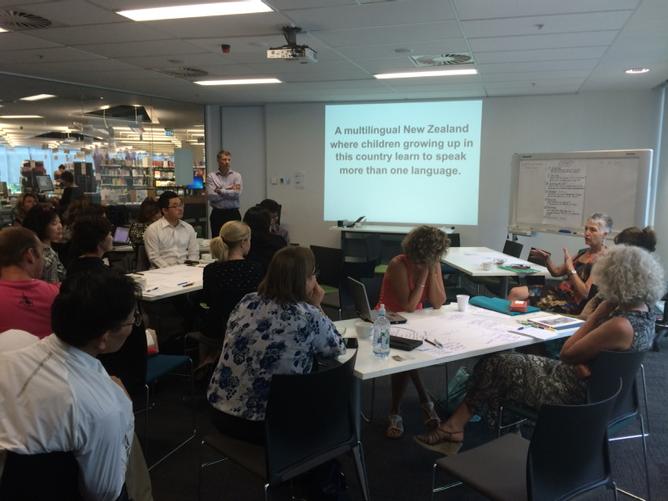
Yesterday i had the privilege of collaborating with a room full of passionate language learning advocates from community groups, schools and supporting organisations. Our main focus was to discuss the challenges and opportunities for schools in developing and sustaining language programmes in schools and how we can provide support and guidance for schools in the ALLiS initiative.

There were many details discussed of how we can collaborate to support successful and sustainable programmes but what has been clear in this meeting and previous ones is that a national language policy & strategic plan for learning languages is critical to co-ordinate, drive and sustain this work. 

It was really interesting to meet Susan Warren and hear about the work of COMET educational trust and in particular the development of a Languages Strategy for Auckland. It makes a strong case for developing Auckland (and that should read - New Zealand) as a multi-lingual community and also a strong case for a National Languages policy. Here are some of the points that resonated with me - you can read the whole document here and there is still an opportunity to submit a response here within the week.

"Multilingualism is central to a diverse city: it allows us to value ourselves, build community, build tolerance, and live peacefully and prosperously.Currently, many Aucklanders miss out on the cognitive advantages of multilingualism. As a community we miss out on the potential of younger language learners because we fail to take advantage of the best windows for language learning and the most effective years for language maintenance. Auckland’s migrants, especially our older migrants, could receive much better support for their aspirations to learn communicative English. As a community we fail to grasp the cultural and aesthetic benefits of multilingualism, and many Aucklanders cannot garner the educational attainment that crosses language boundaries and unifies knowledge in varied domains. One of the more obvious impacts of the absence of a languages policy in New Zealand is seen in education.  Evidence shows that quality bilingual or immersion instruction in children’s first or heritage language brings measurable gains in literacy achievement in the target language and also in English[1].  However requests to the Ministry of Education for tailored materials or professional development for bilingual classes are met with an explanation that there is no policy to enable provision for learning through languages other than English, te reo Māori and NZ Sign Language.Most New Zealanders (93 per cent) agree it is valuable to learn another language[2]. Language skills and cultural sensitivity are now required for successful participation and engagement locally, nationally and globally in all spheres of activity. Auckland is well placed to harness its language potential.In the past, it has been possible to “get by” in English only. For our young people to thrive in the future, they will need more options and more experience as language learners. Because most of the world is multilingual this need will be felt even more acutely as today’s young Aucklanders spread their wings globally. Most English-dominant countries today require their young people to have another language; all of New Zealand’s associates in ASEAN require kids to learn another language from a young age. New Zealand identifies strongly with the ethics of team membership: being a team player in the 21st century will mean being multilingual."


[1] Asia New Zealand, http://asianz.org.nz/newsroom/media-releases/2014/perceptions-asia-2013 

[2] Ministry of Education (2008).  Teaching and learning for bilingual Pasifika students in New Zealand.

Tuesday, 13 January 2015

No need for Learning Languages in the Future - Skype translator


The age of the Babel fish is nearly upon us? 

Will technology soon become so sophisticated that we can trust it to translate reliably and with correct expression and nuance that we won't need to learn another language but will be able to interact easily universally in our own languages? Another way that technology will be ubiquitous in our globally connected lives... not quite there yet, but definitely on the horizon.


Skype translator - some background.


Thursday, 8 January 2015

Call to action for Governments & Policymakers - support Open, Online & Flexible Learning.

"Access to, and success in, open, online and flexible learning are key solutions to the pressing development challenges and needs of 21st century societies, emphasizes the November 2014 Bali message by ICDE’s higher education leaders.

Recommendations from a recent summit in Bali called on ICDE and UNESCO to continue their efforts to support and encourage governments to:
  • Create favorable frameworks for opening up education – making education at all levels available to all through open, online, flexible, blended and distance education.
  • Stimulate the use of Open Educational Resources (OER) – publicly funded educational resources licensed to make materials needed for learners freely available to all.
  • Enable learner mobility through the development of transnational qualification frameworks, which make the recognition and transfer of qualifications, course credits and learning within and between jurisdictions part of the fabric of an open, global education system.
  • Encourage the adoption of quality standards, guidelines and benchmarks for open, online and distance learning to be mainstreamed into quality frameworks and protocols.
  • Foster innovation in the form of new approaches to the assessment of learning outcomes, prior learning and work-based learning; new approaches to instruction, which both increase learner engagement and learning outcomes; and new ways of collaborating and connecting to learners and higher rates of student success.
  • Invest in research focused on best practices in the design, development, deployment and delivery of open, online, distance and flexible education; the use of open educational resources; the mobility of learners; new business models for the operation of educational institutions; and new models of public assurance and accountability."
Some key messages for our government here - not just for higher education but for the schooling sector too. These recommendations are not about bandwidth, networks or infrastructure but about building capacity in people, systems and open resources
More detail from the Bali UNESCO Policy Forum here.

Tuesday, 16 December 2014

Tuesday, 25 November 2014

China /NZ friends in the Classroom

The VLN Primary School is really privileged to have the support of the Confucius Institute Auckland to partner with us to provide Mandarin programmes in our schools. Last week i farewelled Katie & Dandan who have been working with us this year. They have been awesome teachers and ambassadors for their country. Our kids love them & we will really miss them crying 
The same day Chinese President Xi Jingping was also in Auckland having lunch with '400 other close friends at SkyCity'. Our MLAs got to wave at his motorcade as it drove by. The MLA programme is where the real China/NZ friendships are forged - as we welcome these young people into our homes and or classrooms. They get to enjoy a slice of kiwi life (everyone of them talked about gaining extra kilos in NZ) and we gain a better understanding of each other's cultures. 
The government is promoting the development of Asian Languages in Schools with a contestable funding pool for schools. The first deadline for funding has closed but a second opportunity opens in 2015. The VLN Primary School will be offering Mandarin, Japanese & Korean classes online next year - take the opportunity to try it out with your students and consider how you can grow this in the schools in your area.
Mandarin Class

Wednesday, 19 November 2014

Connect your Learners - Over the Back Fence 2015

Successful projects keep on running & keep getting better. Well done Geoff into your third (4th?) year of Over the Back Fence Project.
Over the Back Fence
Geoff is welcoming schools wanting to participate in 2015

What is OtBF?

• We broadcast a simple health/safety lesson to your class each week.
• The lesson is between 5 and 10 minutes. We use Skype or Connect.
• The classroom teacher can choose the topics or chose from our list.
• Lessons are taught at the same time each week to avoid confusion.
More info here (2014 startup) and listen to Geoff's students & have a peek in his classroom here.
Here is the schedule of available times for 2015 - contact Geoff gmwood@xtra.co.nz for more information or to secure a time for your school to participate.
MONDAY
10:10-10:40

11:25-11:55
TUESDAY
10:10-10:40

12:10-12:40

2:20-3:00
WEDNESDAY
10:10-10-40

1:40-2:10

2:20-3:00
THURSDAY
10:10-10:40
FRIDAY
10:10-10:40

2:20-3:00

Wednesday, 15 October 2014

Cultural Connections @ Confucius Institute Day

This post may be a bit belated but i really loved joining in with the Confucius Institute day in Auckland recently. I know our Mandarin students around Aotearoa would have loved to participate in these activities too. I wished they were all with me to enjoy the day. My mind was racing on how we can have a 'Camp China' for our students that are distributed around the country or how we can support them to attend future events such as this one. Definitely something to plan for the future and may be more accessible if we can grow participation in Asian Languages (see my last post) further than Auckland and out into the regions.

The day started with a Breakfast seminar at the Fale Pasifika, Auckland Uni, with guest speaker Professor Zhang Wei. His topic was around a Chinese Perspective of democracy & the future of China. It is a good reminder that there are many viewpoints beyond our own that we should be aware of, irrespective of our own political ideologies. Naive statement i know but politics is not a path i want to follow on this blog. I am sure though if the events in HongKong were unfolding earlier we would have had a livelier Q & A session.

So breakfast is always good and my first real Chinese breakfast with Black Rice:


We then headed over to the quad for a powhiri, more speeches, great dancing and martial arts demo. Here are photos of just a few of the activities to join in:


Chinese cultural activities are a great way to spark interest and participation in learning Mandarin and in developing Asia Awareness in your school. Check out Parnell School's Mandarin Blogspot that showcases all their activities - i like the idea of the Great Dragon Challenge that engaged the whole school in a day of immersive cultural activities.


Well done to the team at Confucius Institute and our Mandarin Language Assistants (some above), including Dandan (below) I know a lot of effort went into the planning, preparation and hosting of the day! (Here is the link to more pics from Confucius Institute of the day)


Promoting Asian Languages


I was recently invited to join discussions with Asia NZ on the future directions of Learning Languages (particularly Asian Languages) in New Zealand. It was very well organised for conversation as we  moved Cafe style around changing groups of participants from across the sector and language and cultural organisations. This engaged us in discussions that teased out key themes and issues that emerged throughout the day. Thanks Jeff for superb facilitation of the day & outgoing AsiaNZ director John McKinnon for an inspiring welcoming speech (you can read the accompanying opinion piece here). The Key Question was: "By 2025, all school students in New Zealand will have the opportunity to learn an Asian language. How do we make this happen?"


Some of the general discussion raised around the room was echoed by many - access to NZ based teachers, the recognition of languages as important, the drop off in students past year 10, competition for resourcing within schools & lack of policy direction. This is not just the case for Asian Languages but these are the same messages coming through on the Languages listservs i belong to as well.

For me the main themes I formed from discussions I had, was the need for a clear strategic direction that should be developed and enacted through the collaboration of all key stakeholders; alongside this is the need to engage with the wider community and to make learning relevant to our students in order to incentivise greater participation. You can read the full overview of the day's discussion collated and shared by Asia New Zealand here.

It is encouraging to know that the government is investing in this area and schools can access funding to support learning Asian languages but at the same time it also a concern that this funding isn't aligned to clear educational strategies. Schools will find it useful to refer to this supporting document from Asian New Zealand that gives guidelines for planning, piloting and sustaining Asian Language learning programmes.

So moving forward from here we look forward to taking these conversations further, building on our collaborative partnerships and developing new ones to support Asian language learning opportunities for our students. Watch this space!

Wednesday, 8 October 2014

Connected Students @ Rosmini College

I have always been a great fan of the work that Geoff Wood is doing with his students at Rosmini College and have written on them often in the VLN Primary School blog (here, here & here). His classroom is truly a Connected Classroom and his students Connected Learners. Geoff is a full time classroom teacher and has 'flipped' his classroom to be revolving around the constant connections that fuel their learning processes, through the sharing and relationships they develop with the many, many different students who come 'virtually' into their classroom everyday. On my second face to face visit in two years i can see now how this has really developed into the culture of the students Years 7 - 13 in Geoff's health classes. They are organised, they are confident, they are patient & persistent (dealing with the technology), they are able to communicate with a diversity of students from new entrants, all over NZ and globally. On the afternoon i was at Rosmini two boys were in the workroom (cupboard?), teaching youngsters in South Auckland about sugars in our diet; another two were on the outside deck talking to students from Te Hapua about online safety & Geoff was preparing an international connection with Bangladesh & Pakistan (?) for later in the day. I was impressed with the ease of communication, through pretty average technology & connections (HD desktop VC it wasn't). It was a joy to watch the students at Te Hapua perform a waiata & haka for the Rosmini boys and then one by one approach the camera to introduce themselves & say thank you.
Below is are some snippets of one of the sessions and a short interview with two of the boys:


Wednesday, 1 October 2014

VLN Primary Schools Roadtrip

A quick round up of my road trip to Auckland last week. It was great to pop in to some of our schools who have students learning with us in our online classes and projects. So good to have some face to face time with our students, getting to meet teachers & kids we have been working with throughout the year; also good to catch up with old friends in real space & time :-)

Moanataiari School                                     

Students at Moanataiari school participate in our extension Mandarin class, extension Maths & te Reo Māori. In addition to these students are another dozen joining in with My Story, Our Story, Your Story - Photography project. (Lots of kids running around with camera's & a very keen classroom teacher). Feedback from their Principal ise that in Mandarin they are 'going great guns', te reo just starting to come out of their shell and participating more, were a little whakama to start with & maths students are being challenged with the step up in learning.

You can listen to some of the students comments here:

Mahurangi Christian School

A shame that I spent a good part of my visit on Helen's floor looking for the screw for my glasses and then more time with her sticky taping my glasses together - we did have a short 'meet &greet' to touch base. Language classes are the interest for this school at the moment & perhaps we won't see them again next year with the prospects of having a Japanese teacher at school. Which is a good thing, some of our schools are participating or NOT depending on the needs of their students and what support they need at the time. The VLN Primary should not be an end in itself but a bridge to connect our students, our schools and learning opportunities. Other projects are of interest but only if they fit what's happening for these kids - so message here - just keep in the loop, keep connected, hook in & engage where there is a clear & relevant purpose to participate.
Great to see independent student learning & inquiry based learning in this school and have the children tell me all about how it works in their school. Thanks for taking the time to chat with me Louise. Here's a short video via VPLD on how Staff at Mahurangi Christian School connects the classroom to the community through digital technologies.


Ahuroa School


A great little country school less than an hour north of Auckland. Ahuroa School was my destination to meet Theressa who is running a collaborative Photography project - again another great opportunity to make a face to face connection. Although completely virtual, if there is an opportunity to touch base in person, it is really worthwhile making the time. Theressa is a great asset to her school, not only running the photography club, but also their Robotics team, and a keen hands on interest in elearning. Thanks Theressa for taking the best of what you do in your school and collaborating with other schools - i know there are a lot of teachers & kids already buzzing with this project, Some nuts & bolts still to work out around managing so many photos, maintaining a feedback & improvement process and keeping engagement going to ensure student are improving their photography skills, choosing relevant photo's to the theme and having some great thoughtful images to exhibit in 2015. Looking forward to watching this unfold.

Tuesday, 30 September 2014

Eyes on the Horizon, Feet on the Ground

As all of my work is exclusively in the virtual and online education world, it has been a welcome change in the last couple of weeks to have the opportunity to meet with teachers and get my feet on the ground in schools. It's exciting to be working on the edges of educational change but it's so important to keep it real too! Here's my first update:

EBOP Connected Teachers

Thanks to Edgecumbe Primary for hosting, @jeanettem1 for organising and leading this initiative and  @mrs_hyde for supporting this first event. This builds on from other Connected teachers groups in Rotorua, Taupo & more recently Napier. DIY PLD, the knowledge is in the room! Good to be around classroom teachers, hearing what is important and happening in their schools and getting to know people in the Eastern Bay. Looking forward to another hui at the end of the month in my town Matata.

Ngatea Primary School

Image attribution:http://karlas-learning.blogspot.co.nz/
I have been following @Neil_NPS 'Principal of Ngatea Primary School where we challenge and re-define our learning environment.' and had been keen to stop in and see what was happening at this school, so just to be nosy i invited myself for a school visit on my way up to Auckland. Thanks @hull_karla for showing me around and sharing your school's learning journey with me. Lots of great things happening with student centred personalised learning, flexible timetables, collaborative teaching, open learning spaces, 1:1 chromebooks. Most of my questions were around logistical things like how to support learning in flexible time & space; now I'm keen to go back and find our more about about the learning than the organisation. Has any research been done yet in our MLE schools? Would be interested to see.
Check out this short virtual tour:


Thursday, 18 September 2014

Getting Ready for Connected Educator Month #CEM #cenz14


Everyday is a Connected Educator day for me, it's my job, that's what i do - &  I love it! So to be involved with Connected Educator Month is a real privilege. I am encouraging our schools to not just share and support our activities but to go and explore the wide & interesting range of what's on offer throughout the month and immerse themselves. This is an awesome PLD opportunity for our teachers to 'learn by doing' and #participate. I really like the Starter Kete for teachers which introduces us to different concepts & tools each day, a great supporting resource. There is something for everyone in events that run in NZ & globally throughout the month. High fives to @virtuallykaren you are doing a fantastic job of bringing this all together.

Here are our contributions to Connected Educator Month coming up soon!
They are adaptations of those we ran earlier in the year at DEANZ and more recently (coming up) at ULearn14 conferences.  I am aiming to get our students to lead and co-host some of these events too and hoping that we will pull in members of our school communities to participate too.

Workshop Presentations

VLN Primary Montage

Leveling the playing field for schools through networked learning

Thursday 16th October - 4.00 - 5.00 pm
(Suitable for school leaders, members of school communities &  teachers)
NZ schools have been collaborating for many years across the old No.8 wire & bush telegraph, now we are on the cusp of being more connected to one another than we have ever been in the past, with ultrafast broadband and more ubiquitous & reliable technology. How can we leverage on our connectedness, taking the best of what we have from across our schools and creating new learning opportunities for all our students? Our students have so much to gain with equity and access to learning that has boundless possibilities.
This presentation will showcase how Primary Schools from around NZ are collaborating online and the benefits to our students. We will discuss the vision, practicalities & challenges of working collaboratively online; and explore future opportunities to make connections with schools who are interested in participating in networked learning.

Getting ready for teaching & learning online 

Thursday 23rd October - 4.00 - 5.00 pm
(Suitable for teachers)
This is a hands on workshop for teachers who are keen to participate in online learning with the VLN Primary School. Whether you are supporting students who are online learners (mTeacher) or if you are teaching online yourself (eTeacher), or if you just want to see how it all works; this ‘induction’ workshop will prepare you with the skills, knowledge and confidence to step out with your kids in the world of virtual learning. This workshop session will introduce you to the VLN Primary online learning initiative; you will learn how to use some online tools - Adobe Connect, Welearn & Google Docs to develop an online class, and explore some strategies for teaching and learning online.

WeLearn – Student eLearning Hub 

Thursday 30th October - 4.00 - 4.30 pm
(Suitable for teachers & school leaders)
Welearn has been developed as the social networking and support hub for VLN Primary School online learners. There is awesome potential to shape & share this environment as a collaborative blended learning space across NZ schools. Come and check out what is happening in Welearn and explore the possibilities for participating with your students.

Student Participation

These events are for students to participate in and are designed to introduce and model activities where students can connect and learn together online.  This is a real time quiz based competition. We would love an international challenge - Global Connected Educators!
image

Literacy Challenge

Thursday 16th October 10 - 11 am
This has a focus on literature, suitable for your avid readers.

Maths Challenge

Thursday 30th October 10 - 11 am
Test your Maths brain - suitable for students who are working at L4+ NZC
Both of these competitions are aimed at Y7 & 8s but Y5 & 6s are also welcome to participate if their teachers think they will be able to compete. Students can compete in teams of 2 - 4 (but no more than 4).

Taster Classesimage

These are for both students and teachers together who are considering participating in online learning supported by the VLN Primary School. Also suitable for those interested in seeing a snapshot of how we learn together in our online classes. This session provides a walk through of the nuts & bolts of connecting and communicating in online spaces, how students can set themselves up for managing their own learning and how teachers can support them.
Thursday 23rd October 10.00 am
Thursday 30th October 1.30 am 

Connection Details

All sessions will run through Adobe Connect, supported by the Ministry of Education
With concurrent audio conference connection and/OR Skype audio

To join the meeting: http://connect.vln.school.nz/cem/
Participation code will be emailed to you on confirmation of your registration

Phone /Audio Conference Number(s): 0800693638 or 04 4951378
Participant Code: 407130#
----------------
If you have never attended an Adobe Connect meeting before:
Test your connection
Get a quick overview


Click Here to Register