Thursday, 11 June 2015

Share, Celebrate, Participate - VLN Primary School Newsletters

May Update


In our latest newsletter we update you on our recent AGM, talk about our small rural schools, share the buzz on Prince Harry's recent NZ visit, give you a heads up on whats coming up and a shout out for teachers to join us in teaching online. 
Prince Harry takes an online Class.PNG

Read our newsletter. Subscribe.


June Update

In this newsletter we update you with a great story of online meets face to face at Orewa Estuary Arts Centre, share the excitement about the VLN Primary School supporting Asian Languages learning in NZ, make a call for enrolments for Second semester online programmes & projects, introduce two new members of our Governance team and congratulate two of our wonderful eTeachers. Please share this newsletter with your colleagues and follow us on our social media channels - we just can't fit all the good news in here!
Recently Updated.jpg
Opening of the My Story, Your Story, Our Story  exhibition at Orewa Estuary Arts Centre 

Read our newsletter. Subscribe

FacebookTwitter

Monday, 20 April 2015

My Vision for Teaching & Learning


In response to a FB discussion, my 2C worth: "Many of us are working hard to support our teachers and students with concepts and practices related to 21st century thinking.... MLEs, blended learning, student agency etc,etc. What comes next for schools? "
I think keep extending on learner agency and push past the classroom walls & school gates. Children will learn from many people and places and not just the teacher in their own classroom or school. Look for more community involvement supporting learning and sharing of expert teachers across schools. More opportunities for tuakana/teina and students leading learning. More global education, where our children learn from others and develop cultural understandings. Children will access personalised learning pathways - learning what they want, with who they want, when they want to. Our role will be to make sure they have sound foundation skills in place (literacy, numeracy, key competencies) to enable them to excel in their learning and to help them navigate and access a wider world of learning. This is my vision for a future of learning 
So what are you waiting for? Just do it!

Wednesday, 15 April 2015

Our Stories - Exhibition Coming Up

''My Story. Our Story. Your Story' 

The result of a year long project initiated and co-ordinated by the Ahuroa School Photography Club, and facilitated online via the VLN Primary School.


The Project
An exploration of photography as a means of telling and sharing a story, for primary school aged children.  “My Story” - individual journey’s of self discovery; “Our Story” - the combining of individual photographic stories to become a representation of a school community; “Your Story”- school communities stories are compared and combined to tell one story - our exhibition.

Our Story
We are a small, rural country school.  We have a story to tell. But are our stories different to those of kids who live in the city, or kids whose cultures are different from ours, or from kids who have had experienced natural disasters?  What about kids who live in isolated places?  What about kids who live in different countries to us?  Will their stories be different?  How?  Or, will their stories be similar?  Will their be a common connection?


Participating Schools:

New Zealand
Kaikohe West School (Kaikohe); 
Mulberry Grove (Great Barrier Island); Kaitoke School (Great Barrier Island); Ahuroa School (Warkworth); Hobsonville Point School (Hobsonville); Devonport Primary School (Auckland); Te Poi School (Matamata); Toko School (Taranaki); Moanataiari School (Coromandel); Pahiatua School (Palmerston North); Rewa Rewa School, (Wellington); Dipton School (Otago); Burnside Primary (Christchurch); Glenorchy Primary School (Glenorchy); Half Moon Bay School (Stewart Island)

International
Flowery Branch Elementary (Hall County, USA); 
Lakeview Elementary (Robbinsdale, Minnesota, USA); Nexus International School (Singapore);
AMMAC, Chihuahua (Mexico); Beaconhouse School (Islamic Republic of Pakistan)"
from http://www.estuaryarts.org/currently-showing.html

Monday, 23 March 2015

I Love Zotero - the webs best referencing tool!


I have been meaning to write about Zotero for some time but as more of my friends are resuming their studies i thought it would be timely to share this post.
When i returned to study last year i tried Zotero for the first time, wow so much better than EndNote that i had used many years ago. EndNote may be good but here are the reasons i LOVE Zotero.
  1. So easy to use and organise your work
  2. Stand alone & mobile versions sync really well, enabling easy access to readings from your tablet or ipad
  3. Browser add on enables you to pull bibliographic info straight in at a click of a bookmarklet
  4. If you know the isbn or doi number and put that in it automagically populates all info
  5. And the best reason i love Zotero is you can create groups in Zotero online and SHARE
    What a great way to crowd source around a topic, create groups with your class mates, ask your lecturer to share the readings straight into Zotero (now that would be handy)
  6. Completely free to use

Here is a group i set up called VLN Scholars specifically for NZ teachers - you are welcome to join and contribute.
Here are Zotero getting started guides - happy studying!

Wednesday, 11 March 2015

More than just Sharing a few Pics - My Story, Your Story, Our Story.

It has been great to follow and support the project My Story, Your Story, Our Story  Big kudos to Theressa for initiating and driving this schools collaboration. As the project progresses we can see it is more than just developing some expertise in photography skills & techniques, or sharing their best pictures. It is about making meaningful connections that provide different perspectives on our lives and this has been particularly evident, so far, with the global participation.

Here Stephanie shares her story of participating in this project - Bringing the classroom out into our World. And here they are again practicing a waiata for their school visitors, inspired by their interactions with the My Story Project. Click over there and give the students some positive feedback on their kapa haka efforts! Here is the direct link to their photos.


Wednesday, 25 February 2015

Experts in K-12 online and blended education - Reviewers Wanted

This request forwarded from a colleague:

Reviewers Needed


My name is Jason Siko, and I’m currently an assistant professor of educational technology at Grand Valley State University in Grand Rapids, MI.  My research interests included K-12 online and blended learning.  I am looking for teachers, administrators, and researchers to review a series of modules that promote readiness skills in online learning.

These modules were developed to align with the Educational Success Prediction Instrument (ESPRI), a survey that examines student beliefs in four areas:  technology use/self-efficacy, academic risk-taking, organization, and achievement.  Various studies using the ESPRI have found that it has an 80-90% accuracy rate in determining student success (i.e., pass vs. fail) in online and blended courses (see references below).

There are four modules: one for each of the four areas of concern in the ESPRI.  In theory, students could take the ESPRI, and low scores in one or more of the areas would alert an online teacher or facilitator to encourage the student to work through the appropriate modules.  However, any student could be encouraged to work through any or all of the modules.

At this point, I am looking for feedback from experts in K-12 online and blended education.  If you are interested, please contact me at sikojp@gmail.com.  I will set you up with a student account so that you can view the modules as a student would and attempt the tasks associated with each module.  Upon completion of each module, a survey will appear allowing you to provide feedback.

Those who successfully provide feedback on all four modules will be entered into a drawing for a small prize.

Thanks in advance.

Sincerely,

Jason Siko
Assistant Professor of Educational Technology
Grand Valley State University
Grand Rapids, MI
jasonsiko.com

References
Roblyer, M.D., Davis, L., Mills, S.C., Marshall, J., & Pape, L. (2008). Toward practical procedures for predicting and promoting success in virtual school students. The American Journal of Distance Education, 22(2), 90-109.

Roblyer, M.D., & Marshall, J.C. (2003). Predicting success of virtual high school students: Preliminary results from an educational success prediction instrument. Journal of Research on Technology in Education, 35(2), 241-255.

Siko, J.P. (2014).  Testing the waters: An analysis of the student and parent experience in a secondary school’s first blended course offering.  International Journal of E-learning and Distance Education, 29(2).  Retrieved from http://www.ijede.ca/index.php/jde/article/view/882

Monday, 23 February 2015

See, Think, Make, Imagine!

I was very excited to hear from Emma Sherie from the West Coast who, while currently on sabbatical and studying for her Masters, has volunteered to teach with us. Yes a word we don't hear so much in this busy day and age VOLUNTEER - 'a person who freely offers to take part in an enterprise or undertake a task.'
I was very impressed with Emma's attitude in stepping up to the challenge to further her knowledge and experience in becoming an online teacher. She is 'walking the talk' with developing her teaching practice to complement the learning she is undertaking with Massey this year.
Our maths teacher Rick has been doing this for the last three years & this year is preparing to write his dissertation based on the VLN Primary School. This is a win/win for our students, not only do they get access to some great teachers, we also get to feed into (& benefit from) research based around our learners.
So if you are a post grad. student focussing on elearning or online learning (or is you work with these students) - i would encourage you to get in touch with us to get some practical experience to base your theoretical knowledge on.

Here is the class that Emma is offering, registrations welcome now!

See, Think, Make, Imagine!film.png

Have you ever wondered how movies are made? Do you want to learn to make your own?
This is a unit designed for extension literacy learners in Year 7-8. Students will have the opportunity to explore areas of filmmaking while making connections with the literacy strand. It is an opportunity for them to explore film making in preparation for junior media at high school.
Students will be scaffolded while they acquire skills. This term the focus will be on;  storyboarding, camera angles  and editing. They will discover the different roles involved in making a movie and have a chance to hear from a New Zealand film maker. Students will be exposed to a range of apps and online tools to help them create their own short film using an ipad. They will have the opportunity to reflect on and critique their own work and other online participants.

Links to the curriculum:
Key Competencies;
Key competencies are inherent in film making. These include opportunities for group work and the competencies related to working with others, and managing oneself. Students learn to use media language, symbols and texts. They also discover how to be reflective and critical thinkers.
Literacy;
Processes and strategies
Students will:
Integrate sources of information, processes, and strategies with developing confidence to identify, form, and express ideas.director.jpg

Purposes and audiences

Show a developing understanding of how to shape texts for different purposes and audiences.

Ideas

Select, form, and communicate ideas on a range of topics.

Language features

Use language features appropriately, showing a developing understanding of their effects.


IMG_1138 (2).JPG
Course Co-ordinator and Facilitator;
Kia Ora,
My name is Emma Sherie I am an experienced New Zealand trained primary school teacher and I have a passion for e-learning, so much so that I am undertaking my Post Graduate in - e-learning this year.

I am also a self confessed “movie buff!”  I live in the remote West Coast of New Zealand and you will often find me outside “bush bashing” and practising my photography skills.69551_10153911445050375_1129218013_n.jpg

I am excited to be part of the VLN Primary School this year, having the opportunity to be able to offer students access to a wider range of learning opportunities, no matter where they live is very cool!
I believe that filmmaking and digital stories are a powerful way for students to demonstrate and share their stories. It is an opportunity for students to use a range of media to express themselves (not just in written form) to entertain, inform and educate us.
I am really excited to be bringing you this unit on filmmaking and look forward to seeing your creative creations as they develop.
Students will need access to;
A laptop
Ipad
Internet
Able to download “Silent Film App” for ipads cost is $1.29

*Students will be working on the internet and uploading their work. Schools need to check that students are working within the schools internet policy.

Check out our Protocols of Participation that outline procedure & costs involved and use our online form to register your students to participate.

(Note if you already have students registered with us this year, please just send an email to primary@vln.school.nz expressing an interest to participate in this class)

Monday, 26 January 2015

Online Learning Opportunities 2015 #Participate!

From our latest newsletter:

Tēnā koutou katoa

Welcome back to the 2015 school year! Here is a heads up on the year ahead for the VLN Primary School and an invitation for all interested students & teachers to participate.

VLN Primary School activities - online classes and projects are open for all NZ schools to participate. Please read our Protocols of Participation for specific details on how to participate and what costs are involved.

This year we have a wide range of languages available - 
te Reo Māori, Mandarin, Japanese, Korean, French, Spanish, German; also Extension Maths, Science (Chemistry - Mixing things). Over the Back Fence  & Rural & Remote Schools, are long running projects that are welcoming interest from new participants.
 
There are several programmes under development, that are yet to be confirmed for 2015 - Tokelauan, Ngā Pūrākau, Asian Studies, Science (Plant Biology) and we welcome expressions of interest for participation in these. We would also love to be able to offer Cook Islands Māori, Astronomy, Extension Literacy, Coding & Minecraft challenge and are looking for teachers who are keen to run these programmes. (We have run some of these programmes before and have supporting resources available.)
We are keen to support new projects or classes getting started so please make your suggestions!

All schools wishing to register for online programmes for Semester 1 (classes begin mid March) should do so on this online form as soon as possible. For expressions of interest in anything mentioned above or queries please Contact Rachel
 

Check out our 2014 year's highlights

Wednesday, 21 January 2015

Global Connections #Participate!

From my inbox today - can't find the web version of this mail out so will reproduce here.
If 2014 was the year of the webinar for teachers perhaps 2015 will be the year of global classroom connections? (now teachers are getting more confident).
Get with it teachers so many wonderful learning opportunities for our students and a way to increase their global awareness and understandings. See 'Healing the World One Classroom at a Time' for some excellent reasons why we should reach out beyond our classroom walls & beyond our national borders.

Skype in classroom

Transform literacy and learning in your classroom

Beginning on February 16th 2015, Skype in the Classroom is launching “Skype Celebrates Literacy”. This six week program will feature guest speakers from the publishing industry, lessons and resources to support and inspire literacy learning in classrooms around the world.
Literacy remains a high priority on the global education agenda and a core subject for classrooms everywhere. Lessons that involve reading, writing, speaking and listening – from poetry jams and reading aloud to author visits – have always been popular amongst teachers using Skype in the Classroom.
In 2014, you and your students travelled millions of virtual miles taking part in lessons around the world via Skype. Whether you collaborated with another classroom, played Mystery Skype, invited a guest speaker in for a Q&A, or went on a virtual field trip, chances are these experiences engaged your students’ literacy skills, perhaps without them even realizing it!
Here's how you can get involved:
1) Invite a guest speaker: authors, illustrators and storytellers will be available to join your classrooms via Skype. To make it easy to find and schedule a speaker to inspire your students, we’ve created a way to quickly schedule these calls. These conversations can be scheduled via Skype in the Classroom beginning February 9th.
2) Participate in World Read Aloud Day events: schedule a call on World Read Aloud Day or World Book Day (both the week of 2nd March) to celebrate the art of reading and writing. There will be a wide range of partner-provided content, tools, and resources to help with traditional reading and writing, including digital literacy and internet safety content too.
3) Literacy projects: we will have some very exciting literacy-related partner organizations including School in the Cloud, Microsoft, Safer Internet Day/ChildNet, and some very special guest speakers through those partnerships all coming soon.
4) Create your own Skype lesson: get creative and post your own literacy lesson for other classrooms to get involved in. Let us know about it @SkypeClassroom and we can promote it for you.
Join Skype in the classroom
Using an online Reading Level site, Mike Soskil, a teacher at Wallenpaupack South Elementary School in Pennsylvania discovered that “Our 4th grade students, who have been using a curriculum of Skype experiences and blogging as part of their Social Studies curriculum this year, increased their writing scores on average by half a grade level from October to December. The students using this curriculum are either in special education or low achieving.”
With a stronger focus on learning experiences that directly support literacy we hope to help teachers everywhere create even greater impact through the use of free accessible technology like Skype.
We hope to see you and your students join in all of the new literacy lessons. If you are new to Skype in the Classroom, we invite you to hop on a tour hosted by our Skype Guides, teachers just like you who are excited to show you the innovative and educational adventures that await your students. Don’t forget to help inspire others with your experience via our Stories PageFacebook andTwitter.
We look forward to a fantastic celebration of literacy.
Your friends at Skype in the Classroom

education@skype.net
@mysteryskype
@SkypeClassroom
#skype2learn
Skype respects your privacy. If you no longer wish to receive emails about Skype in the Classroom, you can manage your preferences at the "Update email notification settings" link below.
© 2003-2015 Skype Limited. Skype Communications Sàrl, 23 – 29 Rives de Clausen, L-2165 Luxembourg. Skype, associated trademarks and logos and the "S" symbol are trademarks of Skype Limited.
Terms of service     Privacy     Update email notification settings

2014 - the year of the Education Webinar

I don't know how NZ stacks up with the rest of the world in webinar participation but it feels like our teachers and the educational community in general are finally starting to 'get it' that they can connect with each other virtually and still have a quality professional learning experience.

We have been encouraging the educational community for some years to come into the virtual space so that our teachers can have access to professional learning opportunities that you don't have to drive miles to attend, find relievers to cover the extra time you need, or fork out loads of scarce PD budget for. Yes there is nothing so good as face to face but sometimes you don't really need to be there in person to achieve the learning outcome you are looking for. Blend it for balance - take the opportunity to f2f when it makes sense to and when you are thirsting for some more social contact or there are practical aspects that are easier to be there for - (conferences are great for this). Then make the most of a growing wealth of pld opportunities that fit more flexibly into your busy work life.

Originally through the NZed video conferencing network we collaborated to bring expertise to schools in our VC clusters for example - Julia Atkins, NZ Film Commission, MyPortfolio, StudyIt,  Now with a stronger, faster, more stable infrastructure, you don't need high end VC equipment or a dedicated bridge to connect, you can come in from the desktop (or mobile device) at school or home. Adobe Connect, Elluminate, Google Hangouts, Skype... take your pick.

ConnectEd Educator month was a real clincher for teacher participation in webinars, with many teachers connecting to a wide variety of sessions throughout the month, in Adobe Connect & Google Hangouts You can check out the recorded webinars archived here.

The Enabling ELearning team hold regular PLD webinars and these are archived here. Before this our VPLD team ran Hot Seat sessions - some sessions still worth checking out are archived here. Would recommend Karen's session on Social Learning (Karen is definitely the queen of the webinar - a fantastic & composed presenter :-) also Christina discussing Teaching as Inquiry.

And those are just our NZ webinars - there are so many opportunities to connect globally for example edWeb.net and Adobe Exchange. So make sure you follow whats coming up and plan your personal PLD for 2015. Love to hear of your recommendations of virtual PLD opportunities to follow!

Pinelopi Zaka from Science Alive running a PLD session on the Nature of Science, supported by the VLN Primary School.

A Vision Without Action is just a Dream - Learning Languages - A Global Future

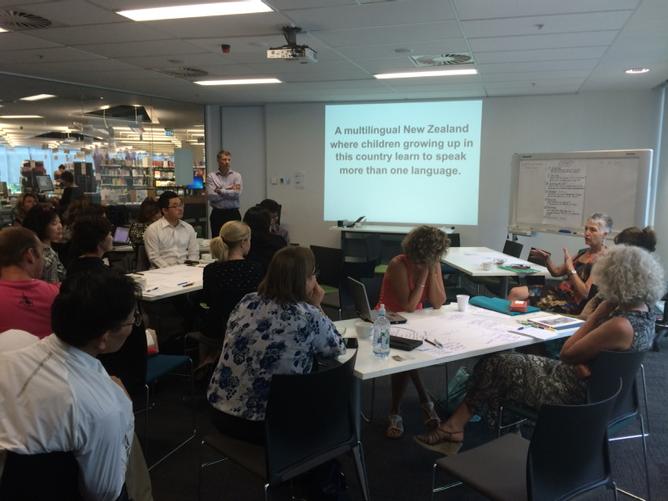
Yesterday i had the privilege of collaborating with a room full of passionate language learning advocates from community groups, schools and supporting organisations. Our main focus was to discuss the challenges and opportunities for schools in developing and sustaining language programmes in schools and how we can provide support and guidance for schools in the ALLiS initiative.

There were many details discussed of how we can collaborate to support successful and sustainable programmes but what has been clear in this meeting and previous ones is that a national language policy & strategic plan for learning languages is critical to co-ordinate, drive and sustain this work. 

It was really interesting to meet Susan Warren and hear about the work of COMET educational trust and in particular the development of a Languages Strategy for Auckland. It makes a strong case for developing Auckland (and that should read - New Zealand) as a multi-lingual community and also a strong case for a National Languages policy. Here are some of the points that resonated with me - you can read the whole document here and there is still an opportunity to submit a response here within the week.

"Multilingualism is central to a diverse city: it allows us to value ourselves, build community, build tolerance, and live peacefully and prosperously.Currently, many Aucklanders miss out on the cognitive advantages of multilingualism. As a community we miss out on the potential of younger language learners because we fail to take advantage of the best windows for language learning and the most effective years for language maintenance. Auckland’s migrants, especially our older migrants, could receive much better support for their aspirations to learn communicative English. As a community we fail to grasp the cultural and aesthetic benefits of multilingualism, and many Aucklanders cannot garner the educational attainment that crosses language boundaries and unifies knowledge in varied domains. One of the more obvious impacts of the absence of a languages policy in New Zealand is seen in education.  Evidence shows that quality bilingual or immersion instruction in children’s first or heritage language brings measurable gains in literacy achievement in the target language and also in English[1].  However requests to the Ministry of Education for tailored materials or professional development for bilingual classes are met with an explanation that there is no policy to enable provision for learning through languages other than English, te reo Māori and NZ Sign Language.Most New Zealanders (93 per cent) agree it is valuable to learn another language[2]. Language skills and cultural sensitivity are now required for successful participation and engagement locally, nationally and globally in all spheres of activity. Auckland is well placed to harness its language potential.In the past, it has been possible to “get by” in English only. For our young people to thrive in the future, they will need more options and more experience as language learners. Because most of the world is multilingual this need will be felt even more acutely as today’s young Aucklanders spread their wings globally. Most English-dominant countries today require their young people to have another language; all of New Zealand’s associates in ASEAN require kids to learn another language from a young age. New Zealand identifies strongly with the ethics of team membership: being a team player in the 21st century will mean being multilingual."


[1] Asia New Zealand, http://asianz.org.nz/newsroom/media-releases/2014/perceptions-asia-2013 

[2] Ministry of Education (2008).  Teaching and learning for bilingual Pasifika students in New Zealand.