Monday, 17 April 2017

Do rural communities want to be connected?

A couple of weeks ago I was pontificating on a vision for connected rural communities and the benefits it would bring, even going so far signposting a Rural Renaissance!
So it was interesting to read this article from the Taranaki Daily News about locals in the Republic of Whangamomona being divided on the need for internet or cell phone coverage in their district.


On the flip side (& there is always a flip side) - here is what Rural Women NZ have to say in their 2014 - 2017 Manifesto

It is encouraging to see there has been some movement on extending mobile coverage but there is a lot more work to be done to make fast internet accessible for all our rural learners and their families. Access is not only about having the infrastructure available but more importantly about affordability.
With an election year is process I look forward to seeing what is in store with a new manifesto from Rural Women NZ.

Wednesday, 5 April 2017

The more things change, the more they stay the same

In my recent post NZ Research & Articles - Online Teaching & Learning, I commented on the similar themes coming up in the research from nearly two decades of learning online. To illustrate this, and just because history really interests me, I want to share this report.

Te Pouaka Whakaako ki te Kāreti o Ngata
Telelearning and Contexts of Awareness at Ngata Memorial College. Report prepared for Te Puni Kōkiri by Ken Stevens (1998).
This case study of telelearning at Ngata Memorial College in Ruatoria, compares students who are telelearning with those who aren't and what their perceptions were of the wider world.
Telelearning (audiographics) provides students with a connection with the world beyond school and extends educational and vocational opportunities for students and adults in remote communities.
In this report Steven's raises the government's commitment to equality of educational opportunity and how developments in ICT have  wide ranging implications for schools, in teaching & learning, and administration policy.
He unpacks in detail the differences between telelearning and distance education in relation to how each was positioned to serve the society of the times. Distance education belongs to an industrial age model; telelearning to the information age. Steven's goes on to describe the changing educational environment where:

  • schools are inter-connected through ICT networks, 
  • technologies are used to provide new and better ways of learning, 
  • ICT skills will provide employment advantage, 
  • there will be an urgent need to provide the mass provision of appropriate technologies to classrooms. 
These are key themes that are still important today, as are individualised model of teaching and learning and the changing role of the teacher, which are also discussed.
This report was written just on the advent of Tomorrow's Schools and describes a highly centralised system of education without which small schools would be challenged to provide a quality education in a increasingly competitive environment. This has been a huge change since this time and in itself has been a key driver to the growth in collaborative online networks in the decade to follow. Steven's mentions the growing reality of the virtual classroom with the development of Cantatech & TOSItech and a developing East Coast network (which could be the precursor to the KAWM Network).

There were a number of recommendations from this report to the Ministry of Education. Some are summarised below:
  • Recognise their pioneering role in telelearning education and support the expansion to other NZ schools;
  • Expanding links to Colleges of Education;
  • Recognise the Māori cultural context and consult with the broader Māori community;
  • Be recognised as a special technology school, 'a valuable educational laboratory' from which other schools could learn;
  • They should no longer be considered a small school but be funded as a virtual school.
It is interesting to see the work that was pioneered by Ngata Memorial College is still very relevant today. Maybe now we are 17 years into the 21st Century we will start to see the change that the Information Age has promised being realised for NZ learners.

Tuesday, 4 April 2017

Fast internet drives 'Rural Renaissance'.

 In 2003 TUANZ led a National Broadband Applications Project where cross sector forums were set up regionally to discuss the potential of broadband and come up with some scenarios about what life would be like beyond dial-up. This was during the days of the roll out of Project Probe. We are now well onto the second wave of superfast internet with the roll out of fibre, 4 G networks and improved satellite service.
Those scenarios discussed in 2003 forums were published in "Survival of the Fastest"
I love the education scenario of "A Third Way at Blacksmith's Elbow" (Chapter 4) which describes a small rural community connected to broadband:
  • Broadband brings everybody access to whatever resources they need;
  • The community grows, instead of shrinks;
  • People find it easier to be life-long learners;
  • People are collaborate;
  • The school is the hub of the community.
“Rural New Zealand” by Sarah Stewart is licensed under CC BY 2.0

And "A Renaissance in our Heartland" (Chapter 4)
"But perhaps among the most important were social applications. Broadband is ultimately about empowerment and decision-making. It's about access to information. It's about a change in the rural environment. No longer is it just farmers and craftspeople plying their trade in relative isolation. Give them a broadband link and any entrepreneur worth their salt can live and work anywhere. We're already seeing software design becoming a rural industry. With a video-conferencing link, people can have a virtual presence from almost anywhere.
Broadband access means the whole distribution of the population will be different as the city moves to the country. Why? Because they want to, because they can, and all because of broadband.
And if one person moves, it's likely that the family will, too. They will go to the schools, buy from the shops, use the services, and generally contribute to the community. In turn, they will create jobs, opportunities and lead to a rural renaissance."
These future focused scenarios were envisioned 14 years ago. So where are we now? How far down the track are we heading towards scenarios described here? Or are the paths we are walking different than we had earlier imagined and will they lead us to different destinations? 

Adams, G., & Telecommunications Users Association of New Zealand. (2003). Survival of the fastest: a guide to how New Zealand can use broadband to lead the world, from the TUANZ National Broadband Applications Project. Auckland, N.Z.: Telecommunications Users Association of New Zealand.

Tuesday, 28 March 2017

NZ Research & Articles - Online Teaching & Learning

As part of my literature review I am collating as much of the NZ written/NZ based literature on online/virtual learning as I can find. Much of this I have read, and some I have contributed to, been a participant in, or even written myself. Some of it is before my time, but I believe our whakapapa and learning  journey contributes to where we are today, and where we will go tomorrow. I also see that what was relevant in a report for example on Telelearning in the early 90s, is still relevant today and is really a case of 'the more things change the more they stay the same.' Two decades and more down the track virtual/online learning is still on the fringes (and often not even a blip on the radar) of mainstream learning. However this may start to change as policy catches up with practice (see recent post on CoOLs).
Although technology brings us closer together (it is only 2 years ago that we were able to turn cameras on in our VLN Primary classrooms!), we are still challenged by many of the same things online teachers were in the 90s.  The need for schools to be open and collaborative, the professional learning needed by teachers (& students) to become more digitally fluent, the need to change teacher pedagogies to be more student directed; there are many more similar themes running through the literature some of which I will unpick more of over the coming months.

I use Zotero and have a group with shared bookmarks - genuine contributors welcome to join here. In this post I will share some key resources and include abstracts. There are many more in this Zotero folder & I am sure many new readings to discover.

Monday, 13 March 2017

Review of education funding systems - Threat or opportunity for NZ Rural Schools?

Following on from an earlier post about Rural NZ - A great place to live and learn, here is some context of what is happening in the educational landscape at the moment.

We are currently going through the process of legislative change and a funding review that will have the biggest impact on NZ schools since 1989 and the introduction of Tomorrow's Schools. For more on Tomorrow's Schools see Langley, 2009; Wylie, 2013.

The Education (Update) Amendment Bill proposes a range of changes, of particular relevance to my study is Communities of Online Learning (or CoOLs), which has been the most contested and provocative part of the bill. I write about this in another post.

The Education Funding System Review, that sits alongside the proposed legislative changes, has been in the consultation phase since last year (I recommend that you read the Cabinet Paper that sits behind what is on the MoE website) There has been one change of tack to the original proposal when teacher unions pushed back on Global Funding mechanism - this was seen as another way of bulk funding schools that was so strenuously opposed in the early 2000s. The reasons given for not proceeding with the global budget was
"schools indicated that the current system of funding delivery generally works well and can provide the flexibility required"..."Moreover, it is clear that neither principals nor teachers yet have confidence in governance and management to make good choices about the mix of inputs necessary to meet the educational challenge for their students." 
That last phrase is dynamite and should be of concern if the Minister thinks that after more that 20 years of self governance school leaders lack the skills to make good choices. Without going further into the politics of the discussion in this paper - here are the key points in relation to small and rural schools:


 The Proposed Model of Funding

26.1 a core funding model in both early learning and state and state integrated schools made up of two components:
26.1.1 a curriculum-based per-child funding amount - linked to the learning expectations of children and young people at each stage of the curricula. In early learning, this involves moving to per-child funding. In schooling, this involves a review of funding levels at each stage of the curriculum;
26.1.2 additional funding for individual challenges:
26.1.2.1 targeted additional achievement allocation - for children and young people from disadvantaged backgrounds and to replace the current decile system and better align funding to the actual curriculum-based achievement challenge; 
26.1.2.2 learning support (special education) allocation - for those learning support needs that services and schools are expected to meet from within their funding;
26.2 for small and isolated early learning services and state and state integrated schools, supplementary funding to enable the maintenance of a network of provision;
Of importance to rural and small schools is section 70 - 73:

Defining small and isolated services and schools
70 To support education provision being located as close as reasonably possible to families, I propose supplementary funding for small and isolated services and schools. This takes into account population densities in rural and provincial areas and our objectives for choice and diversity in education provision, including for Maori medium education. 
71 Small schools face fixed costs in administration and curriculum delivery, including in providing subject choice at the senior secondary level. Isolated services and schools can face extra costs related to both teaching and learning and accessing trades and services. These services and schools would not be educationally viable if they received only the curriculum based per-child funding amount and the additional funding amount for individual challenges. 
72 I am seeking to develop an approach to these services and schools that provides the minimal additional funding necessary, supports our objective of increased collaboration across  and system,  and takes into account  the potential  over  time for  Communities  of
Learning I Kahui Ako  and for Communities  of Online  Learning  to mitigate  some of  the costs in the operation of small schools, including those associated with providing curriculum breadth. 
73 The first stage of this work involves establishing a coherent basis for defining small and isolated services and schools. The second stage of this work involves determining the extra costs that these services and schools face in maintaining a viable provision and, hence, the funding that they require over and above that provided by the core funding model. There is a close relationship between this work and that related to the per-student funding amount.

I can understand the need to simplify a complicated system, I can understand the benefits of network provision across schools, I can see a need for equity across our schooling system, I believe to move forward we need to make changes, and change is challenging. However lets make sure that we do this while retaining what is special about our small rural schools, and not just focusing solely on 'progress that can be measured at each level of the curriculum'.


If you are a supporter of our small rural schools, I would be watching this review process carefully, talking with Principals in your local schools and advocating on their behalf.


Langley, J., & Cognition Institute. (2009). Tomorrow’s schools 20 years on-. Auckland, N.Z.: Cognition Institute. Retrieved from http://www.cognitioneducationtrust.org/wp-content/uploads/2013/09/report_cognition_institute_john_langley_ed.pdf


Wylie, C. (2013). Tomorrow’s schools after 20 years: can a system of self-managing schools live up to its initial aims? The New Zealand Annual Review of Education0(19). Retrieved from https://ojs.victoria.ac.nz/nzaroe/article/view/1555

Sunday, 12 March 2017

CoOLs - Communities of Online Learning - A double edged sword?

Tomorrow the report from the Education and Science Select Committee, who are looking at Education (Update) Amendment Bill, is due. There are a raft of changes proposed in this bill, though the part that is most of interest to me is Part 3A - Communities of Online Learning.

With my work at the VLN Primary School, I have been asking for something like CoOLs for a very long time. Here are our VLN Primary Submissions over recent years, they all ask for better resourcing, support and for inclusion of online learning within the mainstream schooling sector:
Why the outrage from parts of the sector that say they have been blind sided by part 3A of the Education Amendment Act bill? That it came out of nowhere, and there has been a clear lack of consultation? Well no, for some that were 'gobsmacked' to hear about it, they just didn't have this on their radar because they aren't taking notice of what is already happening in our schools. It isn't through lack of engagement on my part, I have been trying to get these ideas through to the wider sector for many years, as have some of my colleagues & been frustrated by the sectors lack of interest and support.

I have to support the notion of CoOLs this is what I have been working for most of my professional life towards. So why would I be concerned that CoOLs is going to come back and bite us on the bum!

Because it's not just about the VLN and its not just about CoOLs alone, its about being part of a whole system change, with some contentious neoliberal agendas in the mix.

The VLN Primary School has always been about providing equity and access to our learners where ever they are through online learning; the flip-side some see commercial providers using online learning as a tool to provide cheap online education to the masses.

The VLN Primary School has always been about collaboration across schools and building collective capacity, networks and relationships where all are contributing to the education and well being of our learners; the flip-side the imposition of networks across schools with a focus on standards based learning and accountability of achievement, this may change the unique character or rural education in NZ.

If you want to know more about what has been happening with Virtual Learning in New Zealand, and have some myths about online learning busted, then watch my EdTalks video, screened at ULearn16.

CENZ presents Rachel Whalley from EDtalks on Vimeo.

If you want to read some of the submissions about CoOLs made to the Science & Select Committee you can see them all in their entirety, or you can read notes from some key submissions that I have collated here. This will give you an idea of many of the concerns that are being put forward about CoOLs, some of which I agree with.

Rural New Zealand - A great place to live & learn

This video from Barbara Kuriger, MP for Taranaki/King Country, prompted me to think and write about my focus on Rural Education.

Barbara is responding to this type of media report "Tough choices ahead for small-town New Zealand". These sorts of articles appear regularly in our media "Regions must adapt or suffer decline, says academic" or how about this lovely headline "Zombie towns looming, leaders told".


I believe that with affordable land and housing AND access to super fast broadband, not to mention a better quality of life for families then we could see a demographic shift away from the cities back to the regions and rural areas.

More professionals are now working remotely and running their businesses from home. In 2015 The Future of Work Commission found that:
"30% of workers in New Zealand now work full or part time remotely. 11% of these stated they were working full time at home which is double when it was last measured by the company in 2006.
It found further expansion might be on the cards as well with 39% of people saying their work could be done remotely and 68% of those who don’t currently work at home would like to. One of the major advantages it identifies from this is that it would enable the person to live in a different town or city if they wanted to." [my emphasis]
People can live and work anywhere, they don't need to be stuck in the cities. A Rural Renaissance could be just around the corner!

With fast reliable internet, and collaboration across schools and communities our children can also can learn anywhere with anyone. The small rural school that is open, networked and collaborative now has greater teaching & learning capacity than it's urban counterparts.
"For the first time in history, school size, as measured by students in daily, physical attendance, is no longer a measure of a school's teaching capacity. In an open learning environment it is the extent to which a school is networked that determines its teaching and learning capacities." (Stevens and Stewart, 2005)
Stevens, K., & Stewart, D. (2005). Cybercells: learning in actual and virtual groups. Southbank,
Vic.: Thomson/Dunmore Press.

So why do i love rural schools?

Growing up in Rural NZ (Stratford, 1970)
  • Where else can you have fresh blackberries picked for you for morning tea;
  • Build tree huts in the shelter belt;
  • Play in piles of autumn leaves at break time;
  • Look after lambs in the staffroom;
  • Have a weeks worth of cross curricular learning originate from the school woodpile - technology, maths, science, reading;
  • Have the whole school come in camouflage at the start of the duck shooting season;
  • Go to the harbour for creative writing and have an elephant seal oblige for story starters;
  • Have bush camp for juniors (and all your kids);
  • Have a conservation reserve in the middle of your adventure playground when a rare stilt nests there;
  • Join in the docking in the paddock next door after lunch;
  • Care for the kiwi in your local area;
  • Tell your Mandarin teacher that you need to learn how to count past 10,000 because that's how many animals you have at home;
  • Have a school trip/treat to the end of the road to meet the Mr Whippy van that stops for all Eastern Taranaki schools on a Wednesday afternoon on the way to Whanga. (I don't know if this still happens :)

Saturday, 18 February 2017

Collaboration Across New Zealand Rural Primary Schools: A Virtual Learning Perspective.

So here is my successful Research Proposal. I'm going through the process of preparing my Ethics Approval now and hope to be inviting participation in this research in about a month's time.


 Abstract/Summary
Virtual learning has been taking place in New Zealand for two decades and pioneered in our rural
schools (Barbour, 2011; Roberts, 2010; Wenmoth, 1996).
“Small rural schools in New Zealand are in the forefront of changes in the application of information and communication technologies to teaching and learning. The emergence of rural school electronic networks is an important step towards the development of virtual classes in New Zealand, requiring new ways of organising teaching and learning. It is particularly appropriate to reconsider the pedagogy of the one- and two- teacher school in relation to the emerging virtual class. These small schools could have a new role in the information age and should, accordingly, be repositioned within the national educational system” (Stevens, 1996, p. 93).


This quote from Ken Stevens, made 20 years ago, has challenged me to consider how virtual learning has evolved over the last twenty years. How have rural schools been leading the way and benefiting from virtual learning? To what extent are we seeing new ways of teaching and learning online?


Virtual learning can be defined as learning that is facilitated by a range of technologies to enable communication and collaboration, where students and teachers are in distributed locations (Bolstad &Lin, 2009).

My research aims to examine how collaborative practice between schools working in virtual learning environments can alleviate the challenges small rural schools face for both students and teachers. These challenges could be in relation to access to professional support and a wider curriculum because of a school's small size and relative isolation.  I will explore how collaborative online learning could enable innovative practice and new ways of thinking about the nature of schooling; while also exploring the challenges and potential pitfalls this may bring to schools. This research will be undertaken within the context of the Virtual Learning Network (VLN) Primary School network within which I work, and with the Principals who participate in VLN Primary programmes and projects.

The VLN Primary extends learning opportunities for students by enabling online learning between schools. Children have the choice to engage with a wide range of subjects that may not be available in their school. The VLN Primary provides professional development for teachers, student learning support, technical support and logistical coordination of online classes and programmes to schools around New Zealand (Virtual Learning Network Primary School, 2013). Learning is tailored to meet the needs of students, and make the most of the strengths of the schools. For example, through a reciprocal arrangement, the schools provide teachers in a subject in which they have a high level of expertise. Where it isn't possible for schools to provide that teacher, another teacher is contracted into the VLN Primary. Students and teachers use a range of synchronous and asynchronous tools that enable them to communicate and learn online together. The VLN Primary School is a registered Charitable Trust governed by its participating schools and supported, in part, by the Ministry of Education (Virtual Learning Network Primary School, 2016).

Research question or hypothesis
My main research question is:
What are the challenges small rural schools face and how can collaborating online provide benefits to learners, teachers and principals?


Supporting questions:
  • What is the experience of teachers/principals with online collaboration across schools?
  • What are their beliefs about learning online?
  • What are some of the enablers and barriers to collaboration across schools?
  • What are some of the enablers and barriers for teaching and learning online?
  • How do teachers/principals think that teaching and learning online may change the nature of schooling in the future?
Methodology
The conceptual context of this research will be situated within an interpretivist or constructivist framework. Within this framework reality is socially constructed, is context dependent (socially, culturally and historically) and can have multiple meanings depending on individuals’ perspectives. The stance of the researcher is not subjective as they are part of the research process, and involved in co-constructing meaning (Cohen et al., 2007; Mutch, 2013).

In addition to this there will be some elements of Critical Theory emerging as underlying the aims of the VLN Primary School are notions of social justice through providing greater equity and access to learning. Tait & O’Rourke, (2014, p.51) articulate the vision of the VLN Primary really well when they say: “our concept of social justice for each individual encompasses both the notion of equality rights as a ‘level playing field,’” and the “right to opportunities and support that enable each person to fully participate in all aspects of society—to get to the playing field in the first place.”

Semi-structured interviews will be held with a focus group of school Principals. Key themes will be drawn from the focus group discussion and followed up in more detail with individual interviews with no more than six of these Principals. I will use an iterative data analysis process whereby patterns and trends emerging at each stage of data collection are used to inform the next stages of data collection (Srivastava & Hopwood, 2009). Existing VLN Primary documents will be analysed to contribute to the body of knowledge developing. eResearch will be woven through the process not only because it makes sense due to the context but because it enables and amplifies research in ways that were not previously possible. eResearch will include online focus group discussions, the collection of data such as recorded lessons, conversations, screenshots, chat transcripts and Google analytic tracking of website usage and interactions. With this type of eResearch, ethical concerns of privacy are raised. Pardo & Siemens, (2014) identify four principles that should be addressed in regards to privacy of online data in educational institutions; they are transparency of processes, student control over data, security and access to data, and accountability and assessment of systems

Who would be interested in the outcome of your study?
Whanau and communities who have children learning in collaborative online communities would be interested in this study to gain a better understanding of their children’s online learning experiences. For those whanau and communities whose children are not learning in the virtual setting, this research may make them more aware of the potential benefits and challenges involved and cause them to consider supporting virtual learning in their own schools.

Schools (teachers, principals and Boards of Trustees), who are involved in collaborative online learning might be interested in the findings of this research for self-review and school improvement purposes; and schools that are not yet involved may be interested to see the possibilities and to learn from experiences of those who have pioneered the space.

Research findings will inform policy makers on current practice in collaborative online learning across schools and how we can realise the potential benefits of virtual learning for students, teachers and school communities with the New Zealand educational setting. This study aligns with Ministry of Education priorities in relation to collaborative practice and system changes within IES - Communities of Learning and the current Education Review  - Taskforce on Regulations Affecting School Performance (2014). Particularly relevant is the proposed regulatory framework for online learning and potential formation of CoOLs (Communities of Online Learning). It also aligns to the Ministry of Education (2016), priorities as outlined in 'The Four Year Plan 2016 - 2020' for improving student centred pathways and championing 21st century practice in teaching and learning.

References
Barbour, M. K. (2011). Primary and secondary e-learning: Examining the process of achieving maturity. Christchurch, New Zealand: Distance Education Association of New Zealand. Retrieved February, 2015, from http://www.vln.school.nz/mod/file/download.php?file_guid=114023


Bolstad, R., & Lin, M. (2009). Students’ experiences of learning in  virtual classrooms. Wellington: NZCER. Retrieved November, 2016, from http://www.nzcer.org.nz/system/files/students-experiences-learning-virtual-classrooms.pdf


Cohen, L., Manion, L., & Morrison, K. (2007). Research methods in education (6th ed.). London ; New York: Routledge.
Ministry of Education. (2016) Ambitious for New Zealand: The Ministry of Education Four Year Plan 2016 - 2020. Retrieved November, 2016, from http://www.education.govt.nz/assets/Uploads/4-Year-Plan-2016-WEB.pdf


Ministry of Education. (2016) Establishing a regulatory framework for online learning. Retrieved November, 2016, from http://www.education.govt.nz/ministry-of-education/legislation/the-education-update-amendment-bill/establishing-a-regulatory-framework-for-online-learning/


Mutch, C. (2013). Doing educational research: a practitioner’s guide to getting started. Wellington: NZCER.


Pardo, A., & Siemens, G. (2014). Ethical and privacy principles for learning analytics. British Journal of Educational Technology, 45(3), 438–450. doi:10.1111/bjet.12152


Roberts, R. (2010). Increasing access for learners – The Virtual Learning Network. In V. Ham & D. Wenmoth (Eds.), e-Learnings: Implementing a national strategy for ICT in education, 1998-2010 (pp. 144-152). Christchurch, New Zealand: CORE Education Ltd.
Srivastava, P., & Hopwood, N. (2009). A practical iterative framework for qualitative data analysis. International journal of qualitative methods, 8(1), 76-84.
Stevens, K. (1996), The Technological Challenge to the Notion of Rurality in New Zealand Education - Repositioning the Small School. New Zealand Annual Review of Education, 5, 93 - 102.
Tait, A., & O’Rourke, J. (2014). Internationalization and Concepts of Social Justice: What Is to Be Done? In Online distance education: towards a research agenda. Retrieved from http://www.aupress.ca/books/120233/ebook/99Z_Zawacki-Richter_Anderson_2014-Online_Distance_Education.pdf
Taskforce on Regulations Affecting School Performance. (2014). Considering education regulation in New Zealand. Retrieved November, 2016, from http://www.minedu.govt.nz/theMinistry/EducationInitiatives/~/media/MinEdu/Files/TheMinistry/EducationInitiatives/Taskforce/TaskforceReport.pdf
Virtual Learning Network Primary School (2013). Charter & Strategic Plan 2013 - 2015 - Connecting New Zealand Schools for Enhanced Learning Outcomes. Retrieved November, 2016, from https://docs.google.com/document/d/1vLMmV1-1zJvMH3kL7z9VzyTvZYdtnRKIbQpUXVB5WEA/edit?usp=sharing
Virtual Learning Network Primary School (2016). Submission on the Education (Update) Amendment Bill. Retrieved November, 2016, from https://goo.gl/LHXttO
Wenmoth, D. (1996). Learning in the distributed classroom. SET Research Information for Teachers, 2(4). 1–4

Tuesday, 31 January 2017

How Accessible is the Internet for our Rural Children?

We had our first staff meeting for this group of Principal's to make plans for the year ahead in our collaborative cluster of schools. 
So we got to talking about access to technology that is so important to providing the base from which we learn together. What do our children have available to them at school and at home in the form of computing devices and internet connectivity?
We estimated that in our schools the range of childrens' access to internet at home was 50% in one school through to 80% in another and several points in between for the rest. So still a clear digital divide for a lot of our learners. But the digital divide does not stop there. Although we can say our students have the internet at home, it is often still not accessible to them, or for very limited periods of time. ISP costs mean that data is carefully rationed and often only used by parents on their phones.
Although it is said that there is internet at home, children may only get to access the internet when they come to school. Given this scenario, it would be interesting to see the real data about how accessible the internet is to our children. I should include this as part of my research questions. I am sure it would be nowhere near Statistics NZ's number of internet enabled households. 

Principals from the Rural & Remote Project first staff meeting 2017
More than a dozen years since Project Probe was initiated specifically to serve these communities we still have broadband that is too expensive. This is very disheartening on the back of announcements that fibre will be coming to more of rural NZ. Good for those areas, it is good news for them, although the wait time is still up to 2024! However some of those areas (like my own) already have access to a reasonable copper network & VDSL. Our rural areas have no networks and have to rely on expensive & unreliable satellite service.

The next UFB rollout is aimed at provincial NZ where there are towns - I didn't see Whangamomona on the list (Whataroa, Tapora, Makahu or Oban). What about the rest of the rural NZ, what can be done to make Internet more affordable and accessible to our children there?

Sunday, 29 January 2017

TeachNZ Study Award

Matata Beach at Sunset
I feel very privileged to have received a TeachNZ Study Award to undertake some research this year. My thesis will be in my special area of interest - Rural Education; and expertise - Virtual Learning. I'll be on sabbatical for Term 2 & 3, however I will still be working in a Governance role and doing all that is necessary to keep the VLN Primary School on track and moving forward. I'll be using my blog to share some of my learning and reflections during the year ahead.

I am really looking forward to having some time and headspace to read, reflect and write more deeply on education issues that interest me. In the last few years any time and headspace has been completed directed to growing and maintaining VLN Primary communications - Blog, Facebook, Twitter & Hail; and there has been little left over to write from my own professional viewpoint. Not that these viewpoints widely differ, there are just some things that I wouldn't want to say in VLN Primary media that i hope to be able to write about here.

Sunday, 11 October 2015

VLN Primary School in Print - STA News

Here is an article i wrote for the NZ School Trustees Association about the VLN Primary School. It gives a pretty good snapshot on who we are and what we do:

"At a time when schools are increasingly stretched to find the resources to provide a broad and relevant curriculum for students, they are also being challenged to become more collaborative and future focused. We are on the cusp of major changes both politically driven through IES Communities of Schools and technologically driven through the N4L managed network for schools. There is a drive to harness the power of technology to change the way we learn, make learning more student centred and personalised and for collaboration across schools. How are schools meeting these challenges? With a deluge of ipads, the ‘appification’ of learning (there’s an app for that), should we have 1-1, BYOD, Chromebooks, Google, Microsoft, Wireless, have we been snupped, when do we get on to N4L?  We are getting close to the point where technology is ubiquitous, a utility like power or water. Schools need to look beyond the digital network and environment to the people network that connects and learns in that space.

The Virtual Learning Network (VLN) Primary School has as its’ tagline “Connecting Schools for Enhanced Learning Outcomes”. It is a people network collaborating online and dedicated to providing equity and access to learning opportunities for New Zealand students. It aims to connect schools through a collaborative online network (the virtual school) in order to open up access to specialist teachers, share the best of our teaching strengths, and to build professional capability that enables schools to become more flexible and open places of learning for our children. It began as a school cluster hosted within Matapu School, South Taranaki, and has evolved into a Charitable Trust led by school leaders and virtual learning advocates. It is partly funded in partnership with the MoE and contributions from participating schools.  
The VLN Primary School builds on work that has been developed in the schooling sector, over the last nearly 20 years where programmes have been provided ‘virtually’ through online classes & projects taught by NZ based teachers. Approximately 80 primary schools and 1000 students have participated in the VLN Primary School to date since 2009. Learning opportunities are developed through the needs and strengths of the schools themselves and eteachers and tutors are provided by schools themselves or contracted into the network.There are regular weekly scheduled classes for extension maths, literacy, science, Astronomy and a wide range of languages - Te Reo Māori, Mandarin, Spanish, French, Cook Islands Māori, German, Japanese, Afrikaans, Korean, Bahasa Indonesian and Tagalog. 
In addition to this the ‘Over the Back Fence’ run by Rosmini College, has regular connections with schools in NZ, Pacific, India & globally focussing on Health & Environmental topics. Our Rural & Remote Schools Project brings together schools from Stewart Island, Great Barrier, Eastern Taranaki & Wairarapa with the goal of reducing the social isolation of these distributed students, giving them opportunities to learn alongside peers their own age and preparing them for leaving their districts to go to High School. There is a great opportunity to build on this project to extend the benefits to many other small and isolated schools, but sustainability of resources has prevented us from scaling up this very successful project. 
Participation in the VLN Primary School gives students a voice and choice in what they learn, how, when and where they learn, and who they learn with; regardless of their geographical location and economic means. It aims to provide teachers and school leaders across networked schools with professional learning and support to enable them to develop as future focused learning organisations. When you next think of your school network, think beyond the technology to the people network and how your school can become connected to an online community of learners."

Sunday, 4 October 2015

What's up for the VLN Primary School


We're coming up to the downhill side of the 2015 school year and we are still not sure if we have got funding to continue our VLN Primary operations into 2016 and beyond. This is a real challenge!

There is a strong need particularly among our rural schools to keep this collaborative, learning support happening for our students; there is a depth of experience that has been developed over the last 6 years in our eteachers, teachers and Principals, that we would lose if we lost our schools network. I had been cautiously optimistic that there would be a place for our work, within the changes that are happening in our schooling system at the moment. Although we (along with other VLN community clusters) have plainly been told 'we don't fit the policy parameters' for accessing resources for Communities of Schools. We also are not the right stuff for 'Teacher Led Innovation Fund' as we were unsuccessful in our Rural Schools application. It is hard to see that we aren't innovative enough to access this fund? Maybe we didn't get the right spin on our application so will try again in November. It is really disheartening to see the opportunities that are coming up that we are still not the right fit for....
So to keep ourselves afloat for 2016 until we can take our (rightful) place within the publicly funded schooling system,  I have  spent the last month in chasing up and writing funding applications through our charitable trust, breaking down various parts of our projects & operations to aim at different funding opportunities. I have all my fingers and toes crossed waiting to hear.

(one glimmer of good news is that we do have an Asian Languages contract with the Ministry of Education and will be continuing with Chinese, Japanese, Korean & Bahasa Indonesian)

Just been remixing our Virtual Learning Network Primary School Story, created by Kath after our last rural camp. What an...
Posted by Virtual Learning Network Primary School on Saturday, October 3, 2015

Wednesday, 2 September 2015

CRAM - Unpacking the Model with #DEANZ

This afternoon i joined a Google Hangout session with Bill Anderson from DEANZ. Today's informal hangout was to provide an opportunity for DEANZ members to connect and 'talk or ask questions about any of the newsletter items such as the CRAM model; Creative Commons Clinics; the National Digital Forum; the Blended Synchronous Learning Handbook... or any of the latest items about DEANZ.'

It was great to have an opportunity to meet with other like minded professionals and talk about not just whats new in flexible and online learning but how this reflects in our experience within our own institutions and teaching practice.


Bill unpacked the theory behind CRAM (Course Resource Appraisal Model), showcasing it as a tool that can help provide a framework for us to analyse the design and quality of our online courses. He advocates for it to be used as a reflective tool for inquiring into the quality of our teaching and not as a tool for institutional efficiency. From the newsletter:
'CRAM is an acronym for Course Resource Appraisal Model. Doesn't exactly sound 'sexy' does it?
Yet, CRAM is a little online tool that I think is really interesting, and well worth a look. It attempts to support tertiary teachers (and maybe others) who want an answer to the question
“Can we improve the quality of students’ learning experience without increasing staff
workload, even for greater student numbers?” and I think does a pretty good job helping them There is a caveat. To use the tool effectively (even to consider using it at all) you have to be familiar with Diana Laurillard's work on learning and technology – especially her most recent work “Teaching as a Design Science”, although a quicker read is the article “Making meaningful decisions about time, workload and pedagogy in the digital age: the Course Resource Appraisal Model” published in Distance Education here (Caution: You'll need library access or else be prepared to pay!)'
There were lots of good ideas to follow up on around learning design of online courses and support for teacher professional development. In following up on Diana's work in learning design, I found myself at this website http://learningdesigner.org/  an early release version of an online tool for learning design. For the learning designers out there - do you have a particular model or framework that you use and/or specific tools that help you pull it all together. Please share, i would be interested to know.

Tuesday, 21 July 2015

The Joint Initiative - A Better Plan

(Wordle based on the Joint Initiative Working Party Report)

Today the NZEI released details of the Joint Initiative - a plan forward with the MoE instead of the IES that was rejected by the NZEI collective.

Communities of Learning instead of Communities of Schools
The aim of this initiative is to give more emphasis on collaboratively improving students achievement outcomes and less on the roles and admin of a system change that was being proposed through IES.

Is it just the same thing but dressed up differently using different eduspeak? I am sure members will be discussing that as they meet to vote on this over the coming few weeks.

Louise Green, NZEI President, tells members, "We believe the new model is an exciting educational development, genuinely shaped by educators. Inevitably, as with any negotiations, we have had to make compromises, but we are confident that the progress we have made will genuinely improve teaching and learning."

Key Learnings from the Working Group were summarised as:

  • Communities of Learning should self-identify with clear pathways across the sector;
  • Their clear purpose is to improve educational achievement aligned with NZC, though they can define their areas of focus;
  • Data, evidence & research is used to target efforts;
  • Each Community should determine its own leadership, teaching, collaboration and support functions:
  • Some roles will be required for all and these will be appointed in conjunction with an external professional advisor;
  • Be flexible and prepared for change over time;
  • Each Community will assess it's own resource needs;
  • 'Whole of Community of Learning collaboration" is critical to success;
  • Commit to second stage - further work on priority areas - Māori, Pasifika, ECE, Support Staff, Special Ed, PLD;
  • Community roles will align with career pathways.
So what will this look like when we come to implement such a plan? 
How flexible will this plan be?
How will this work for the rural and isolated school, will they be able to develop CoL that are geographically distributed?
How do schools select their Community that has clear pathways when the pathways for many of our students are so diverse?
Where will be the tension between roles determined by the Community and roles required by the MoE - and how will resources be distributed between them?

One positive that were raised for me was that there was recognition of the roles across schools as well as within schools - this may provide some support for the role I have occupied across schools for years with no formal recognition, support or career pathway.

Another point to flag in this plan was the inclusion of Professional Learning and Support as an explicit feature to be worked towards in the second stage of the Joint Initiative. We have been waiting for some time as to the outcome of the Professional Learning & Development Review, so this may be the basket it is ending up in.

So still a work in progress, and a space i am watching closely with the hope that the 'Policy Parameters' of this plan are flexible enough to include the work of  the VLN Primary School.

Monday, 20 July 2015

A Call to Action - Equity, access, quality and teachers in the digital age

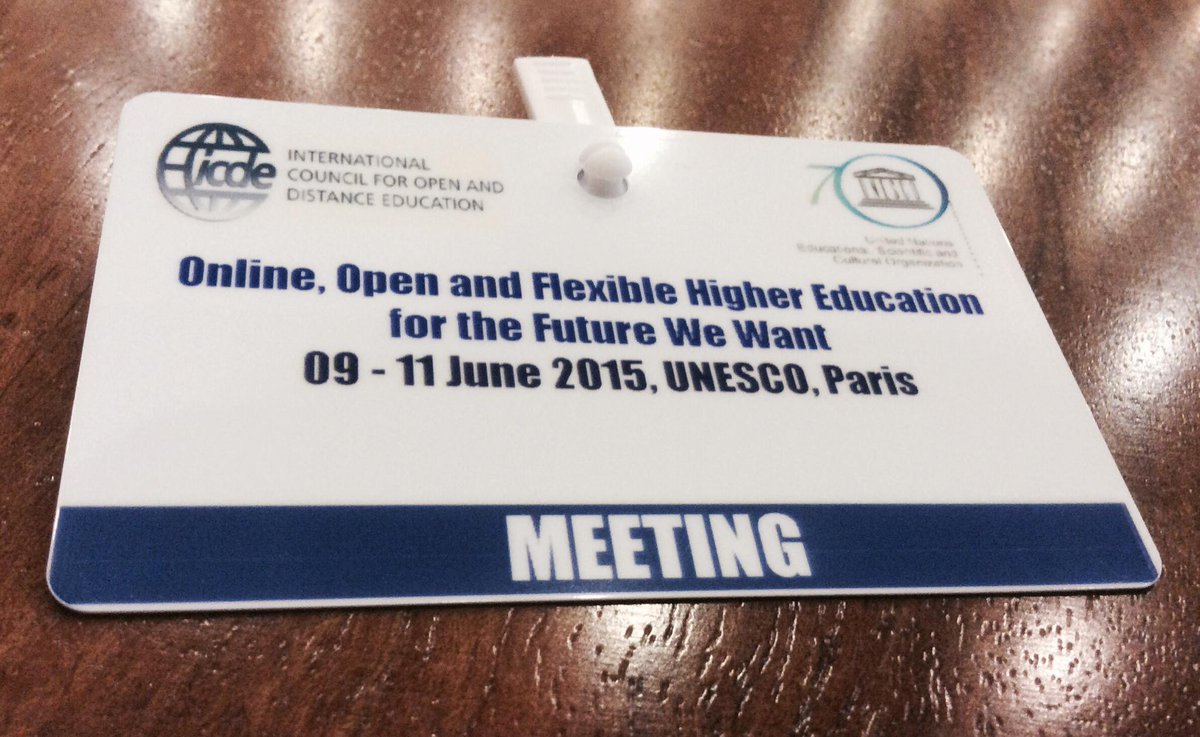
Embedded image permalinkThe ICDE (International Council for Distance Education) met in Paris recently for a Global Policy Forum. The aim of the forum was to build on previous work such as recently in Bali and to ensure equity, access and quality learning outcomes. This was framed with some urgency around the area of higher education with the prediction that in the next 15 years there will be a huge increase in the number of students seeking access to a quality education.

They are asking all governments, educational institutions, teachers and students, to jointly address the needs as outlined in the Paris Message (recommend you read this 3 page document) Key messages are around recognizing the importance of online, open and flexible learning to contribute to the quality & provision of education; the development of effective policy & regulation based on principles of equity; and that funding is critical to the initiation and sustainability of elearning initiatives. 
These are all messages that resonate strongly with my work with the VLN Primary School. Through open, flexible, online & collaborative learning (I added the last qualifier) we have the potential to unlock the gates to so many learning opportunities for our students. This is not just for higher education, but across the sector and community. Government and the educational sector are just starting to 'get it' in terms of understanding the contribution online networked learning can make and are still way behind in resourcing and supporting initiatives such as ours. A good part of my time is spent advocating, and applying for different funding streams because we as yet don't fit into any government 'policy parameters' of which there are a host beginning to be aimed at schools collaborating. This is quite a frustration as what we really should be doing is spending our very little time that we do have working with schools, teacher and students.
Image attribution: https://twitter.com/JGlapaGrossklag/status/608193506444722176