Friday, 29 August 2014

Project Huia - call for student participation

Project Huia - Book Study - Extension Learners

Project Huia

This reading project was run successfully last term, with our Rural & Remote Schools students, and now is being offered again as an extension opportunity for all interested schools.
This project will run entirely through Google Classroom and our WeLearn website, with a couple of 'real time' scheduled Adobe Connect sessions, as well as a connection with the author Des Hunt.
Weekly activities are designed to encourage the students to engage with the text to extract greater meaning; to seek out, identify, understand and apply new and interesting words; and enable students to visualise the thoughts and feelings they have in relation to the text and to recreate these artistically and enable them to reflect and respond in a written manner.
Students will have reading and activities to complete each week to be sent to their teacher so schools will need to ensure that this work is integrated into their classroom programmes to enable the time needed. Please put forward students who are working at NZC Level 4. 

Learning Objectives

Students will be reading, responding to, and thinking critically about the text in order to work towards meeting the reading demands of Level 4 NZC.
Students will locate, evaluate and synthesise information and ideas within the text(s) selected, and have opportunities to generate and answer questions about the selected text(s)
Students will recognise and understand a variety of grammatical constructions and some rhetorical patterns (e.g., cause and effect; comparing and contrasting);
  • using their prior knowledge, along with information in the text, to interpret abstract ideas, complex plots, and sophisticated themes
  • identifying and evaluating writers’ purposes and the ways in which writers use language and ideas to suit their purposes;
Students will discuss word meanings and grammar or talk about how language choices and modes of delivery vary according to purpose.

Enrolments & queries to primary@vln.school.nz
New schools please check Protocols of Participation first.
Makuri School

Contributed by:

Keryl Kelleher

Makuri School


Des Hunt & Rural class students
A conversation with author Des Hunt - Rural & Remote Students Term 2, 2014

Tuesday, 26 August 2014

May the Force be With You!

Are you a student who is interested in Science?
 - in the world around you, and why things work as they do? 

Why is it harder to stay up on a snowboard than on a ski?
Did you know that the G forces at work on a NZ falcon’s brain are over twice as many as those at work on an astronaut’s brain just before he blacks out?

Welcome to the exciting world of “Forces.” This 8 week course will help answer some of the above questions, and similar questions or wonderings you might have had to do with the topic of Forces. This area is part of Physics, and is part of the Physical World Strand of Science.

We will also be thinking about the “Nature of Science” strand of science as we progress through the 8 weeks. The Nature of Science is to do with “what is Science”; “scientists – past, present , future, and what they do”; and “how we can be like scientists – thinking and acting like scientists by predicting, investigating, gathering data, making observations by using our senses and by measuring, inferring, and looking for patterns.”

The 8 week course is very hands on. You will be expected to do investigations and trials in between sessions, and to report back the following week. (In other words there will be “hands on” based homework every week). It would be good to email me photos or short video clips of your investigations between sessions as well.

By the end of the 8 weeks you will be able to think and act like a scientist by gathering and interpreting data. You will have designed your own investigations and trials. I will give you suggestions and ideas to help with this. From designing and doing trials with balloon powered racers to using pulleys and ropes to lift objects, you are in for an exciting 8 week ride!
Fasten your seat belts and get ready for take-off…..oh, and may the Force be with you. (Please excuse the mixed metaphors – Literacy is my other area of interest besides Science!)

Enrolments & queries to primary@vln.school.nz
New schools please check Protocols of Participation first.
Resources students will need access to.
Ngamatea School

Contributed by:

Kathy Forster

Ngamatea School

Saturday, 16 August 2014

Connected communities: What are the implications for school leadership?

Cross-posted from the NZEALS forum:
"A report by the 21st Century Learning Reference Group entitled Future-focused learning in connected communities (May 2014) refers to evidence suggesting the beneficial impact that collaborating in regional networks and across school communities has on student outcomes.

With this in mind what might principals need to consider in schools’ strategic planning to provide opportunities for school communities to connect and collaborate in ways that are productive and meaningful to staff, students and the wider community?"

I think school leaders need to start developing a collective vision of education that goes beyond their own classroom walls & school gates. Tomorrow's Schools has done a great job of creating a silo system of schools and creating an environment where collaboration is difficult between schools. This post of Derek's is worth a read - we really need school leaders thinking at the top level of Spackman's moral scale and in a schooling system that supports and enables that.

I really like the definition of Learning Communities in the LCO (Learning Communities Online) Handbook :

"-- Learning – this must always be the primary focus of these communities. The emphasis here is on the emerging pedagogical practices that must be explored and adopted in the networked school, and on the outcomes that are sought for learners. This also recognises that teachers are also learners in this system, and that provision must be made for them to access learning opportunities in this way.

* Community – a networked school is more likely to succeed if it acts as part of a collaborative community. The term community here embraces the notions of participation, trust, agreement and purpose. Individual schools may be a part of several communities, and each will be defined differently by its purpose and the roles of those within it. For most it is likely that there will be a primary community, one defined by geography or special character, to which an individual school will belong."

The LCO handbook, although with a focus on online collaborations, is a useful guide to the myriad of considerations communities of schools need to go through from Proposal (Develop a philosopical context; Identify community of interest; Establish purpose; Set goals and principles; Agree on membership; Explore potential funding sources) through to planning, implementation & sustainability. I recommend you take a look, if you haven't already - you can download the whole LCO as a pdf)

The VLN communities of schools (that created this LCO handbook) show that long term sustainable collaboration is possible and it doesn't necessarily have to be geographically based, it can be with other schools with similar learner needs anywhere in NZ. These sorts of successful collaborations need to be seriously considered and supported when looking towards the systems level change that IES will bring the NZ schooling sector.

Monday, 11 August 2014

My Story Our Story Your Story - Call for interest collaborative project

Ahuroa School Photography Club would like to invite interested schools to join them on a photographic journey around Aotearoa/NZ (& beyond?) 

My Story. Our Story. Your Story.

Ahuroa
Image Attribution - Ahuroa School Photography Club
Each student is working on photographing their own personal stories (who am I, what am I about).  The end goal is to present their work as a collective (who are we, what are we about). How amazing it would be if we could then compare our collective photographic story, with other collective photographic stories from a wide range of similar aged kids...within NZ and (hopefully) from other countries too.
The end goal would be a public exhibition "My Story. Our Story. Your Story."
The uniqueness of your students location would make their photographic "stories" so interesting.  Students would not need to be photography experts at all just enthusiastic!
Participation in this project is open to all children aged 5-12 years old, although space will be limited to 10-15 schools.  If your school is interested in being involved please let us know as soon as possible! Further information here.
Contact Theressa to participatetbutler@ahuroa.school.nz 

Sunday, 3 August 2014

Edtech History - Integrating Technology

I love to look back on how things change (or not) over the years. I found this article in the bottom of a drawer today, from around the turn of the century ;-)

"If i'm a teacher and suddenly I have a lab or a series of PCs brought into my classroom, what do i do with them? How do i integrate the technology into the curriculum I teach on a day-in day-out basis? There's not a good open framework to allow such integration."

Click on the pic to enlarge to read
Image attribution: NZ Herald, & the bottom of my sock drawer
Over a decade later and i don't think we have still really appreciated the potential of how learning can be transformed with the support of 'computer-based learning'. Many teachers are still thinking 'integration' - how do i make this fit with what i'm doing in the classroom.

Turn it around people and stop thinking integration. Think about what your students need and what should change in your classroom and how learning with technology can enhance that.
Look out for the edtech vendor who seizes on problems to create solutions for - eg in this article a digital curriculum based around MS Encarta. This is something that hasn't changed over the years, don't perpetuate the cycle of edtech problem/solution, big bucks spending but be critical and look to the heart of the matter before you let the vendors come into your school and tell you what you need.

For NZ teachers, to help guide you and your school on this journey check out the Elearning Planning Framework, look out for the Online Tool that will help you through a school wide assessment. Hook into  professional networks, tap into their expertise and share yours - the VLN groups is a good place to start the conversations.

Thursday, 31 July 2014

LEARNZ - Backchannel Participation

I jumped into a LEARNZ fieldtrip this morning to check out their new Backchannel feature.

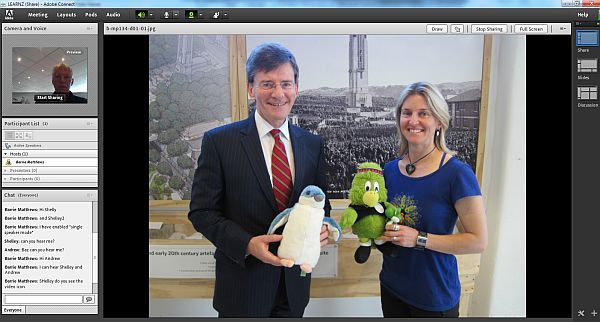
LEARNZ backchannel on Adobe ConnectAdobe Connect is being used to supplement the audio conferences from out in the field. This platform provides a space for visuals to be shared - such as pictures from the participating schools, from out in the field, and of the LEARNZ host & guest expert.
It also provides the opportunity for schools to experience more interactivity and opportunity to connect with each other through the chat feature. The audio conference itself is participated in by only one or two schools and is broadcast live out to other schools. This is a great way to enhance the LEARNZ virtual field trip in being able to bridge the 'virtual' with the 'reality' for students, being able to extend with a way to ask side questions, give contributions, feedback & additional resources like visuals & links to supporting materials. Yes the LEARNZ website can also do some of this, but the Adobe room brings this into the synchronous environment of the field trip.

I was really impressed with the quality of the audio, particularly as it was coming from a cellphone by the side of a river in Turangi! A feed is made from the audio conference direct into Mixlr where it is streamed live.

Mixlr was a find for me so signed up as i was listening. I can see how this might be really useful to some of our work in the VLN Primary School. We will be exploring how we can support collaborative groups of schools in participating together in LEARNZ activities, more to come on that later in the year.

There are still lots of great fieldtrips planned for the reminder of 2014 - get onboard with your students and participate!


Wednesday, 16 July 2014

How the Web Tamed Me!

http://okofrancisco.deviantart.com/art/Information-Overload-293890815
I have been thinking of late i need to get myself organised. I am about to undertake the completion of my Masters studies, and really i should have some sort of orderly system of bookmarking & filing that will ease my way as i foray further into the information superhighway. Well after 17 years of learning & teaching online you would think i would get that right by now but it only get worse and now i am going to throw my hands up in defeat - instead of taming the web - it has tamed me!

What NZ teachers remember Mark Treadwell's Teachers@Work resources? Every month a resource update of teaching websites, cataloged by age group & curriculum area would be posted (talking snail mail) to subscribing schools, put into large arch binder folders and be available to teachers in the staffroom or the workroom to use while you access one of the few computers in the school. At this time all the files I had ever created, including my backed up emails would fit on a few floppy disks. Yes life was simpler then... BTW Mark still creates & shares resources for teachers  though this is legacy work compared to the successful educational consultancy Mark has grown since this time.

I was a religious Delicious bookmarks user, curated & shared with my PLN,  then moved to Diigo with the added features of annotations & screenshots, with Google chrome syncing across all my devices, i then went back to old fashioned browser bookmarking, and have been tempted of late by slick looking drag & drop bookmark & curation tool Dragdis.

To be honest i very rarely even go back through my bookmarks so what is the point in so much angst about having my digital house in order. There just isn't enough time in the day to find, catalogue, curate or share this overwhelming amount of material I have saved over time. If i am serious about needing something relevant, current and at my finger tips I will search for it every time. 

So therefore i have decided to let it go with the 'Just in Case' curation of the internet and focus on the 'Just in Time' search when i need it - the good stuff will always come to the top as long as we all keep hitting the share buttons - tweet, G+, like. Now that is achievable!

Tuesday, 24 June 2014

Primary Science

You don't need to be a Scientist to DO Science! 

Don't think you need to leave it to the experts for your students to learn about Science, there are lots of great PD opportunities & resources to support you in providing Science learning opportunities for our kids.

Check out this online PD from the Open Polytech - no fees! Register now for July's intake.

"The Graduate Certificate in Primary Science Teaching (Curriculum) takes the perspective that science can be fun. It encourages the learning of science by doing science and discusses the effectiveness with which science concepts and principles are embedded into learning experiences. Through the programme practising teachers will become more confident in their science knowledge, and their ability to design and deliver learning experiences that support and inspire students to investigate and understand science knowledge and concepts."

ScienScience Alivece Alive provides outreach programmes in the Christchurch area, they also have some great open source resources. 
Follow them on twitter @sciencealive


Science in a Van
Science in a Van also run outreach programmes, anywhere in NZ.
They have a fantastic blog site, and you can also follow them on twitter @Science_ina_Van 

Science Learning Hub'The Science Learning Hub is developed by educators and teachers in collaboration with New Zealand scientists to provide resources for teachers of students up to year 10.'
Hear what teachers have to say about how they use the Science Learning Hub to support them in the classroom. Twitter @NZScienceLearn 

There are a number of Science groups in the VLN Groups area. The following three seem to be the most subscribed, open and active:
Science VLN Groups

Digital technologies and future-oriented science education
Not forgetting Science Online @TKI. Linked from TKI are a series of papers developed from the questions raised here:
"The Chief Science Adviser raised some challenging questions in his  2011 report. The Ministry of Education responded by funding three new science education projects. His questions were:
  • How can we “engage and enthuse” more young New Zealanders in science?
  • Is the science we teach getting students ready to address serious questions we will all face in the future?
  • How might science education help New Zealand's development as a smart, innovative, knowledge-oriented country? "
Some interesting professional reading.

Lastly not forgetting the VLN Primary School as a way to collaborate and extend Science learning opportunities across our schools. Currently we are running a Day Time Astronomy class - we welcome schools and teachers who have expertise to share across our network.

Thursday, 19 June 2014

Virtual Role Models - Tuakana/Teina

This is a great story in the VPLD ning from Krishna about the value of their virtual connections with Rosmini College, Over the Back Fence Project. What are you waiting for start connecting with others and break down those classroom walls!

Virtual Mentors

Monday, 16 June 2014

Student Voice - Our kids expect it

Crazy Clever Kids
Our kids expect to have a voice in their learning - and so they should; including the details of what the music is like that they have to listen to while they wait for the audio bridge to be opened. We have advised Student Council to take this up themselves with Asnet Technologies who manage our audio bridge :-)

Here is their conversation:
" Halfmoonbay: (13:40) hey everyone
  Halfmoonbay #PowerMovesOnly: (13:41) Hi blackmount
  Halfmoonbay #PowerMovesOnly: (13:41) Hello everyone
  Tylah: (13:43) hi everyone
  Halfmoonbay #PowerMovesOnly: (13:43) hey
  #N¡k¡: (13:44) heey
  Tylah: (13:44) do you ever get sick of listning to the music on the phone??????
  Halfmoonbay #PowerMovesOnly: (13:45) noo
  Halfmoonbay: (13:45) yes yes i do
  #N¡k¡: (13:45) hah
  Halfmoonbay #PowerMovesOnly: (13:45) thats why in the next student council we may discuss the music on the phone
  Tylah: (13:46) i get sick of listning to "please wat for thee chairperson to join the conference
  Halfmoonbay #PowerMovesOnly: (13:46) we got really cool music on ours yahhh
  Tylah: (13:47) me too today but don't get it very often
  #N¡k¡: (13:47) please wait for the chairperson to join the conference
  Halfmoonbay #PowerMovesOnly: (13:47) hi rachel
  Halfmoonbay: (13:47)
  #N¡k¡: (13:47)
  Rachel Roberts: (13:48) hi Tylah we would give you the chairperson pin but then you guys would have phone parties without us!
  joseph&kase: (13:48) hey
  Tylah: (13:48) yeah  its ok i just figured out to mute it when it gets really aannoying"

Thursday, 12 June 2014

VLN Primary School - Semester 2 call for participation.

Schools are invited to enrol students in online learning programmes beginning in Term 3. Te Reo Maori (beginners to fluent), Mandarin, Japanese, French, Spanish, German, Afrikaans, Te Reo Maori Cook, & Maths Extension.

Teachers are warmly welcomed to participate alongside their students in our language classes, this is a great PLD opportunity for Learning Languages & teaching online.
Expressions of interest are invited to participate in ‘Over the Back Fence’ Health Project & DayTime Astronomy. Small schools with very low numbers of Y7 & 8 students are invited to cluster and join our Rural & Remote schools Project.Enquiries to primary@vln.school.nz

Tuesday, 10 June 2014

Happy Birthday Bardwired - 10 Years Old Today!

Wow what a milestone, I am feeling old today as my baby hits double digits!

I was introduced to blogging by Richard & his students at Matau School & thought this would be a great way to keep schools in touch with what was going on around the Bardwired ICTPD cluster. Sure beats stuffy reports to Principals' once a month. It has been quite a journey over that time, with many highlights and in the last couple of years quiet patches too. My first post was a very factual account, in fact a list, of what i did at work that day...i think it only got better after that.

To start with it was text only, you had to have some working knowledge of  html to make anything else happen. Pictures weren't easy and it was four months before any images appeared on my pages.

Flickr arrived early in 2005 and that was the beginning of my love for Flickr. That was also the time i began to use hyperlinks but it was still awhile until hyperlinks became part of my deliberate writing style. My writing here waned when blogging became a professional requirement for my two other roles with the VLN Primary & VPLD; Twitter & Facebook also took over my attention. As with any pride & joy there are special milestones & highlights - here are a few of mine.

Here are some of my babies milestones:

First podcasts May 2006 - Prensky@School Marc Prensky's keynote from Learning@School
First video May 2006 on Vimeo - Kidz & Kitez @ Makahu,
First flash animation - Christmas 2006
First friends -  Tom & Graham - when i learnt that blogging is about conversations and learning together
First blog post from my phone - moblogging February 2007
First Youtube video embeds TUANZ 2007
First embedded slideshow - Around te Maunga May 2007
First avatar - Meez May 2007
First Panorama - Panoramic Pitt August 2007
First slap on the wrist for this post May 2009

Highlights:

Where Are We Going??????? - 2005 thoughts about Google
Connecting with others - Edubloggers Offices Photostream
Starting nzedublogs with Jedd
Life changing highlight - getting to know my darling Rick
Time 4 Online Conference
Dead Cats & Laptops - most interesting/gross picture
Helping Bruce update his blog
Connecting with others - 8 random facts meme (great to be reminded of those connections :-)
VLN Primary kicks off at Matapu School
The Future of Education (i just like this post)
Being 'published'
eLearning eBooks (i liked this one too)
N4L consultation  early conversations

Sunday, 8 June 2014

Investing in Educational Success - Systems change in the making.

Investing in Educational Success
Last week this Working Group report was released on the government initiative 'Investing in Educational Success'. All documentation including this report can be found on the Ministry of Education website.

Q & A was held with Graham Stoop on Thursday (advance notice would have been good) Check out the conversation here.

It is certainly encouraging that we are due for some change in our schooling system, the VLN Primary has been asking for system level change that will enable us to work in a sustainable & 'legitimate' way across NZ schools (see our Position paper). The VLN Community have been discussing the need for change going back many years. It is definitely time to move away from the isolating and competitive nature of Tomorrow's Schools and to work more collaboratively across schools. It won't be an easy journey, it will be complex & challenging and one that should be taken with a measured & critical approach.

There is a lot to digest in this report & it's background papers and it is worth looking at in more detail. Some of the points that were raised for me were:
  • Really worthy goals around schools collaborations, and working together to improve student achievement (this is what the VLNP is all about).
  • There seems to be a competing rationale or tension between the development of new professional pathways & rewards for school leaders, raising student achievement and changing the system to structure collaboration. What is the main intended purpose of this strategy? What will be the spin-offs?
  • Specialist positions (& accompanying release time & salaries) seems to be being held out as a carrot and one that the unions are picking up on, with the danger of stepping up the old boys network another level. It is already noted that the PPTA & NZEI have included their separate position statements within the report. 
  • Communities of Schools (CoS) - it is interesting to note this term being used; it is a main descriptor in the VLN Community charter. How will existing collaborations such as the VLN Primary & VLN Community be supported in the new educational landscape? Will they just be swept away with the changes?
  • N4L - has been highlighted as an initiative that would support this change. The N4L has been tasked to create a managed network for schools & also an internet portal Pond. The analogy for me is like asking your school server and website to join your BOT - how does that work? The N4L would need to be developed as a people network such as the VLN groups has become.
    Attribution: http://allthingslearning.wordpress.com/
  • Collaborative action doesn't happen through good intentions alone, it needs to be strategically approached, led and driven in an ongoing way. Working across schools, even the willing and engaged, is still akin to Herding Cats. There will be a lot of facilitation support (PLD) in the early stages of setting up CoSs.
  • 250 CoSs will be created - for some school clusters this will be a no-brainer; for others really challenging. How do you go from competing with the school down the road, to being expected to work really closely with them? One of the successes of the VLN Primary collaboration is that schools have more freedom working outside of their geographic locations, there is less concern about competition between schools. How will this work for schools of different sizes/ demographics/ community needs? How will this work for our rural & remote schools? How can schools participate in more than one community? Where will schools decide where they fit and for some schools will it be like 'choosing sides for basketball'?
I feel very positive about the prospect of meaningful changes to our schooling system that will enable greater collaboration, although I have some reservations about potential design & implementation of a huge undertaking such as this. It is a bold move based on a small local body of knowledge of schools collaborations. I am also wary of the different political levers that surround a restructuring of our system and am concerned schools can have a genuine voice in the process.

Next steps in the process - work streams on Communities of Schools; Professional Standards; Selection, Appointment & Appraisal. (All things that the VLN Community has discussed and developed over the years in our own CoSs).

Join the conversation and make sure your voice is heard #iesnz

Now we can really focus on the learning!


There is no excuse now for teachers who don't use technology to support student's learning. Pick up an Ipad (or similar) and there is an app that will do anything easily. Students can Connect, Communicate, Collaborate, Create with ease - point, click, move things around, upload, share.

When I worked with ICTPD (professional learning for teachers with ICT) there were many, many frustrating hours spent on developing teachers 'soft skills' of how to use technology, & troubleshooting a range of technical & connectivity issues before we could successfully bend the tools to our learning purposes. All that 'Structural Stress' is being removed with ubiquitous, accessible & easy technology. Now a teacher who says i don't have time to learn this is giving the time old kids excuse 'the dog ate my homework!'

Saturday, 31 May 2014

Know Your Learners

One of the themes that was recurrent during the recent DEANZ conference was the importance of getting to know your learners. Along with the call (aimed more at Higher Ed. delegates) to be ready because these connected, confident and digitally minded kids are coming to you next! I feel very privileged to have the opportunity to get to meet some of our learners over the last couple of days while tagging along to VPLD Hui in Auckland.
Orere students let me know before i arrived that after my visit 'I would never be the same again!' What has been experienced can never be unexperienced - it was great to get to meet you and help you move forward in your online learning :-)

Teaching online (without a camera) is like teaching in the dark, we don't see those visual cues, a puzzled look, a spark of understanding or even a yawn! It takes a lot longer to get to know our students, what their needs and interests are; particularly more so if they are shy and stand back from interactions. We are really looking forward to having the critical mass of bandwidth enabled schools to turn on the cameras soon.

Tuesday, 20 May 2014

Sole Charge & Rural Teaching Principals Conference

I have spent the last day at Sole Charge & Rural Teaching Principals Conference in Palmerston North, connecting with many of our VLN Primary principals and sharing our story.

It is great to have this time with Principals away from the busy distractions of daily school life and to talk about what matters for our students and how we can work together to make a difference to their learning.
Principals from the Rural/Remote Schools Project
Our conversations now are no longer so much about how does this online learning stuff work, and what can we learn together (although there is still some of this in introducing new schools). We know it works and we are aware of the potential there is to push the boundaries in learning opportunities for our students. Conversations are now beginning to move into how can we build this capability across our schools, and how can we improve what we are doing? What are our children achieving through their participation in their online classes and how is it making a tangible difference to their learning. What evidence have we got to support our understandings beyond anecdotal feedback & observations. Time to step things up another gear!


Thursday, 15 May 2014

There are some things you just can't say in 140 words!


Social Media has taken over my professional life and so BardWired has been parked for some time as other work blogs & social media streams take precedence in my time poor days.
In the beginning there was just Blogger.com, then came Flickr and wahoo i could put pictures in my blog posts. Now i post www.vln.school.nz, for awhile and still sometimes at VPLD and Ethos, Google+, Facebook & Twitter. Maybe i am on the road to wrangling this web beast with HootSuite.
There are some things to write about that just don't fit anywhere else and that you just can't say in 140 words either. May this be a return to MY blog - I hope so, I've missed you BardWired.

Tuesday, 12 June 2012

"Future-oriented learning and teaching" report now online

I am sure there will be much to process, think about & discuss in this report. Will download onto my reader so i can take my time to have a good look through.

Future Learning
Supporting future-oriented learning and teaching - a New Zealand perspective
"This research project draws together findings from new data and more than 10 years of research on current practice and futures-thinking in education. The report discusses some emerging principles for future learning, how these are currently expressed in New Zealand educational thinking and practice and what they could look like in future practice.
Author(s): Rachel Bolstad and Jane Gilbert, with Sue McDowall, Ally Bull, Sally Boyd and Rosemary Hipkins [New Zealand Council for Educational Research]"